Pick your hero, pick your team-up, break the map. Marvel Rivals is NetEase's free-to-play third-person hero shooter, launched December 6, 2024: 6v6 objective battles with a launch roster of Marvel icons, destructible environments, and Team-Up abilities that fuse heroes into combos.
Its pitch was simple and devastating: every hero free at launch, every future hero free forever, money buys cosmetics only. Players noticed — it became one of the biggest live-service launches in years.
About this game
Words by Jin Park
Read moreShow less▼
Marvel Rivals did what a dozen hero shooters couldn't: it made the genre feel joyful again. NetEase's third-person Marvel shooter launched December 6, 2024 with all heroes free — every one, forever — and a movement system that treats every character like the star of their own game.
Third-person changes everything, and it's the first thing you feel. Overwatch taught the genre to aim down sights; Rivals pulls the camera back and hands you traversal as a primary verb. Spider-Man web-swings with momentum you have to manage. Iron Man flies with a fuel gauge that's a resource to budget. Venom wall-crawls, Star-Lord boost-dashes, Doctor Strange portals the team through geometry. Every hero's movement kit is a mini movement-shooter, and KB's take is simple: traversal IS the combat here. Positioning isn't something you do before the fight — with this roster, positioning is the fight.
The Team-Up abilities are the systems-design centerpiece. Pair specific heroes and you unlock fusion abilities: Hulk charges Iron Man's repulsors with gamma energy, Rocket Raccoon rides Groot into battle. These aren't cosmetic synergies — they're comp-building verbs. Drafting stops being ‘pick the meta six’ and becomes ‘which fusion lines are we building around, and what breaks them?’ It's the kind of combinational depth that gives a hero shooter a multi-year meta instead of a solved one. Add destructible environments — hero abilities reshaping maps mid-fight, cover that's a suggestion — and the battlefield stays unsolved round to round.
The business model is the anti-pitch that won the launch. All heroes free at launch, all future heroes promised free, forever; the store sells cosmetics. After years of hero shooters locking characters behind paywalls and battle passes, NetEase read the room and printed the opposite strategy. Never hype without substance, so the honest footnote: launch balance swung hard — some heroes were overtuned, some team-ups were win buttons, and live-service life means the meta churns seasonally. That's the tax on the model, and it's a fair one. The seasonal cadence has kept the roster growing and the draft screen interesting.
Netcode and feel hold up where it counts: abilities fire when you press them, ultimates have the weight their cinematics promise, and the game runs clean on modest hardware — which matters for a free-to-play title whose audience is everyone. 70,228 playing concurrently when we last looked, deep into its live-service run. For a genre that spent years eating itself, Rivals is proof the patient is alive. Concurrent counts don't lie: joy is a mechanic, and this one ships it.
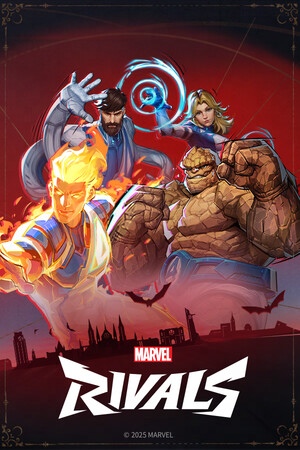
Official key art — self-hosted
The road to launch was fast and public. NetEase and Marvel Games announced the game in early 2024 and ran it through two big tests: a closed alpha from May 10–20, 2024, where participants earned permanent rewards like an alpha-tester title and a Scarlet Witch skin, and a closed beta from July 23 to August 5, 2024 across PC and consoles to stress servers and tune balance. It was built as a third-person hero shooter from the ground up — NetEase's most ambitious Western-facing live-service bet, running on Unreal Engine 5, with the Marvel license doing what licenses rarely do: giving the genre's familiar scaffolding a cast players already have a decade of emotional equity in.
Then came the launch, and it was enormous. Marvel Rivals released December 6, 2024 with 33 heroes — every one free — and pulled in 10 million players within 72 hours, 20 million by December 17, and over 40 million by February 2025. Steam alone peaked above 444,000 concurrent players in the opening days, and user reviews sat at "mostly positive," with the fair monetization the single most-praised feature. Critics were more divided: some dismissed it as Overwatch in a cape, others called it exactly the competition Overwatch needed. The truth is somewhere in the middle — the genre grammar is borrowed, but the execution and the model were genuinely new.
The fiction earns its keep, too. The premise is a "timestream entanglement" — a dangerous meeting between Doctor Doom and his heroic 2099 counterpart merges realities, and heroes and villains battle across the multiverse to stop either Doom from seizing it all. Each season gets its own story beat: Season 0 was Doom's rise, Season 1: Eternal Night Falls brought the Fantastic Four in to fight Dracula's takeover of New York, Season 2's Hellfire Gala put Emma Frost and Ultron at war for the mutant island of Krakoa, and Season 3 took the fight to Klyntar, planet of the symbiotes, with Phoenix and Blade. The roster has grown season by season to more than 50 characters, with faster hero cadences starting in Season 3.
It has become a multimedia operation, not just a game. The Marvel Rivals Infinity comic, written by Paul Allor, launched alongside the game as a promotional one-off and proved so popular that NetEase and Marvel turned it into an ongoing series following each season — rare air for a game tie-in comic. There's a growing esports scene with competitive tournaments, and the seasonal model has held the community's attention deep into its second year. Two years on, the honest verdict is that Marvel Rivals did the hardest thing in live service: it launched huge and stayed relevant — by remembering that a hero shooter is, first and last, about how it feels to be the hero.