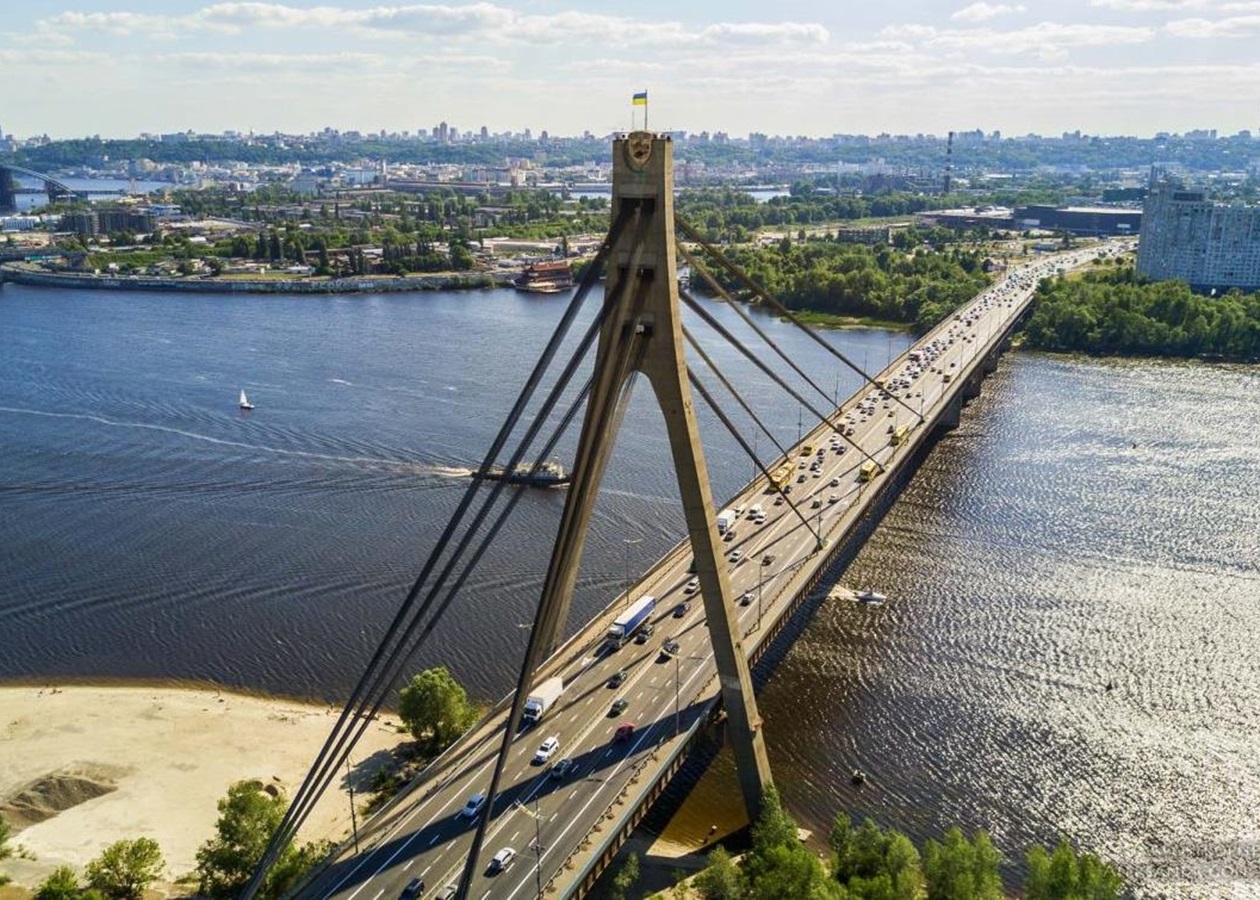
KYIV, SATURDAY, OCTOBER 3, 2026 — A Russian strike hit Kyiv's Northern Bridge on Saturday, marking the third consecutive day of attacks on the Ukrainian capital's crossings over the Dnipro River. Two people were injured in the attack, Mayor Vitaliy Klitschko said, and traffic across the bridge from the east bank to the west bank was suspended after the strike damaged the road surface and the overhead power system that supplies the trolleybus line.
Emergency services were deployed to the scene, Klitschko said. The attack came amid an escalating Russian campaign against Kyiv's infrastructure that Ukrainian officials say is effectively cutting the capital in two.
It was the latest blow in a week that has brought the worst sustained assault on the city's bridges since the full-scale invasion began. Just a day earlier, Kyiv's Southern Bridge — which carries both ground transportation and the city's subway line — was hit five times in less than 24 hours. That bridge remains closed. With traffic on the Northern Bridge now restricted as well, the attacks have caused major travel disruption across the capital since Thursday.
A city divided by design
To understand why the bridges matter, you have to understand Kyiv's geography. The Dnipro River splits the capital roughly in half. The right bank — the western side — holds the majority of the city's business centers, offices, and government institutions. The left bank — the eastern side — is mostly residential, home to at least 30 percent of the capital's roughly 3 million residents.
Every morning, hundreds of thousands of people cross from east to west to work. Every evening, they cross back. The eight main road and railway bridges spanning the Dnipro are not just infrastructure — they are the circulatory system of a city of three million.
Ukrainian officials said the strikes are effectively severing that system. Beyond the Northern and Southern bridges, traffic on the Paton, Metro, and Darnytskyi bridges has also been restricted, though authorities did not report direct attacks on those crossings. The cumulative effect is a capital slowly being divided against itself — not by a front line, but by the systematic degradation of the connections between its two halves.
Moscow claims a military target
Russia's Ministry of Defense said it carried out Saturday's strike, claiming the bridge is used to move Ukrainian troops and military supplies across the river. It also said Russian forces targeted a logistics center in the Kyiv region.
The head of the Kyiv region military administration, Tymur Tkachenko, said Saturday that a warehouse and production facility had been hit in the region, injuring four people.
Moscow has previously denied systematically targeting civilians as part of its bombing campaigns. But the pattern of the past week — repeated strikes on transportation infrastructure used overwhelmingly by civilians, alongside hits on warehouses and production sites — has drawn sharp condemnation from Ukrainian officials, who describe a campaign aimed at the functioning of the city itself.
“No longer possible to pretend”
Klitschko's language on Saturday was the starkest of the war. “The capital is in a very dire situation,” he said. “And it is no longer possible to pretend that we can live as we did in peacetime.”
“The enemy is laying waste to Kyiv,” the mayor continued. “Infrastructure, critical infrastructure, logistics, housing, social facilities. The aggressor has also resumed its destruction of the energy sector. We are doing everything in our power to keep the city functioning under constant destructive attacks, when it is no longer a question of our usual comforts, but of safety and survival.”
He called on residents to “unite, as we did in February 2022” — an invocation of the national solidarity that defined Ukraine's response to the full-scale invasion nearly five years ago.
Kyiv's defense council held an emergency meeting on Friday as the bridge attacks intensified, a sign of how seriously city officials are taking the threat to the capital's connectivity.
The air war above the city
The bridge strikes are part of a broader aerial campaign. Ukraine's Air Force said in a statement that Russia launched 157 attack drones and decoy drones overnight and in the early hours of Saturday. Air defenses shot down or neutralized 131 of them — a high interception rate, but one that still left more than two dozen getting through.
Russia accelerated its campaign against Kyiv in late August, according to Ukrainian officials, taking advantage of the country's shortage of interceptor missiles and limited defenses against jet-powered drones. The newer Russian drones fly faster and higher than the Shahed models that defined earlier phases of the air war, compressing the window in which air defenses can engage them.
The timing is not accidental. Memories of last winter — described by many Ukrainians as the worst of the war — remain fresh. Last week, Russia launched what Ukrainian officials characterized as the first salvo of an expected winter bombing campaign against power facilities supplying the capital. The bridge attacks, coming on the heels of strikes on energy infrastructure, suggest a coordinated effort to degrade multiple systems at once: movement, power, and logistics.
What comes next
The immediate question is whether the Northern Bridge can be repaired quickly enough to restore even partial capacity — and whether Russia intends to keep hitting it. The Southern Bridge, struck five times in a single day, offers a grim precedent: repeated strikes on the same target, designed to prevent repair crews from restoring function.
For the residents of Kyiv's left bank, the practical consequences are already here. Commutes that once took under an hour now stretch across bottlenecked alternative crossings. Emergency services face longer response times. The movement of goods — food, medicine, fuel — slows with every restricted bridge.
The deeper question is strategic. Bridges are among the hardest infrastructure to replace and among the most disruptive to lose. If Russia can sustain this tempo of strikes against Kyiv's crossings through the winter, the cumulative pressure on the capital's three million residents will compound with the cold, the dark, and the strain on an energy grid already under attack.
Klitschko's plea for unity was not nostalgia. It was a warning: the months ahead will test the city in ways it has not been tested since 2022. The bridges over the Dnipro — concrete, steel, and cable — have become the front line of that test.