The ghost particles finally got their due. On Tuesday morning, the Royal Swedish Academy of Sciences awarded the 2026 Nobel Prize in Physics to Francis Halzen, the Belgian-American physicist who spent more than three decades convincing the world that a cubic kilometer of Antarctic ice could become a telescope — and then built it. The Academy said Tuesday it was honoring what it called his "decisive contributions to the IceCube Neutrino Observatory and the discovery of high-energy neutrinos of astrophysical origin."
01 The Announcement in Stockholm
The announcement, reported overnight by Reuters, came at 11:45 a.m. Central European time on Tuesday — about 2:45 in the morning on the U.S. West Coast — when the Royal Swedish Academy of Sciences declared Halzen the sole winner of this year's physics prize. It was the second Nobel of the 2026 season, following Monday's medicine prize announcement (covered in Previously's nightly wrap), with the chemistry prize set for Wednesday, literature on Thursday, peace on Friday, and the economics prize on Monday, October 12. In its statement, the Academy said Halzen "realised that ice at the South Pole could be used to track particles known as neutrinos," adding that "his vision and scientific leadership have been fundamental for the IceCube Neutrino Observatory – a cubic kilometre of ice that is equipped with light sensors." Using IceCube, the Academy noted, researchers can capture neutrinos from extremely energy-rich processes in the distant universe. The physics prize carries a purse of 12 million Swedish crowns, roughly $1.2 million. As with every Nobel year, the medals will be presented to the laureates by Sweden's King Carl XVI Gustaf at a ceremony in Stockholm on December 10 — the anniversary of Alfred Nobel's death — followed by the traditional banquet at Stockholm City Hall. (The peace prize, the one Nobel not presented in Sweden, is awarded separately in Oslo.) Last year's physics prize went to the US-based scientists John Clarke, Michel Devoret, and John Martinis for experiments demonstrating quantum physics in action — research seen as advancing next-generation computing and other digital technologies. This year's choice moves the spotlight from the subatomic weirdness of the laboratory to the farthest reaches of the cosmos.
02 The Man From Tienen
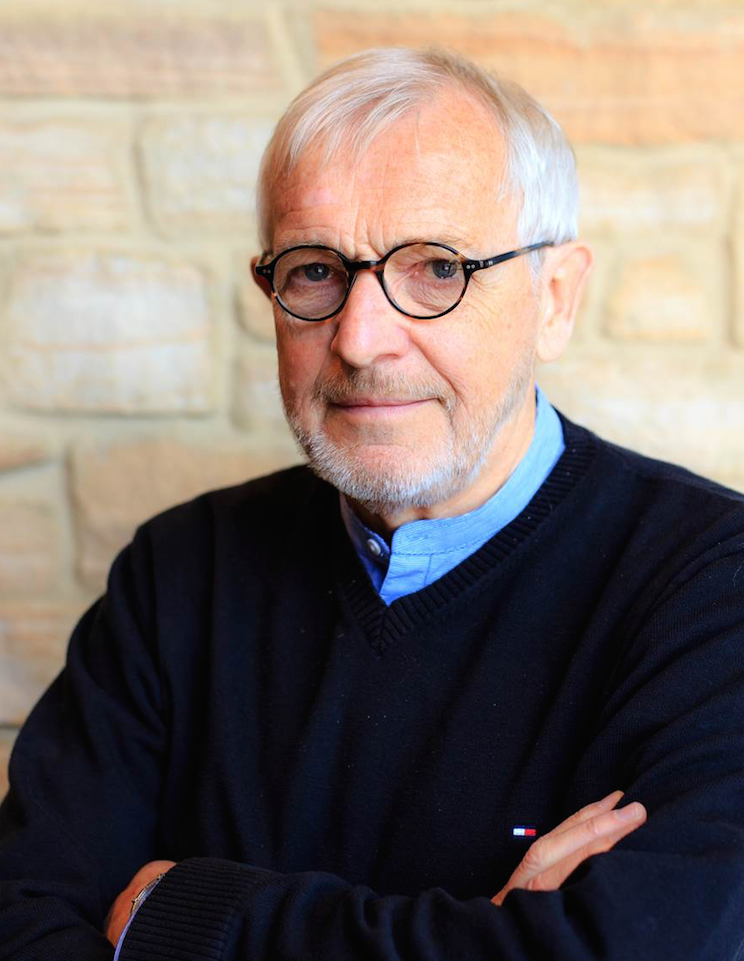
According to his Wikipedia biography, Francis Halzen was born on March 23, 1944, in Tienen, Belgium, and educated at the University of Louvain, where he earned his master's degree in physics in 1966 and his doctorate in 1969. After a stint as a scientific associate at CERN, the European particle-physics laboratory, he arrived at the University of Wisconsin–Madison in 1971 on what he expected to be a six-month stay as a visiting scientist. He never left. He has been a professor there since 1972 and is now a Belgian-American citizen — and, for the IceCube project, its founding principal investigator. The honor roll of his career reads like a preview of Tuesday's announcement. With Alan Martin, he co-authored Quarks and Leptons, a standard textbook of particle physics. He won Physics World's Breakthrough of the Year award in 2013 for the first observation of cosmic neutrinos beyond the Milky Way, the International Balzan Prize in 2015, the Bruno Pontecorvo Prize in 2018 for contributions to IceCube's construction and its neutrino discovery, was elected to the U.S. National Academy of Sciences in 2024, and received the American Physical Society's Medal for Exceptional Achievement in Research earlier this year. Winning the Balzan Prize in 2015, Halzen said that while half that prize was meant to finance future research, "I am going to buy a new racing bike. That is as far as I have thought about it." It was a characteristically modest line from a physicist who, friends and colleagues say, never set out to build one of the largest scientific instruments on Earth — it just turned out that nobody else would.
03 A Telescope Made of Ice
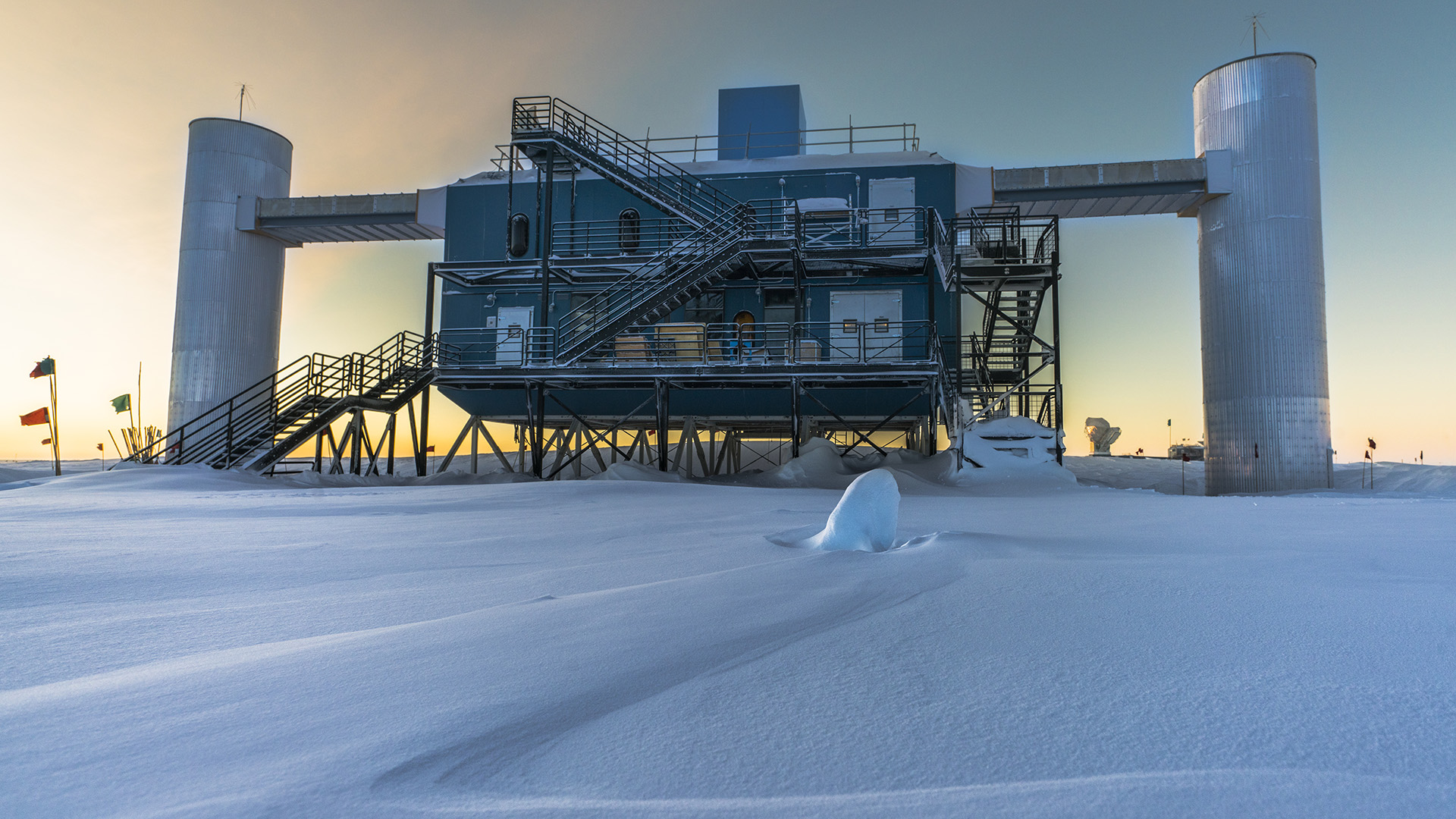
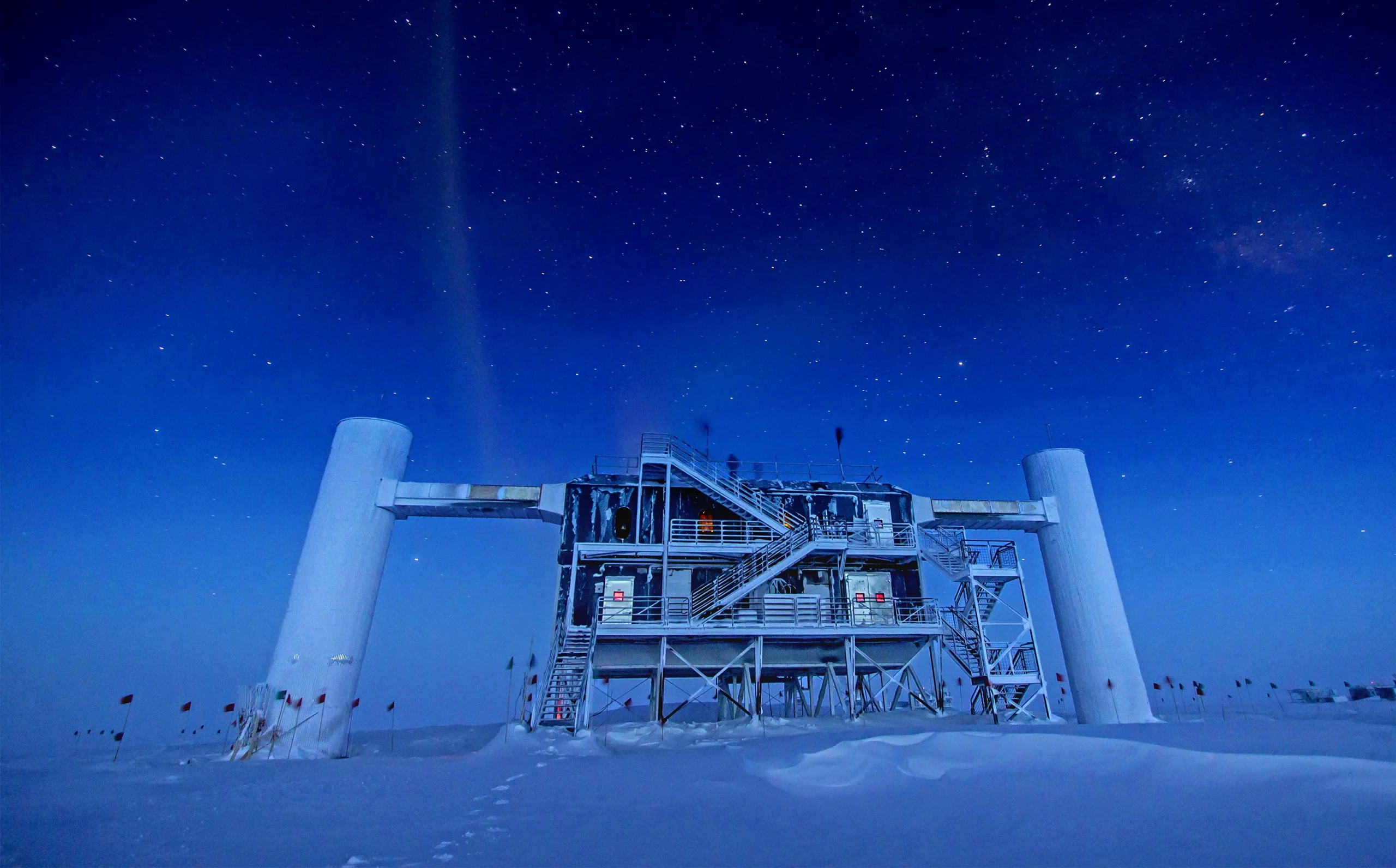
The idea at the center of Tuesday's prize dates to Halzen's first serious work on neutrinos in the 1980s. Neutrinos are the universe's ghost particles: they carry no electrical charge and almost no mass, and they pass through entire planets without leaving a trace. That slipperiness is exactly what makes them valuable — unlike light or charged particles, they travel in straight lines from the most violent events in the cosmos, carrying information across billions of light-years essentially untouched. The problem was catching them. Halzen's answer, published in his first paper on the subject in 1987, was audacious: use the clearest, darkest, most sterile material on Earth — the ice sheet at the South Pole — as the detector itself. As he later said, "From my first paper on the subject in 1987 we knew exactly what we wanted to build." The hard part, it turned out, was everything else. The path ran through a smaller prototype called AMANDA, the Antarctic Muon and Neutrino Detector Array, built in the late 1980s as a proof of concept. Halzen has said it took roughly a decade to develop a working idea, another five years to win funding, and ten more years to build the thing. "Nobody had ever built anything like this before," he once noted. In 1999 he submitted a letter of intent to the U.S. National Science Foundation proposing IceCube — a detector on the order of a full cubic kilometer of ice. The project was approved in 2001, and construction began in the mid-2000s. After six years of drilling holes with hot water into the polar ice cap and lowering light sensors into them, IceCube became operational in 2010. The finished instrument is almost impossible to picture: more than 5,000 light sensors, strung on cables and frozen into a cubic kilometer of Antarctic ice up to a mile and a half beneath the surface. The sensors sit in the dark, waiting for the faint blue flash of light that marks the collision of a neutrino with the nucleus of a hydrogen or oxygen atom. From the pattern of that light, researchers can reconstruct how much energy the neutrino carried and the direction it came from — effectively pointing a telescope made of ice back at the most energetic phenomena in the universe. "IceCube was built as a discovery instrument and what we want is surprises," Halzen said. The universe obliged.
04 The Discovery That Opened a New Astronomy
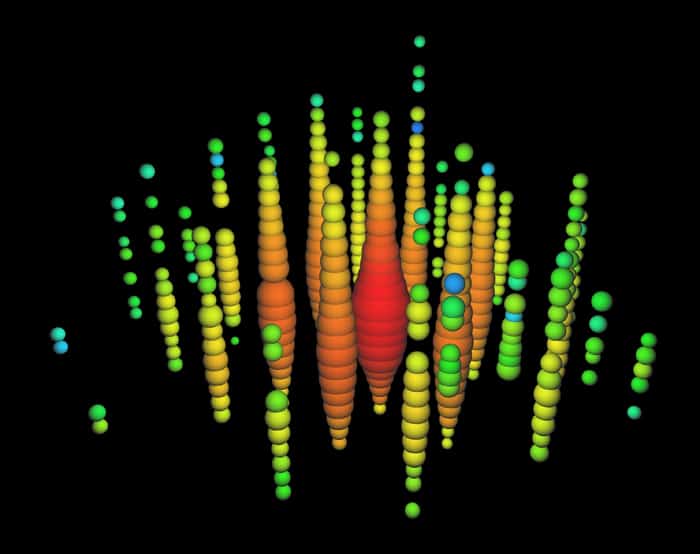
The breakthrough came in 2013. Analyzing its first years of data, the IceCube collaboration reported the first clear observation of high-energy neutrinos from outside our galaxy — particles roughly a hundred times more energetic than anything the Large Hadron Collider, the world's most powerful machine, can produce. The sources were not yet identified, but the signal was unmistakable: Earth was being rained on by ghost particles from some of the most powerful events in the universe — exploding stars, feeding black holes, the engines of cosmic rays. It was the birth of neutrino astronomy. The 2013 result earned IceCube Physics World's Breakthrough of the Year award, and subsequent analyses confirmed that the collaboration was capturing particles from cosmic events beyond even our own Milky Way. With a decade of data, researchers have begun tracing individual neutrino streams back to their origins, including supermassive black holes at the centers of active galaxies — the cosmic-ray accelerators that power the high-energy universe. In 2022, IceCube scientists reported evidence linking a steady stream of neutrinos to the active galaxy NGC 1068, some 47 million light-years away. Along the way, the prize became something of an expectation in the physics community — Halzen had collected nearly every major award in the field short of the Nobel itself, and IceCube's discovery was widely regarded as the most significant advance in observational astrophysics in a generation. When the 2015 Balzan Prize was announced, he said: "The prize isn't for me, it's for this experiment" — and added that "prizes are not given to experiments and I think that's very unfortunate."
05 What Comes Next
The immediate calendar is set: the physics, chemistry, and medicine laureates will receive their medals from King Carl XVI Gustaf in Stockholm on December 10, followed by the banquet at City Hall — the most glittering night in the scientific calendar. But the scientific story is far from over. Halzen has spent recent years campaigning for IceCube-Gen2, a next-generation observatory that could reach a hundred cubic kilometers — a hundred times the volume of the current detector — alongside sister projects that would put neutrino telescopes deep under the ocean. The 2013 discovery was, in his telling, just the opening of a window. What comes through it — the full census of the universe's cosmic accelerators, and whatever surprises the cosmos has kept hidden — is the work of the coming decades. It is a fitting coda to a career that began with a six-month visit to Wisconsin and a paper almost nobody read. On Tuesday morning in Stockholm, the Academy's verdict was simple: one man saw a telescope where everyone else saw only ice. The universe, it turned out, was willing to be seen.
Sources
- Reuters — Francis Halzen wins 2026 Nobel Prize in Physics — reuters.com
- Royal Swedish Academy of Sciences — The Nobel Prize in Physics 2026 — kva.se
- Wikipedia — Francis Halzen — en.wikipedia.org
- UW–Madison News — Balzan Prize goes to UW neutrino pioneer — news.wisc.edu