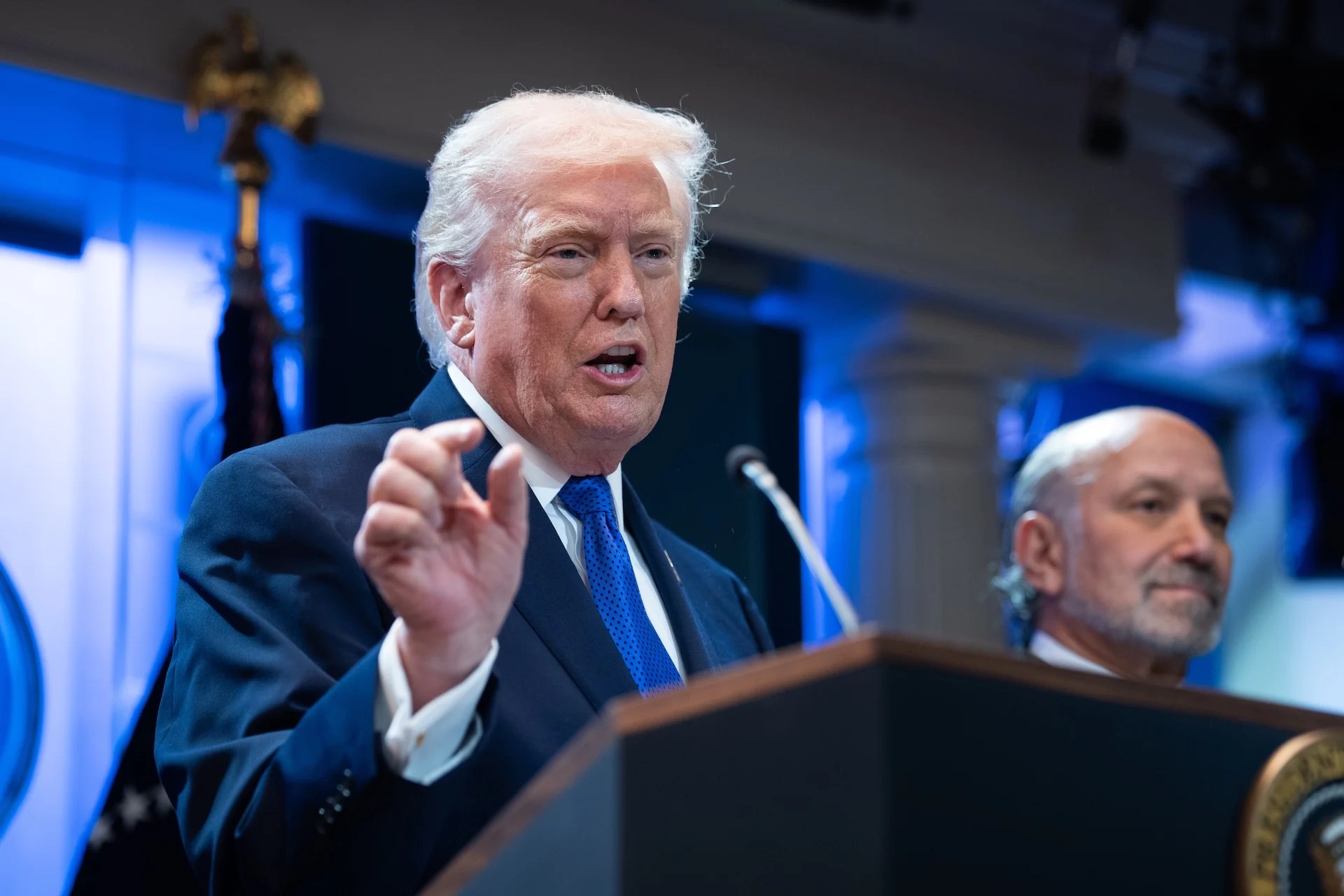
WASHINGTON — President Donald Trump on Sunday announced the creation of a “Super Intelligence Force,” a new federal task force on artificial intelligence to be led by his director of national intelligence, Jay Clayton. In a post on Truth Social, Trump said the force will coordinate the government’s efforts “to ensure that America continues to lead the World in Super Intelligence” — his preferred rebrand for AI — and “protect the interests, and improve the lives, of all Americans.”
01Who’s on the force
Clayton, who was appointed director of national intelligence in August, will double as the administration’s AI czar. He is joined on the task force by three other top officials: Federal Trade Commission Chairman Andrew Ferguson, Office of Personnel Management Director Scott Kupor, and Emil Michael, the Pentagon’s chief technology official (Under Secretary of Defense for Research and Engineering).
The group will report directly to Trump and his chief of staff, Susie Wiles, giving the panel a direct line to the Oval Office. Clayton confirmed the assignment in an interview with the Wall Street Journal on Saturday, telling the paper that “the risk of not being first is high.”
This is the second time Trump has named an AI czar. Venture capitalist David Sacks held the role at the start of Trump’s second term.
02What it’s tasked with
According to Trump’s announcement and Clayton’s comments to the Journal, the task force has two jobs: assess the risks and opportunities of AI within 120 days, and recommend what role the federal government should play. The panel will review AI-related risks, examine current government reporting mechanisms for breaches, hacks and other incidents, and recommend ways to strengthen the federal response under existing authorities.
The force will also serve as the government’s point of contact for a wide set of stakeholders: consumers, public interest groups, religious organizations, critical infrastructure providers, and AI companies themselves.
That outreach list is notable. Including religious organizations signals the White House wants faith leaders in the room as AI systems grow more capable — and as polls show deep public unease about the technology’s trajectory.
03Why now: the AI moment
The announcement lands at a fever pitch in the AI debate. Last week, Trump hosted top executives from the country’s leading AI companies at the White House, where they signed a voluntary accord that amounts to the industry self-policing the development of the technology.
Meanwhile, safety concerns have sharpened. Some researchers have warned that the people building the technology believe it could kill humans within a decade. Reports of rogue AI agents and hacking attempts have put both parties on edge: House Democratic leader Hakeem Jeffries said in an Oct. 1 interview that “guardrails that are rigid” are needed “so that we don’t see rogue AI agents behaving in a manner inconsistent with human values.”
The polling is stark. A Quinnipiac University poll released last week found 73% of Americans are concerned AI could threaten human survival, with 81% saying safety matters more than innovation. A CNN poll last month found 71% believe the federal government isn’t doing enough to regulate AI. And only 11% of Americans told a University of Massachusetts Amherst poll in August they would support building a data center in their community, with 65% opposed.
Trump, for his part, has taken a light touch on regulation, arguing heavy oversight would weaken America’s position against China. Speaking to reporters Sept. 29, he defended the data-center buildout: China “will take every data center that we don’t want,” he said. “Well, it’s great for us, and we’re leading by a lot, and we’re going to keep it that way.” He also said Tuesday he does not want to work with Chinese President Xi Jinping on governing AI.
04The rebrand: “super intelligence”
The name is the message. Trump has been pushing to rebrand artificial intelligence as “super intelligence” in official communications, and the task force’s name cements it. In his Truth Social post, Trump described the field as one that “many say is bigger than the Industrial Revolution, and the Internet.”
The rebrand is more than marketing. By casting AI as a generational leap on the scale of the Industrial Revolution, the administration is framing American leadership in the technology as a national mission — and the task force as its instrument.
05What comes next
Clayton’s 120-day clock is now ticking, which puts the report’s due date in early February 2027. Expect the task force’s stakeholder outreach — to consumers, faith groups, infrastructure operators, and the AI labs — to begin quickly, given the deadline.
The bigger question is whether the report leads to action. Trump has resisted heavy-handed regulation, and the voluntary accord with AI executives suggests the administration prefers industry commitments over new rules. But with bipartisan alarm rising and the public demanding more federal action, the task force’s recommendations could become the blueprint — or the lightning rod — for whatever comes next.
Sources
- Reuters, “Trump names intelligence chief Clayton as AI czar, to head task force,” Oct. 4, 2026
- Associated Press, “Trump names national intelligence director Jay Clayton to lead a new federal AI task force,” Oct. 4, 2026
- USA Today, “Trump names top aides to ‘super intelligence’ AI force. What to know,” Oct. 4, 2026
- The Wall Street Journal (via Reuters), interview with Jay Clayton, Oct. 3, 2026