Washington is sending the fleet — and the president is watching the calendar.
The Pentagon is sending a third aircraft-carrier strike group and another Marine expeditionary unit to the Middle East, adding 9,000 to 10,000 more U.S. troops to the region as President Trump weighs resuming strikes on Iran after the midterm elections, U.S. officials told The Wall Street Journal.
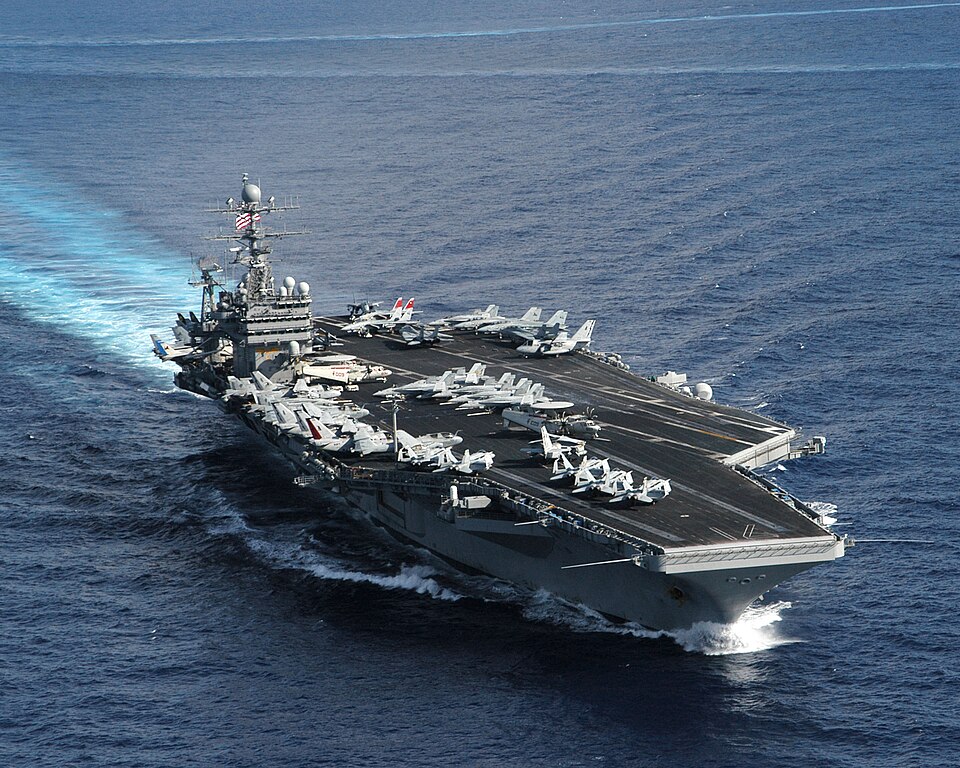
The aircraft carrier USS Theodore Roosevelt departed its home port of San Diego on a scheduled deployment this past week, while the USS Makin Island Amphibious Ready Group — three amphibious ships carrying Marines from the 13th Marine Expeditionary Unit — followed a day later. Together, the two groups are carrying more than 7,000 sailors and 2,000 Marines, and U.S. officials said the full deployment is expected to arrive in the region by the end of November.
The reinforcements will join an already massive American military presence. More than 50,000 U.S. troops are currently in the Middle East, military officials told the Journal, alongside the USS George H.W. Bush and USS George Washington carrier strike groups and the USS Boxer Amphibious Ready Group. If the Washington stays in the region after the Roosevelt arrives, it will bring the area to three carrier strike groups for the first time since April — before Iran and the U.S. clinched a fragile ceasefire that temporarily ended fighting that began on February 28. That ceasefire collapsed, and the two sides have fought sporadically since. It is possible the Washington instead returns to its home port in Japan, which would bring the force back down to two carriers. The buildup isn’t only naval: the U.S. has also extended the deployment of several air defense units and the 82nd Airborne Division, and roughly 20 ships are involved in the blockade and in escorting commercial vessels through the Strait of Hormuz.
The timing is explicitly tied to Trump’s calendar. The president recently told aides that he expects to resume bombing Iran in November, the Journal reported. And in an interview with Time magazine published Thursday, Trump said it was “possible” the U.S. could resume bombing Iran after the November midterm elections if there is no deal with Tehran.
The Strait of Hormuz sits at the center of the standoff. Iran has offered to reopen the strait as part of a seven-day plan that also calls for a return to nuclear talks, sanctions relief and a regional ceasefire covering Lebanon and Yemen. Trump rejected the proposal, telling Time that Iran had offered to “open up” the strait but that the offer was not good enough. The waterway remains dangerous: regional outlets reported that five ships were struck in a 72-hour stretch late this week, including a supertanker that caught fire off Oman.
Fighting between the U.S. and Iran has slowed in recent days, but talks to end the war — now entering its eighth month — have not made much progress. Pentagon and White House officials have said the objective is to keep military options “on the table” for the president, irrespective of diplomatic developments, according to Al Jazeera reporting. The economic squeeze on Tehran is tightening in parallel: Iranian oil loadings were zero in September, with about 15 million barrels still on the water — nearly all bound for China — and Treasury officials estimate Tehran is roughly two weeks from having nothing left to trade.
The move effectively turns the American election calendar into a military one: the heaviest U.S. naval presence in the region in months is set to arrive just as voters go to the polls on November 3 — and just as Trump says he may be ready to use it.
Reporting this story is based on
- U.S. Sending Third Aircraft Carrier, Up to 10,000 More Troops, to Middle East
The Wall Street Journal — 2026-10-02 - U.S. Deploys Third Aircraft Carrier To Middle East As War With Iran Enters Eighth Month
Marine Insight — 2026-10-03 - Pentagon deploys Theodore Roosevelt carrier strike group as Trump threatens more Iran strikes
High Plains Pundit — 2026-10-03