
Results
The Story of AFC Bournemouth
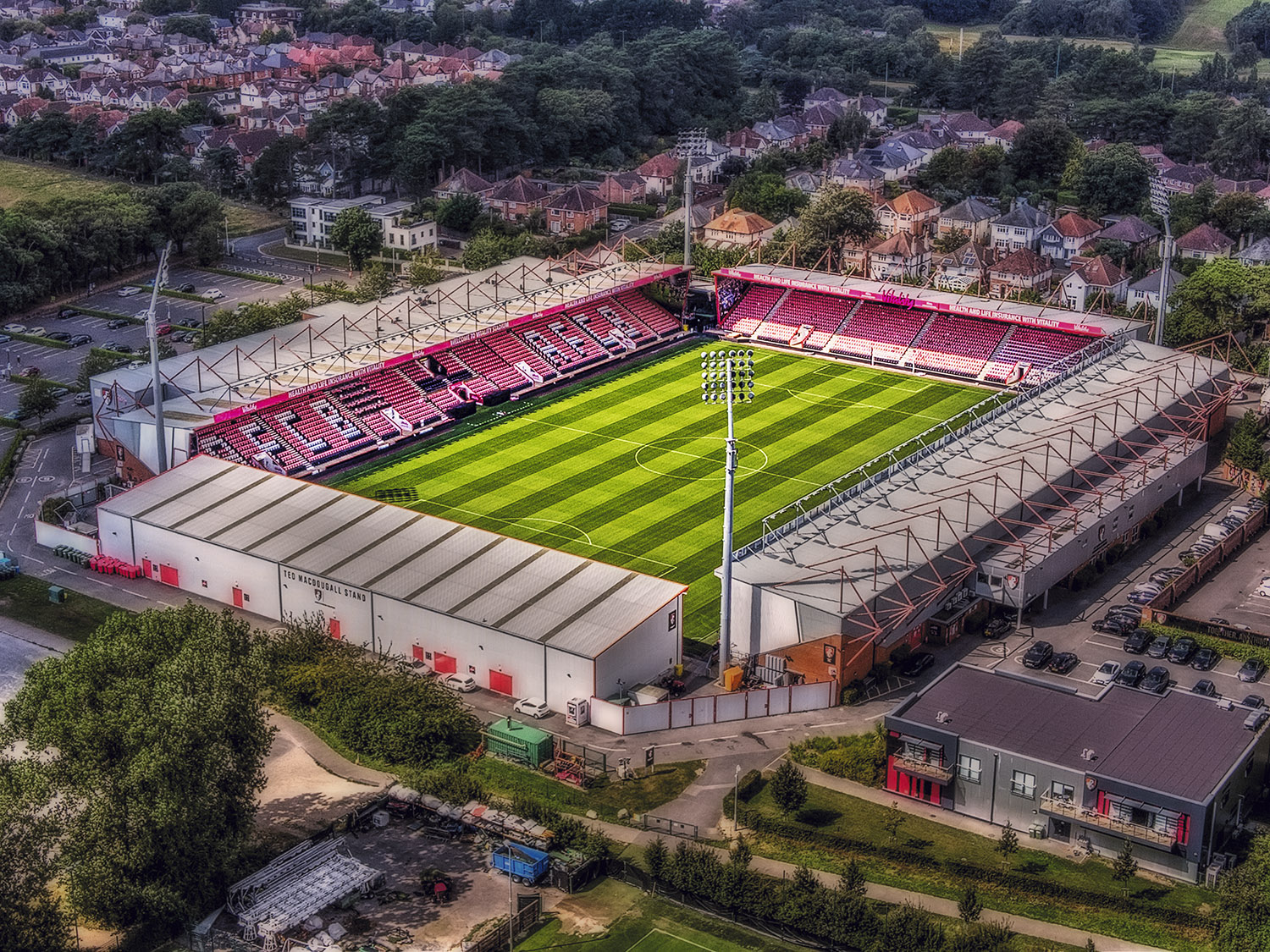
At barely 11,000 seats, the Vitality Stadium is the smallest ground in the Premier League — and AFC Bournemouth are the biggest story it has ever held. English football's great survival tale now plays out as an established top-flight drama: the Cherries begin 2026–27 winless at 0-3-2, under a new manager, with the familiar script of stars sold on and belief undimmed. If you want one club that proves the sport is about more than money, start here.
The club was formed in 1899 as Boscombe FC, joined the Football League in 1923 as Bournemouth & Boscombe Athletic, and took the current name — AFC Bournemouth — in 1971, when they also adopted the red-and-black stripes said to be inspired by AC Milan. They have played at Dean Court since 1910, and the ground's tininess is its charm: the smallest stadium in the division, tucked into a residential street on England's south coast. The 'Cherries' nickname comes from the cherry-red shirts and the cherry orchards that once stood beside the ground.
Long before the fairy tale, there was Harry Redknapp's giant-killing. In January 1984, Third Division Bournemouth beat holders Manchester United 2–0 in the FA Cup third round — one of the competition's great shocks, and still the result every Cherries fan cites first. Redknapp managed the club for a decade; the giant-killing remains the club's immortal cup moment.
Then came the near-death experience. In 2008 the debt-laden club entered administration — for the second time in a decade — were docked ten points, then began the 2008–09 League Two season with a further 17-point deduction. Relegation out of the Football League looked certain; at one point the club was five minutes from liquidation before chairman Jeff Mostyn's money kept it alive. On New Year's Eve 2008, with the club 91st of 92 league clubs, they turned to a 31-year-old former player with a wrecked knee and no managerial experience: Eddie Howe. What followed is known as the Great Escape — survival secured on the final day of the season, the launchpad for one of the most romantic rises in football history. The club marked the tenth anniversary with a documentary, 'Minus 17', and Howe himself called it a historic turning point: hard work, character, and the ability to bounce back, hallmarks the club has tried to keep ever since.
The climb was breathtaking. Promotion from League Two in 2010, Howe's brief Burnley detour, his return in October 2012, the League One runners-up spot in 2013 — and then, in 2015, the Championship title with 90 points and a first-ever promotion to the Premier League. From the fourth tier in 2009 to the top flight in 2015 remains one of English football's great achievements. Relegation finally came in 2020 on the season's last day, but Scott Parker's 2021–22 side came straight back up, and the club has been established in the top flight since.
The American era began in December 2022, when Las Vegas businessman Bill Foley's Black Knight Football Club group completed its takeover. Bournemouth became football's most effective finishing school for elite talent: centre-back Dean Huijsen's form earned a move to Real Madrid, left-back Milos Kerkez joined Liverpool, and the goals of Antoine Semenyo attracted Manchester City — each departure banking the kind of fee a club of Bournemouth's size once only dreamed of, and each one weathered. Under Andoni Iraola the football became the story itself: brave, front-foot, high-pressing, played at a tempo that made Dean Court one of the toughest away days in the league.
Summer 2026 brought the reset. Iraola departed, and the club made the ambitious appointment of Marco Rose — the former Borussia Dortmund and RB Leipzig manager — to keep the upward curve going. The squad keeps the model's fingerprints all over it: Brazil striker Evanilson leads the line, Justin Kluivert brings invention on the right, Tyler Adams and Lewis Cook anchor the midfield, French prodigy Eli Junior Kroupi is the next big thing through the door, while new faces Adrien Truffert (left-back), goalkeeper Djordje Petrović and centre-back Antonio Silva have all been thrown straight into the side.
The start has been winless but far from hopeless: 0-3-2 through five games, with three draws — 2–2 at home to Brentford, 2–2 at Newcastle, 1–1 at home to Everton — and two narrow defeats, 0–1 at home to Liverpool and 1–2 at Manchester City. The margins are small; the performances have asked questions of every opponent. For Rose, the task is familiar: turn brave football into points, keep the development line moving, and give a town of 190,000 people its next famous chapter. The smallest ground in the league, the biggest heart. The Cherries are still punching up — and history says never to write them off.
What makes Bournemouth special is the scale of it all. The Vitality Stadium's 11,000-odd seats mean there is no bad view and no hiding place — players hear every shout, and the east stand's drum never stops. The south-coast derbies with Southampton still crackle, but the real rivalry is with the idea that clubs like this don't belong. Long-term, the talk is of a new stadium to replace the cramped Dean Court footprint, a project Foley's group has explored since taking over; for now, the plan is simpler. Find the first win, get the new signings firing, and keep the line that runs from 'Minus 17' to Marco Rose unbroken: hard work, character, and the ability to bounce back from disappointments. It has worked before.
Key Players
Evanilson
The Brazilian No. 9 — relentless pressing and the focal point of the attack.
Eli Junior Kroupi
The breakout star: one of the most efficient young finishers in the league.
Tyler Adams
The USMNT's captain-in-waiting — all-action, all heart, the midfield destroyer.
Lewis Cook
The deep-lying playmaker; Bournemouth's tempo runs through him.
Justin Kluivert
Son of a legend, explosive in his own right — chaos off the right wing.
Adrien Truffert
The marauding French left-back; a threat at both ends.
Djordje Petrovic
The towering Serbian shot-stopper now commanding the box.
Antonio Silva
The highly rated Portuguese centre-back signed to anchor the new defence.
Club Legends
Steve Fletcher
Record appearance holder; his 2009 goal against Grimsby literally saved the club's league status.
Eddie Howe
Player, then the manager who took Bournemouth from -17 points in League Two to the Premier League.
Ted McDougall
Scored nine goals in a single 11-0 win in 1971 — still an English record.
Harry Redknapp
The manager behind the 1984 FA Cup giant-killing of Manchester United.
Watch AFC Bournemouth
More Bournemouth Coverage
Full Squad
Every player, grouped by position. Tap any player for stats.
Goalkeepers 4
Defenders 9
Midfielders 8
Forwards 8
All-Time Greats
The legends who built this club. Tap for their story.