
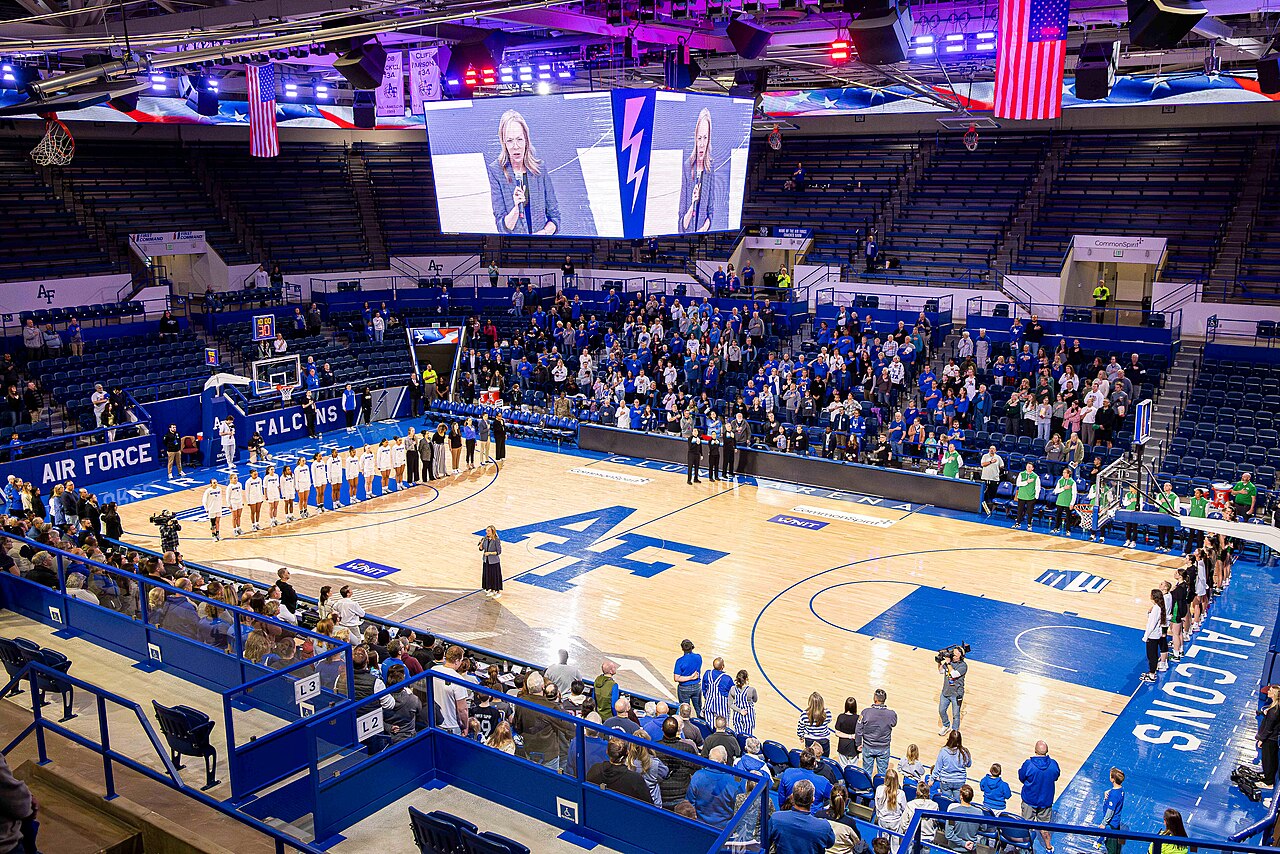
The Air Force Falcons play the hardest version of college basketball: Division I hoops at a service academy, where every player carries a full military course load, faces height and weight restrictions, and graduates into active-duty service. Winning here isn't just difficult — it requires a completely different definition of success, and the Falcons have spent decades proving the model can work.
The peak came under Joe Scott in the mid-2000s. The 2003-04 Falcons went 22-7, won the Mountain West regular-season title with the Princeton offense humming, and earned the program's first NCAA tournament bid in more than forty years — a 2004 trip that ended against North Carolina but announced that Air Force could play with anyone. The 2005-06 team went back to the dance, cementing the most successful two-year run in school history.
The Commander-in-Chief's Trophy series with Army and Navy is the Falcons' championship chase: the round-robin rivalry that matters more than any conference race at the academies. Beating the other service schools carries a weight no NET ranking can measure, and Falcon fans circle those dates before the season starts.
Clune Arena sits inside the Cadet Field House at 7,258 feet, where the thin air and the cadet wing's precision create one of the most unusual home courts in America. Opponents used to the altitude of a normal gym find their legs gone by the second half; the Falcons, conditioned for it, keep running their cuts.
The heritage is institutional as much as athletic. Air Force's earlier tournament teams in 1960 and 1962 played in a different era of the sport, and the long drought between dances only made the Scott-era breakthrough sweeter. Every Falcon who takes the floor knows the deal: the NBA isn't the goal, service is — and the basketball is played with the same discipline the academy demands everywhere else.
What defines Air Force is the standard: win with less, out-execute everyone, and represent something bigger than basketball. No Final Fours, no lottery picks — but the Falcons have something rarer, a program where every player will serve their country. In Colorado Springs, that's the whole point.
The scheduling reality at Air Force is unlike anywhere else: the Falcons play a full Mountain West gauntlet — road trips to San Diego State, New Mexico, and Boise State — with a roster of cadets who will commission as officers. There are no one-and-dones, no transfer-portal mercenaries; there are four-year players who chose the academy life. When the Falcons win a conference game, it's a triumph of system and will over raw talent, and the cadet wing in the stands — in uniform, precise, deafening — treats every victory like a championship. That purity is the program's quiet superpower.
A new era begins in 2026-27. Joe Crispin — the former Penn State star guard who once lit up Big Ten scoreboards — takes over the program for his first season as a Division I head coach, inheriting a roster that is almost impossibly young. Nine freshmen dot the roster: guards Chris Catchings, Ethan Greenberg, Justin Hinds and Kam Sanders, and forwards Riley Dering, Keaton Frisch, Lucas Hobin, Sam Imade and Brendan Martin. The sophomores — A.J. Patterson, Kyle Marshall, Eli Robinson and Elliott Taite — are barely older. In an era when most programs rebuild through the transfer portal, Air Force rebuilds the academy way: recruit cadets, develop them for four years, and trust the system.
The veterans, such as they are, are juniors. Wesley Celichowski, the 7-foot center from Indiana, gives the Falcons rare true size in the middle. Kolby Gilles and Caleb Walker bring muscle to the forward spots, and Josh Gatete adds another long, versatile body. It's a frontcourt that can bang with Mountain West bigs on a good night — and the Mountain West remains one of the best leagues in America, a nightly gauntlet of road trips to San Diego State, New Mexico and Boise State where the margin for error is zero.
Crispin's challenge is the same one every Air Force coach faces, sharpened by a roster this green: install an offense precise enough to generate good shots without elite athletes, and a defense disciplined enough to survive 40 minutes against older, stronger teams. The Princeton principles that defined the program's peak — backdoor cuts, patience, five-man execution — are in the building's DNA, and a former point guard who made his name on skill over size is a natural fit to teach them. The cadet wing will be there in uniform either way, and Clune Arena's thin air at 7,258 feet remains the great equalizer.
Expectations should be honest: this is a development year, and the win column may not reflect the progress. But watch the freshmen in February versus November. Watch whether Celichowski becomes a Mountain West problem in the paint. And circle the Commander-in-Chief's Trophy dates with Army and Navy — no matter what the conference record says, those are the games that define an academy season. At Air Force, success was never just the scoreboard. It's cadets becoming officers who happen to play beautiful, disciplined basketball along the way.