In March 2008, a skinny sophomore with a feathery jump shot and a name most of America couldn't yet pronounce took the NCAA tournament hostage. Stephen Curry scored 40 points against Gonzaga, 30 against Georgetown and 25 against Wisconsin, carrying 10th-seeded Davidson — a liberal arts college of about 2,000 students in the North Carolina piedmont — all the way to the Elite Eight. Kansas ended the dream 59-57 in the Midwest Regional final, but the damage was done: Curry had announced himself as a future two-time NBA MVP and four-time champion, and Davidson had become America's team. Nearly two decades later, that run remains the program's scripture, and everything the Wildcats do is still measured against it.
The 2008 magic didn't come from nowhere. Davidson was already one of the great mid-major powers of the 1960s under Lefty Driesell, reaching the Elite Eight in 1968 and 1969 and the Sweet Sixteen in 1966, with Fred Hetzel going No. 1 overall in the 1965 NBA draft. The Wildcats built a Southern Conference dynasty — regular-season titles stacked through the 1960s, 70s and 2000s, tournament crowns in 1966, 1968, 1969, 1970, 1986, 1998, 2002, 2006, 2007, 2008, 2012 and 2013 — and became the sport's gold standard for how a small school wins: precision offense, relentless screening, high-character players and a system greater than any one roster.
That system had a name: Bob McKillop. Hired in 1989, McKillop spent 33 seasons in Davidson, winning more than 600 games, collecting 15 NCAA tournament appearances and turning the program into a national brand. He coached Curry, developed All-Americans, and made the Wildcats' motion offense — back cuts, flare screens, shooters sprinting off double screens — appointment viewing for basketball purists. When he retired in 2022, the succession was seamless and familial: his son Matt, a three-year starter under his father from 2002-06 with two NCAA trips, who had spent 14 years on the Davidson bench, took over the program.
Matt McKillop's first three seasons were a grind — 16-16, 15-17 and 17-16, all in the Atlantic 10, the league Davidson joined in 2014 after outgrowing the SoCon. But the arrow kept pointing up, and the 2025-26 season was the breakthrough: a 20-14 record, 10-8 in the A-10, a sixth-place finish and a trip to the NIT, the program's best campaign under the younger McKillop. The Wildcats opened with statement wins — Washington State 85-69, Bowling Green 91-87, a 59-49 defensive masterclass against Boston College at the Charleston Classic, and a 62-55 road win at Charlotte — and showed the old Davidson DNA: guard-heavy lineups, international flavor and a shooting touch that travels.
That guard play is the program's lifeblood. In 2025-26 the Wildcats ran through playmakers like Roberts Blums and Parker Friedrichsen, with Sam Brown, Nick Coval and Devin Brown providing punch and Josh Scovens, Manie Joses, Hunter Adam, Sean Logan and Ian Platteeuw rounding out a deep, skilled rotation. It's the classic Davidson formula — skilled over simply athletic, smart over simply fast — and in the Atlantic 10, where VCU, Dayton, Saint Louis and Loyola Chicago all bring size and muscle, the Wildcats' shooting and spacing remain their great equalizer.
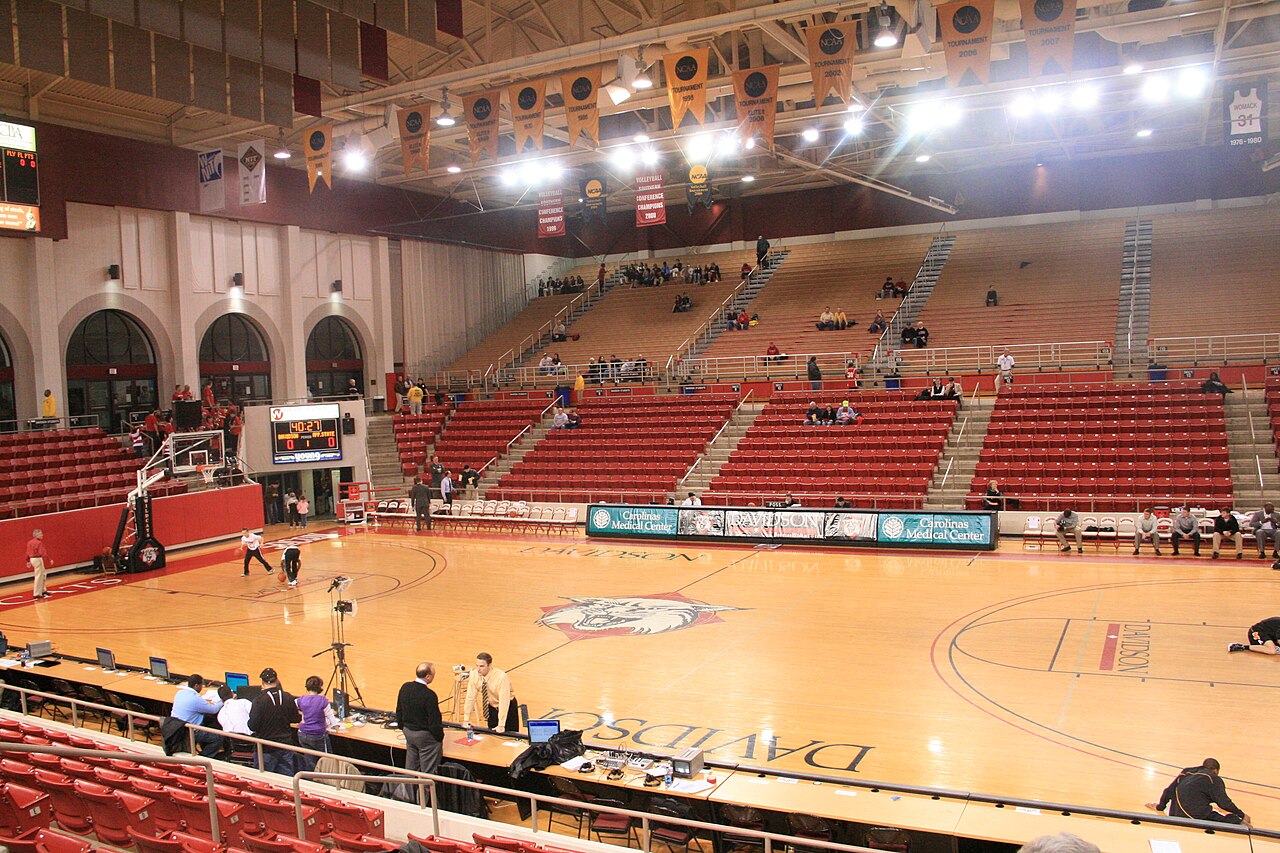
All of it happens at John M. Belk Arena, the 5,223-seat bandbox inside the Baker Sports Complex that is one of college basketball's great intimate venues. The D-Block student section packs in close, the building gets deafening for its size, and the Curry 2008 explosions — born in the quiet work of that gym — are still felt in the rafters. Davidson retired Curry's No. 30 jersey in 2022, a permanent reminder that the greatest shooter who ever lived learned the game in this tiny gym.
The trophy case tells the rest: 15 NCAA tournament appearances, three Elite Eights (1968, 1969, 2008), four Sweet Sixteens, a 2018 Atlantic 10 tournament title, and A-10 regular-season crowns in 2015 and 2022 — the last of which sent Davidson dancing most recently. Beyond Curry and Hetzel, the alumni wall includes 2018 A-10 Player of the Year Peyton Aldridge, sharpshooter Kellan Grady, Jack Gibbs, De'Mon Brooks and Foster Loyer, each a chapter in the program's book of overachievers.
Now comes the 2026-27 season, Matt McKillop's fifth, and the goal is unmistakable: get Davidson back to the NCAA tournament for the first time since 2022. The roster will churn the way every roster churns in the transfer-portal era, but the infrastructure is all here — a proven coach, a top-tier home floor, an identity that recruits itself. The path is the same one that worked in 2008 and 2015 and 2018 and 2022: defend Belk Arena, shoot it better than everybody else, and peak in March.
What defines Davidson will never change. This is the tiny school in the tiny town that launched a dynasty-maker, the program that proved a mid-major with a system and a standard can stand toe-to-toe with Kansas in a regional final. The 2008 Elite Eight banner hangs over everything, and in Davidson, North Carolina, the next March moment isn't a hope — it's the expectation. The Wildcats are done rebuilding. Now they're hunting.