The Duquesne Dukes ended 47 years of waiting in 2024 — winning the Atlantic 10 tournament to reach the NCAA tournament for the first time since 1977, then toppling BYU in the first round for good measure. For a program perched on Pittsburgh’s Bluff, the drought-breaking championship was euphoric: decades of frustration washed away in one March weekend, with head coach Keith Dambrot going out a champion in his final season before retirement. That is the foundation of everything happening now. As the 2026–27 season — the program’s 111th — tips off, third-year head coach Dru Joyce III has his most talented roster yet, headlined by the return of the Atlantic 10’s best backcourt. The question is no longer whether Duquesne can win. It is whether the Dukes can make winning a habit.
The history runs deeper than the drought suggested. This was once one of the nation’s premier programs: the 1955 NIT champions, back when the NIT decided bragging rights; Chuck Cooper, the first Black player ever drafted by an NBA team (the Boston Celtics took him in 1950); Dick Ricketts, the No. 1 overall pick of the 1955 draft; and Sihugo Green, a two-time All-American who helped make the Dukes a fixture of the 1950s national scene. The great teams of the late 1960s and early 1970s, and Norm Nixon’s 1977 Eastern 8 champions — the last Dukes team to reach the NCAAs before 2024 — are Pittsburgh basketball royalty. The Bluff’s basketball soul never left; it just waited a long time for March to notice again.
The Joyce era began in the spring of 2024 with one of the great storylines in coaching: Dambrot’s longtime assistant, a former high school teammate of LeBron James at St. Vincent–St. Mary, taking over a program coming off the highest high in two generations — and immediately watching the roster get gutted by graduation. Stars Dae Dae Grant and Jimmy Clark III, the forwards, the frontcourt depth: all gone. Joyce spent his first two seasons rebuilding on the fly, installing a gritty, defensive-minded identity and leaning on the portal to keep the Dukes competitive in a brutal Atlantic 10.
Then came August 2026, and the news that changed the entire season. A major court ruling granted another year of eligibility to players from the class of 2022, and Tarence Guinyard — the 6-foot-2 guard who led Duquesne in scoring (16.6 points per game) and assists (4.7) last season, finished second in the A-10 in scoring, and was named first-team All-Atlantic 10, the program’s first first-team selection since Damian Saunders in 2010 — withdrew from the transfer portal and came back to the Bluff. He had heard from Oklahoma, Gonzaga and Dayton, among others. He chose Duquesne. Paired with Virginia Tech transfer Izaiah Pasha, the Dukes suddenly have one of the most talented and veteran backcourts in the league — the kind of guard tandem that wins in March, the kind Duquesne last had when Grant and Clark were cutting down nets.
The supporting cast is the deepest of the Joyce era. Redshirt senior Brandon Hall returns after starting the final 14 games last season. Transfers Josh Smith (West Georgia) and Yoav Berman (Queens) both averaged double figures for their previous programs. Jake DiMichele, the McKees Rocks product, gives the rotation a local edge. And the roster reflects the program’s growing global reach: 13 players from eight countries — Canada, Germany, Hungary, Israel, Senegal, Serbia, Spain and the United States — a genuinely international squad for a Pittsburgh program.
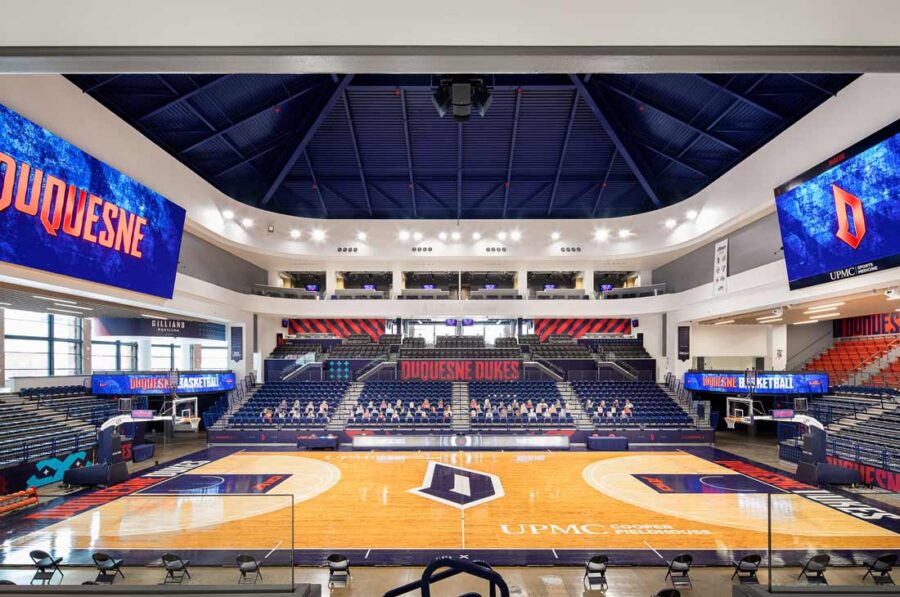
The schedule is built for a team with ambitions. The Dukes open November 3 against Purdue Fort Wayne at the UPMC Cooper Fieldhouse — the gleaming on-campus arena that has become one of the A-10’s best home-court environments since its 2021 opening — then head to the Sunshine Slam in Daytona Beach and the Hope Gas Backyard Basketball Classic against Robert Morris at PPG Paints Arena. The Atlantic 10 slate, announced in late September, features home-and-home series with Davidson, Rhode Island, Loyola Chicago, Dayton and St. Bonaventure, opening with Davidson at home on December 30. And the A-10 Championship returns to the Barclays Center in Brooklyn for the first time since 2024 — the building where Duquesne won four games in five days to end the drought.
The Atlantic 10 wars define everything: Dayton, VCU, Saint Louis, Loyola Chicago — a league where Duquesne went from afterthought to champion in one weekend and now has to prove it can stay at the table. The preseason chatter has the Dukes as a legitimate contender rather than a curiosity, a remarkable shift for a program that spent most of this century as a February footnote.
What defines Duquesne right now is the rarest thing in college basketball: momentum with a memory. The 2024 title proved the ceiling. Guinyard’s return — spurning high-major suitors to finish what he started — signals a culture players want to stay in. Joyce, in year three, has the roster, the arena, the schedule and the backcourt to make a real run at doing it again. On the Bluff, they waited 47 years for one March. They do not intend to wait 47 more.