In 1999, a mid-major from Spokane, Washington — a Jesuit school of a few thousand students — crashed the Elite Eight on Casey Calvary's tip-in against Florida and refused to ever leave the national conversation. That Cinderella run made Mark Few, then an assistant, the successor to Dan Monson. Few never looked back. Twenty-eight seasons later, Gonzaga isn't a mid-major anymore; it's a blue blood with a different area code, and in August 2026 the sport made it official: Few was enshrined in the Naismith Basketball Hall of Fame, the Class of 2026, presented by John Calipari, Grant Hill and John Stockton.
The numbers behind the legend are absurd. Few's record stands at 772-156 — a .832 winning percentage, the highest of any active Division I head coach in history. He has never had a losing season. He has never won fewer than 20 games. He has won at least 25 in each of the last 19 seasons, an NCAA record. His teams have reached 27 straight NCAA tournaments, with 14 Sweet Sixteens, six Elite Eights, two Final Fours and two national title games: 2017, when North Carolina ended the first championship dream, and 2021, when a 31-0 juggernaut — Jalen Suggs's overtime banked-in buzzer-beater against UCLA in the Final Four still the greatest shot in program history — fell to Baylor in the final. Few also won Olympic gold as an assistant coach with Team USA at the 2024 Paris Games. The dynasty-maker who started as the kid assistant on the '99 staff is now canon.
The 2025-26 season was a vintage chapter, and the final one of the old world order. The Bulldogs went 31-4, claimed their 27th WCC regular-season championship and their 23rd WCC tournament title, earned a No. 3 seed, beat Kennesaw State in the first round, and lost 74-68 to Texas in the second round — the ninth 30-win season of the Few era. And then everything changed. In 2026-27, Gonzaga begins life in the new-look Pac-12, the rebuilt conference it now shares with San Diego State, Utah State, Boise State, Colorado State, Fresno State, Oregon State and Washington State. After dominating the WCC for a generation, the Zags are back to proving themselves — in a league that, at least on paper, is a massive step up in nightly difficulty.
The roster, fittingly for a new era, is the most rebuilt of the Few tenure. Eleven players are gone — including Graham Ike, Tyon Grant-Foster (the former Grand Canyon star and WAC Player of the Year who chased one last March), Jalen Warley, Adam Miller and Noah Haaland, plus six players who transferred out and Mario Saint-Supery, who signed professionally with Valencia in Spain. What remains is a core worth building around: senior Braden Huff, a potential All-American, and Davis Fogle. The portal haul is star-studded: Xaivian Lee, the elite pick-and-roll guard who starred at Princeton and Florida; Massamba Diop, the 7-foot rim protector from Arizona State projected as a late first-round pick in the 2027 NBA draft; Chauncey Wiggins from Florida State; Javon Bennett from Dayton; and Isiah Harwell from Houston. Freshmen Luca Foster and Sam Funches add young talent. The wrinkle: several of those veterans are class-of-2022 fifth-year players whose eligibility sits in legal limbo amid the NCAA's battles over "five-in-five" rules — a subplot that could define the season before it tips.
The schedule, as always, fears nobody. Andy Katz ranked the non-conference slate the sixth-toughest in America. The season opens November 2 against Purdue in Las Vegas, and the annual Kraziness in the Kennel tipoff event — held Saturday, October 3, 2026 — set the tone for a fanbase that expects the national title chase to continue uninterrupted. Preseason projections have the Zags around the top 10 nationally even in a rebuild year, because Few's track record has earned the benefit of every doubt.
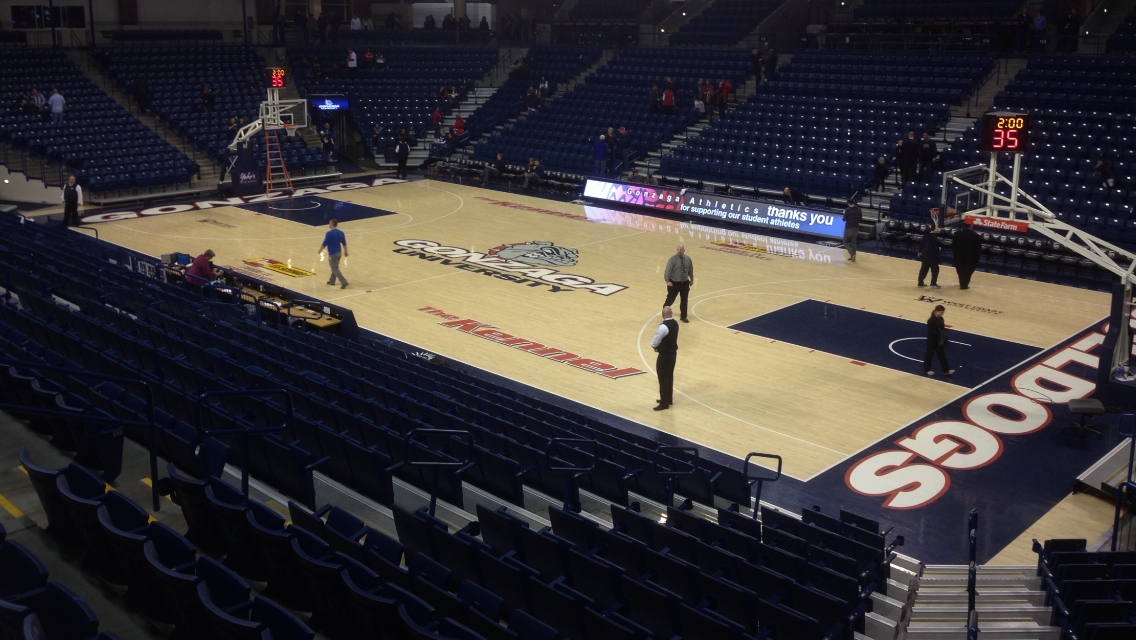
All of it happens at the McCarthey Athletic Center — "The Kennel" — the 6,000-seat bandbox that remains one of college basketball's great home-court advantages. The sellout streak, the choreographed student chaos, the building that gets impossibly loud: it's the physical embodiment of what Gonzaga built from nothing. The program that once had to beg for respect now plays in front of a national television audience every week, and the Kennel is the fortress at the center of it.
The player pipeline tells the rest of the story: Adam Morrison, the 2006 national player of the year runner-up whose mustache and tears made him a cultural icon; Kelly Olynyk, Domantas Sabonis, Rui Hachimura, Chet Holmgren, Drew Timme — a development machine that turned overlooked recruits and international finds into lottery picks. John Stockton's alumni roots run deep in Spokane. The formula — player development, offensive precision, international scouting — is the sport's most-copied blueprint.
What defines Gonzaga has never changed: the '99 miracle, the refusal to fade, the machine Few built, the two title-game heartbreaks, and the one banner still missing from the rafters. Now there's a new league, a rebuilt roster, a Hall of Fame coach and the same old expectation. The Zags don't rebuild; they reload. The Pac-12 is about to find out what the WCC learned a generation ago: Gonzaga is coming, and it's not going anywhere.