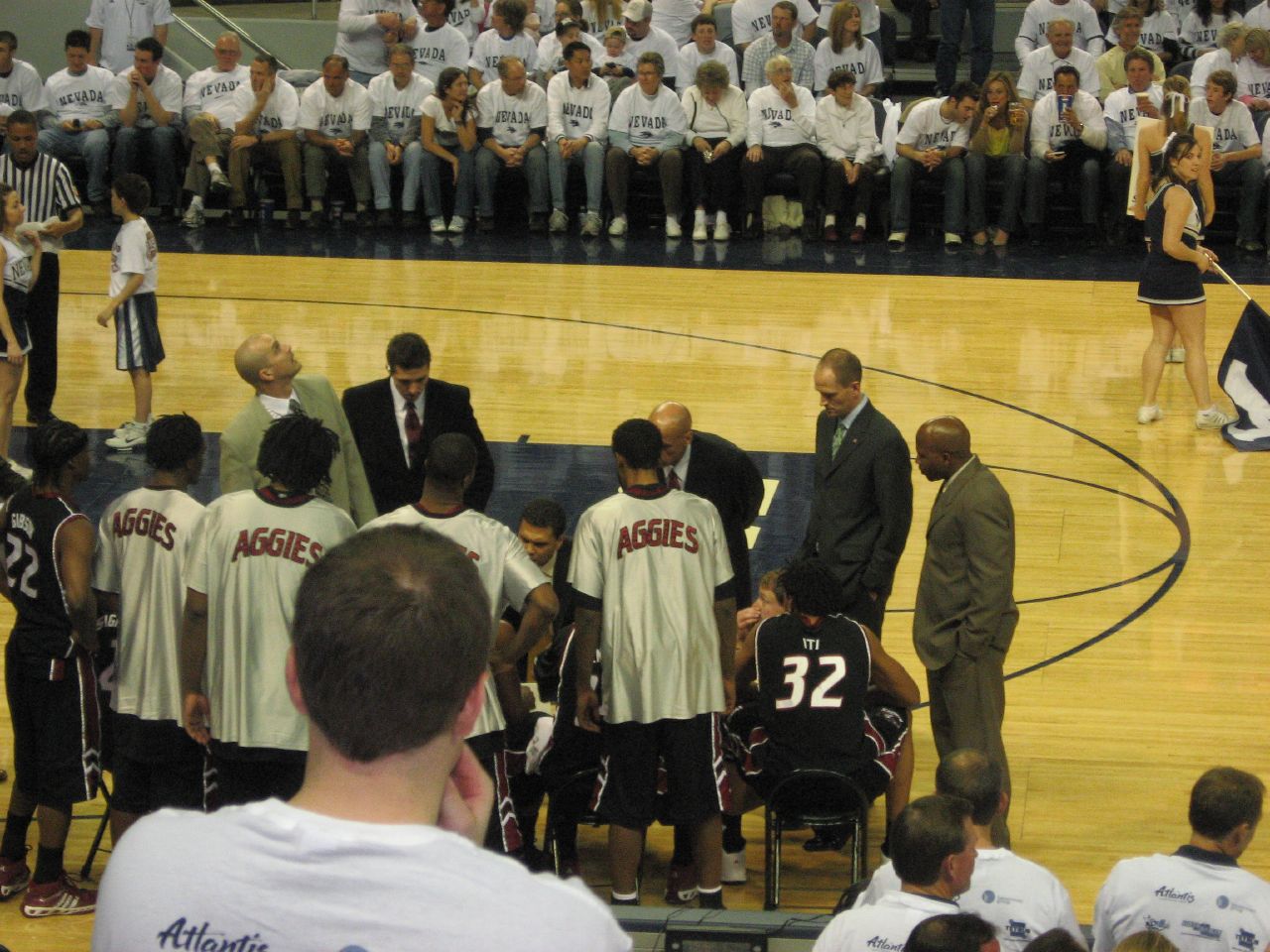
The Nevada Wolf Pack turned Reno into one of the great March launching pads of the 2000s and 2010s — and entering the 2026–27 season, the Pack is chasing something it has never quite seized: a Mountain West championship and a return to the NCAA Tournament after back-to-back brushes with the Dance.
Steve Alford begins his eighth season on the Lawlor Events Center sideline, and his program has settled into a rhythm of winning without quite breaking through. Through 2025–26, Alford is 137–88 in Reno — an average of 20 wins a season — with a career mark of 724–386 that ranks him tenth among all active Division I coaches. He also ranks third all-time, and second among active coaches, in Mountain West victories with 143. The numbers say stability. What remains is the title.
The 2025–26 campaign was the Alford era in miniature: a 24–13 record, the second-most wins of his Nevada tenure, a 12–8 mark in the Mountain West, and a run to the quarterfinals of the National Invitation Tournament, where the season ended with a loss to Auburn. Corey Camper Jr. earned First Team All–Mountain West honors and Elijah Price landed on the Second Team and the All–Defensive Team. Nevada was a fortress at home — 17–2 at Lawlor — and shaky away from it, going 4–9 on the road and dropping its final seven road games. Good, not quite great: the Wolf Pack tied for fifth in a one-bid league and never seriously threatened for the NCAA cut line.
The bar is higher because 2023–24 showed what it looks like. That team went 26–8, finished 13–5 and tied for second in a brutally competitive Mountain West that earned a record six NCAA bids, and Alford guided Nevada back into the AP Top 25 for the first time since 2019. Jarod Lucas and Kenan Blackshear made Second Team All–Mountain West, Nick Davidson landed on the Third Team, and Tré Coleman was an All–Defensive selection. An at-large bid followed. The blueprint is sitting right there on the shelf.
Now the window is cracking open. The 2026–27 schedule is the biggest in school history — 32 games, 17 of them at Lawlor — and for the first time in 26 seasons it contains no Power Five opponent, putting enormous weight on every nonconference night. The season opens November 2 against Robert Morris at Lawlor, and November 8 brings a first: Nevada will play a game at the Tahoe Blue Event Center in Stateline, matching up with Saint Mary’s on the shores of Lake Tahoe. Thanksgiving week sends the Pack back to Palm Springs for the Acrisure Series, where they’ll face San Francisco on November 23 and Santa Clara on November 24. December brings the Texas Legends College Classic in Dallas — Colorado State on December 18, Loyola Chicago on December 20 — and Mountain West play opens at Wyoming on January 2 before closing at home against New Mexico on March 6. The toughest nonconference tests figure to be Saint Mary’s and Santa Clara, which means there is no room for a slip-up.
The roster turns over again — it’s the modern way — but the foundation is real. Elijah Price and Vaughn Weems return as starters, joined by Peyton White and Myles Walker, with ten newcomers (six transfers, four freshmen) filling in around them. And the league itself is changing underneath everyone’s feet: San Diego State, Utah State, Boise State and Colorado State are leaving the Mountain West for the Pac-12, which makes at-large bids harder to come by but a conference title — the one thing Alford hasn’t won in Reno — far more manageable.
But Nevada basketball isn’t just this decade. The breakthrough came in 2004, when Trent Johnson’s Pack — led by Kirk Snyder and Nick Fazekas — won the WAC tournament and then toppled Michigan State and Gonzaga to reach the Sweet 16. It was the program’s arrival, and it set the standard: in Reno, March isn’t a dream, it’s the expectation.
Fazekas became the program’s defining player: a skilled 6-foot-11 forward who could score from anywhere, he carried the Pack to three straight tournaments and set records that still stand. The 2004 run made Nevada a mid-major power, and the modern era took off under Eric Musselman, whose frenetic energy matched the program’s ambition.
The peak came in 2018. The Wolf Pack authored one of the great comebacks in tournament history, rallying from 22 points down to stun Cincinnati 75–73 in the second round — at the time the second-largest comeback in tournament history — before pushing Loyola Chicago to the brink in the Sweet 16. Caleb Martin, Cody Martin and Jordan Caroline refused to lose, and Musselman’s sideline frenzy became March legend. The Musselman years made Nevada a transfer-portal destination before that was even a phrase.
Lawlor Events Center, tucked against the Sierra foothills with room for 12,000, is one of the West’s great home courts — loud, blue and unforgiving at altitude. Reno fans embraced the Pack as the city’s team, and March runs turned casual observers into lifers.
What defines Nevada is the March fearlessness. From Fazekas to the Musselman madness, the Wolf Pack has never been intimidated by a seed line. The Alford years have restored the winning; now, in a reshaped Mountain West with the heavyweights gone, the conference crown that has eluded him is there for the taking. In Reno, they don’t just hope for the second weekend — they plan for it.