
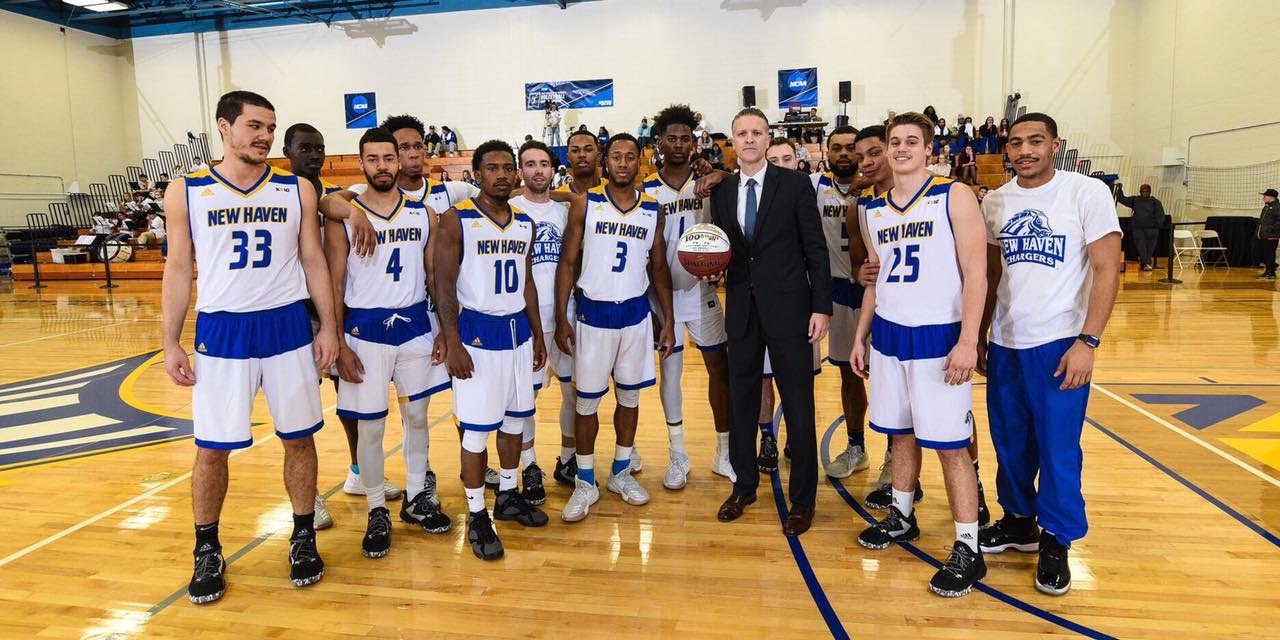
The New Haven Chargers are the new kids in Division I — and their first season at the highest level was far better than anyone expected. Picked dead last in the Northeast Conference preseason poll, with no players on the All-NEC preseason team, New Haven went 14–17 overall and 9–9 in league play in 2025–26, finishing a respectable fifth in the ten-team NEC. For a program playing its very first Division I season, it was a statement: the Chargers belong.
Getting here was the journey. The University of New Haven, tucked into West Haven, Connecticut, competed in Division II’s Northeast-10 Conference until June 30, 2025, when it made the leap to Division I and joined the Northeast Conference on July 1. Because of the NCAA’s reclassification rules, the Chargers aren’t eligible for the NCAA Tournament or the NIT until 2028–29 — the four-year transition period means New Haven can win the NEC but not go dancing for it. The banner can hang; the bid can’t. Yet.
The debut campaign exceeded every expectation anyway. The preseason coaches poll had New Haven tenth of ten, with a Pomeroy rating of 360th out of 365 Division I teams. By season’s end the Chargers had beaten teams picked well ahead of them and sat in the middle of the pack, with a .500 conference record that most first-year D-I programs would trade a lot for. In a league where LIU ran away with the regular season at 15–3, New Haven’s 9–9 put them right in the thick of the mid-table scrap.
Ted Hotaling is the steady hand through the transition. The 2025–26 season was his 15th campaign on the New Haven sideline (his 16th year overall, with the COVID-canceled 2020–21 season in between), making him one of the longest-tenured coaches in the conference. He built the program’s Division II success — the Chargers reached the NCAA Division II Tournament in 2019, 2022 and 2023, with earlier appearances stretching back to 1987 — and he’s now shepherding the same roster-building principles into Division I: defense first, Connecticut toughness, and a roster that mixes local talent with international flavor.
The inaugural Division I roster reflected that identity. Senior guards Kheni Briggs and Maison Adeleye provided the backcourt leadership, junior forward Stefano Faloppa — a 6-foot-8 Italian — brought size and skill, and homegrown talent like Kyle Kearson of West Haven and Najimi George of Bridgeport gave the fan base local names to cheer. Hotaling’s son Owen even made the roster as a freshman guard from Wallingford, making the debut season a family affair.
The home court is the Jeffrey P. Hazell Athletics Center, an intimate on-campus arena in West Haven that gives the Chargers a genuine home-court edge. At the Division II level, Hazell was a fortress — small, loud, and unforgiving — and the program carried that energy into its first D-I campaign. Visiting teams still had to play the same game: grind through 40 minutes in a bandbox against a well-coached team that wasn’t going to beat itself.
New Haven basketball’s history runs deep in Division II. The program dates to 1961–62, with an all-time record of 902–787 (.534) through the D-II era. The tournament appearances — 1987, 1988, 1990, 2003, 2004, 2013, 2014, 2019, 2022, 2023 — made the Chargers a perennial factor in the Northeast-10, and the 2022 and 2023 berths showed the program was peaking right as it prepared for the leap. The move to Division I was a bet that the foundation was strong enough to survive the jump.
So far, the bet is paying off. The NEC is a perfect landing spot for a transitioning program: a compact, competitive league where a well-coached team can punch above its weight, and where New Haven’s regional footprint — West Haven is an hour from most conference foes — keeps travel sane and rivalries natural. The Chargers’ first-year competitiveness has already made them a tougher out than the preseason poll promised.
The horizon is the thing. By 2028–29, the transition ends and the Big Dance comes into play — and a program that finished .500 in league play during year one, with its coach and infrastructure intact, has every reason to believe the ceiling is higher. New Haven didn’t come to Division I to be a curiosity. The Chargers came to win, and they’ve already started.
Year two is where the story gets serious. New Haven enters 2026–27 with a roster that knows it can hang in the NEC, a coach who has built winners at two levels, and a fan base that watched its program win its first Division I battles ahead of schedule. The tournament bid won’t come until 2028–29, but the Chargers are building something better than a waiting list — they’re building a team that’ll be ready the moment the door opens.