Princeton basketball is one of the great brands in the sport — the birthplace of the backdoor cut, the home of Pete Carril's legendary Princeton offense, the school of Bill Bradley, and the author of some of March's most beloved upsets. Which is what made 2025-26 so jarring: the Tigers went 9-20, finished 5-9 in the Ivy League, missed the conference tournament entirely, and endured the worst season of Mitch Henderson's fourteen seasons at the helm — the program's worst campaign in eighteen years.
The reasons were structural, not mysterious. Star guard Xaivian Lee — the engine of Princeton's recent success — left through the transfer portal. Caden Pierce, the program's other cornerstone, sat out the entire season to preserve a year of eligibility. The resulting roster had no seniors at all: a team of juniors, sophomores and freshmen trying to uphold one of the sport's proudest traditions with its two best players unavailable. The Tigers lost 20 games, the most of Henderson's tenure, and were never really in the Ivy race.
It wasn't without bright spots. Junior guard/forward Jackson Hicke emerged as a genuine building block — a 26-point, 8-rebound night at Brown, three consecutive 20-point games in late November, and a summer representing the USA in 3x3 basketball at the World University Games, where he helped the team win silver. Sophomore forward Malik Abdullahi ripped off five straight double-digit scoring games late in the season. Jack Stanton had a career-high 18-point night. CJ Happy, Jacob Huggins and Dalen Davis all showed flashes. The young Tigers scored the ball well enough at times; as Hicke put it after the Brown loss, "it honestly comes down to discipline on the defensive end."
The hope for 2026-27 starts with a name: Caden Pierce. The forward who sat out last season to preserve his eligibility is expected back, and his return — paired with another year of development for Hicke, Abdullahi and the young core — gives Henderson a roster that looks like Princeton again: experienced, skilled, and built around high-IQ players who fit the system. The Tigers don't rebuild through the portal the way the rest of the sport does; they develop, they wait, and they win with juniors and seniors who've been in the program for years.
That model is exactly what produced the modern golden era. Henderson — a Princeton alum from the class of 1998 who played under Carril and Bill Carmody — has won 260 games, passing Cappy Cappon (254) to become the second-winningest coach in school history behind only the Hall of Famer Carril (514). His Tigers won Ivy League titles in 2017, 2022, 2023 and 2024, and the 2022-23 team authored the program's signature March moment of the modern era: a Sweet 16 run as a 15 seed, stunning No. 2 Arizona and then Missouri before falling to Creighton. It was Princeton's first Sweet 16 since 1967, and it reminded the sport what the Tigers can do when the pieces align.
The program's history is genuinely towering. Princeton played its first basketball game in 1901. The all-time record stands at 1,843-1,152 — a .615 winning percentage across 124 seasons. Bill Bradley '65 remains the program's immortal figure, the three-time All-American who carried the Tigers to the 1965 Final Four and became a Rhodes Scholar, NBA champion and U.S. Senator. Carril's 29 seasons (1967-96) produced the Princeton offense — the patient, backdoor-cutting system that became synonymous with intelligent basketball — and a string of NCAA Tournament upsets that made the Tigers America's favorite underdog long before the term "Cinderella" was a marketing slogan. The 1996 upset of defending champion UCLA, sealed by Gabe Lewullis's backdoor layup, is one of the most famous plays in tournament history.
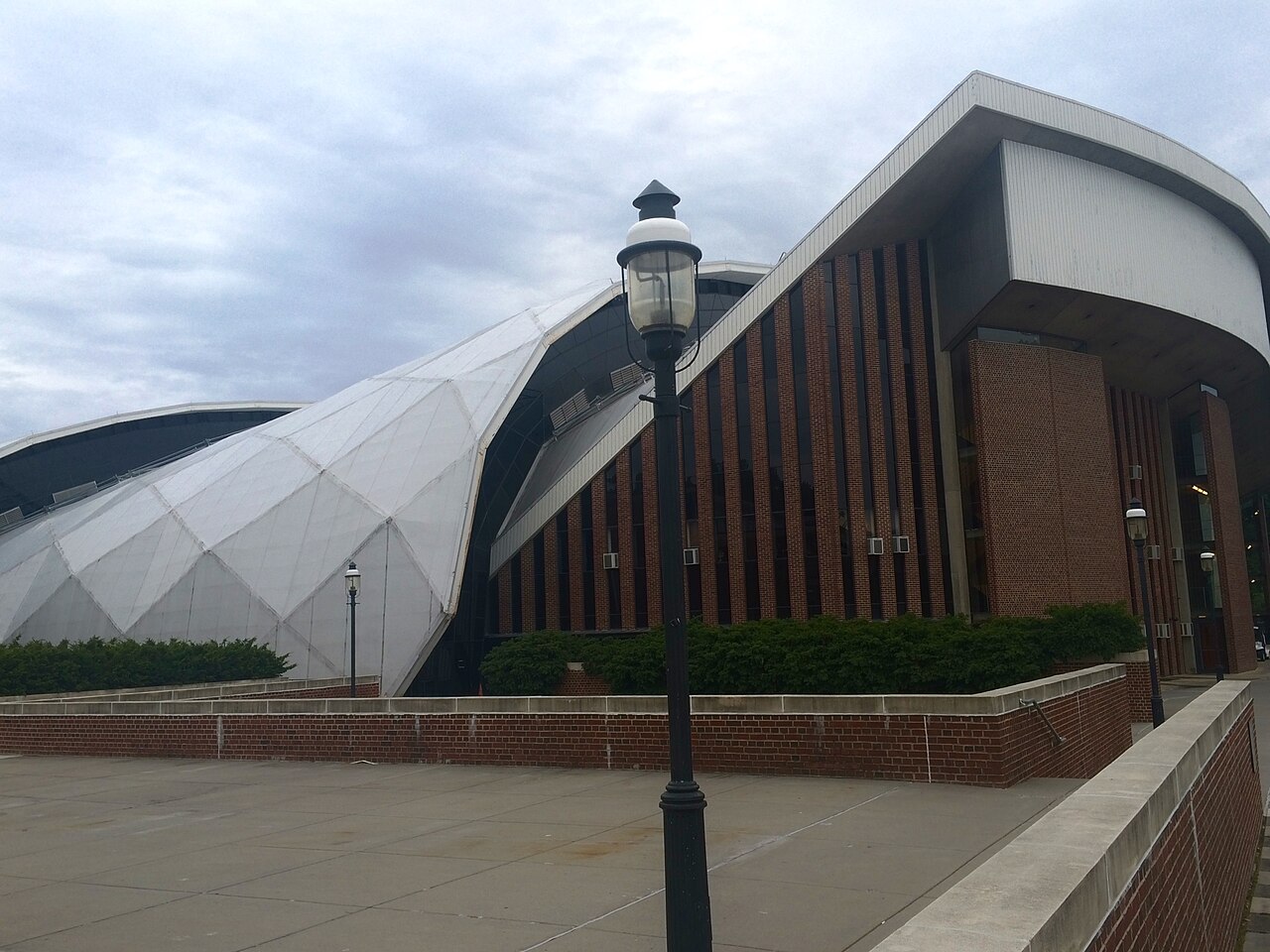
Jadwin Gymnasium — 6,854 seats of orange and black in Princeton, New Jersey — remains one of the great atmospheres in the Ivy League when it's full and the Tigers are rolling. The student section, the history on the walls, the sense that you're watching basketball the way it was meant to be played: Princeton at its best is a cathedral of the sport's fundamentals.
The Henderson era's infrastructure took a hit this spring with the departure of Chris Mongilia, the director of basketball operations, after ten years — a decade that spanned the Sweet 16 run and the program's navigation of the portal and NIL era. Mongilia's exit is a reminder of how much the job has changed even at a place like Princeton, where the student-athlete ideal still means something real.
For 2026-27, the path is straightforward: get Pierce back, let the young core grow up, defend like Princeton teams are supposed to defend, and get back to Ivy Madness. The league runs through the usual suspects — Yale has been the class of the conference, with Brown, Harvard and Penn always dangerous — but the Ivy is a league where experience wins, and Princeton is about to be experienced again.
What defines the Tigers right now is the gap between the standard and the last season — and the belief, rooted in 124 seasons of evidence, that the standard reasserts itself. Princeton basketball has survived every era of the sport by being exactly what it is: smart, skilled, disciplined, and dangerous in March. The 9-20 season was the anomaly. The Sweet 16 is the aspiration. In Princeton, New Jersey, they expect the next chapter to look a lot more like 2023 than 2026.