
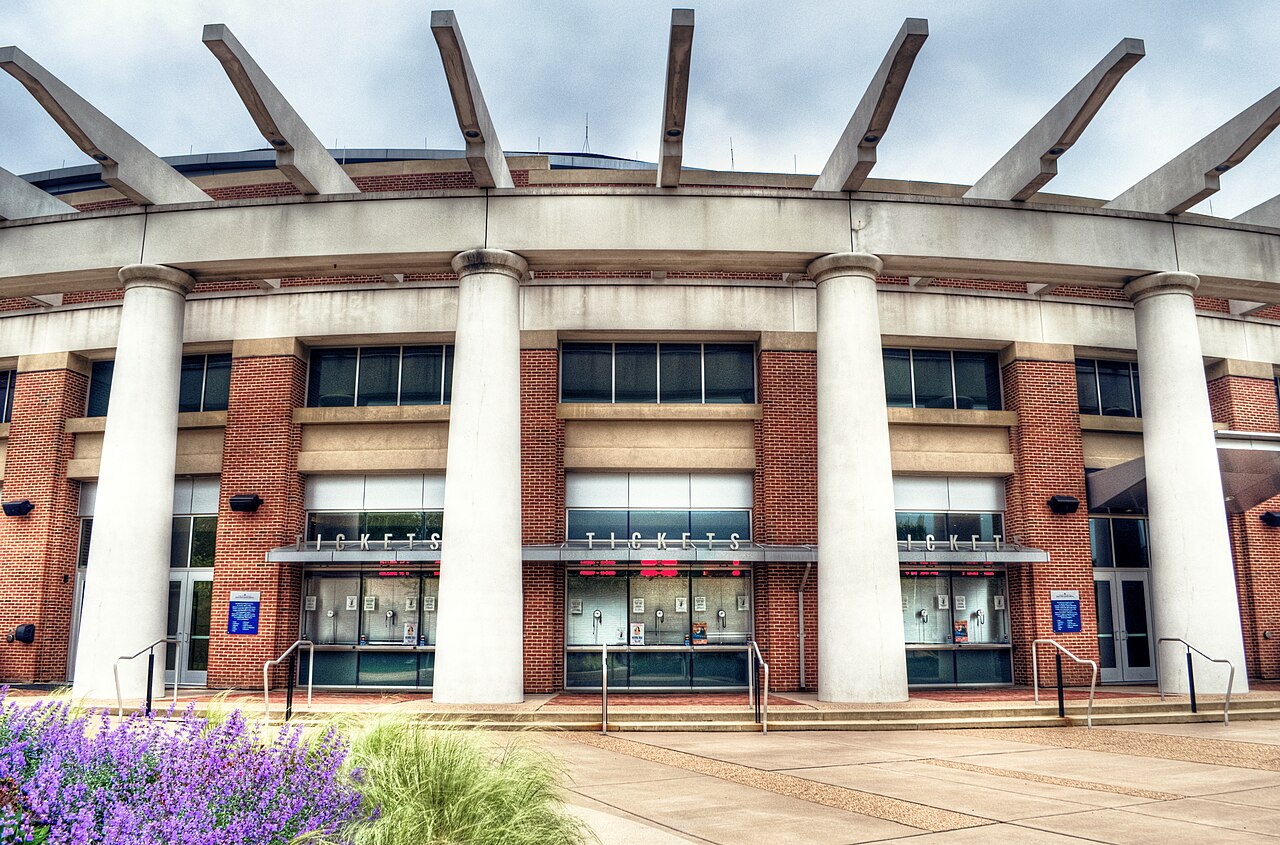
Virginia basketball authored the greatest redemption story in sports history. In 2018, the Cavaliers became the first No. 1 seed ever to lose to a 16-seed — falling to UMBC 74-54 in the most shocking upset ever played. One year later, Virginia cut down the nets: the 2019 national championship, an 85-77 overtime classic over Texas Tech, completing a back-to-back arc from humiliation to glory that no program has ever matched. The banner in the John Paul Jones Arena doesn't just say champions — it says survivors.
That title was the coronation of the Tony Bennett era: the pack-line defense, the methodical brilliance, the 2014-2019 run that made Virginia the ACC's most feared out. Bennett's sudden retirement in October 2024 — days before the season opener — shook the program to its core. Interim coach Ron Sanchez steadied the ship, and then Virginia made the hire that brought the story full circle: Ryan Odom, the man who once beat Virginia as a 16-seed himself at UMBC in 2018, and who had just built VCU into an Atlantic 10 power.
Odom's first season in Charlottesville was a revelation. The 2025-26 Cavaliers won 30 games, playing a faster, deeper, more versatile brand of basketball while keeping the program's defensive soul. The run ended in the NCAA Tournament's second round against Tennessee at Xfinity Mobile Arena — a loss that stung, but one that confirmed Virginia was back at the national level, ahead of schedule.
What makes 2026-27 so tantalizing is what Odom didn't have to rebuild. Virginia retained virtually every scholarship player with remaining eligibility — an almost unheard-of feat in the portal era — and owns the highest percentage of returning scoring in the ACC at 57.4 percent, more than 17 points clear of second-place Duke. All-ACC forward Thijs De Ridder anchors the frontcourt. Seven-footer Johann Grünloh patrols the paint. Sophomore point guard Chance Mallory — now wearing the program's No. 1 jersey after a stellar freshman campaign — runs the offense. Sharpshooting wing Sam Lewis, Elijah Gertrude (the last Tony Bennett-era Cavalier still in orange and blue), Silas Barksdale and Martin Carrere round out a core with genuine chemistry and a 30-win season of scar tissue.
Odom still added selectively, and the additions fit like tailored pieces. UC Irvine transfer Jurian Dixon (15.9 ppg, 39 percent from three) gives the backcourt a proven scorer with two years of eligibility. Arkansas State wing Christian Harmon (12.8 ppg, 2.6 threes a night) brings physicality and volume shooting. Slovenian guard Jan Vide broke out at Loyola Marymount (12.1 ppg, 4.0 apg) as a big downhill playmaker. German forward Nolan Adekunle arrives from the professional ranks shooting 55.2 percent from the field and 42.3 percent from deep — elite catch-and-shoot efficiency, especially from the corners. Kalu Anya, a 6-8 redshirt from St. Louis, adds rebounding and defensive versatility, and 7-1 Nigerian freshman Favour Ibe is the long-term project behind Grünloh.
The formula is Odom's signature: deep, versatile, unselfish — a nine-man rotation where anyone can have the big night. Last season he used the same starting lineup in 35 of 36 games; this year the projected five of Mallory, Lewis, Dixon, De Ridder and Grünloh gives him shooting at every spot and size everywhere else. The pack-line principles remain, but the offense has a modern pulse.
Eight years after UMBC and seven after the title, Virginia finds itself in a familiar position: doubted by no one, feared by many, and built to win in March. The Cavaliers don't rebuild — they reload, and this time they barely had to do either.
The 2019 run itself was a three-act epic: the Elite Eight overtime survival against Purdue, sealed by Mamadi Diakite's buzzer-beating jumper to force the extra period; the Final Four escape against Auburn, won on Kyle Guy's three free throws with 0.6 seconds left; and the title-game overtime win over Texas Tech, with De'Andre Hunter's 27 points carrying the Cavaliers home. John Paul Jones Arena -- 14,000 strong in Charlottesville -- has witnessed all of it, and remains one of the ACC's great home courts: loud, loyal, and steeped in the pack-line tradition that Bennett built and Odom now stewards.
The Bennett pipeline also reshaped how the league recruited: Malcolm Brogdon, Joe Harris, Justin Anderson, Ty Jerome, Kyle Guy and De'Andre Hunter all became NBA players out of the pack-line system, proof that defense-first development could produce complete pros. Odom inherits that credibility along with the culture -- and with the highest returning-scoring percentage in the ACC, he inherits something Bennett's successors rarely had: a roster that already knows how to win together, and a fan base that expects nothing less.


