
Four head coaches in four seasons. Zero players who recorded a statistic the year before. A first-year coach installing a defense-first, walk-it-up identity in the toughest league in America. The 2025–26 West Virginia Mountaineers should have been a mess. Instead, they won 21 games, finished 9–9 in the Big 12, and lifted the College Basketball Crown trophy — the first real evidence that the Ross Hodge era might be something special.
Start with the chaos Hodge inherited. Bob Huggins — the man who built Press Virginia and took the Mountaineers to the 2010 Final Four — resigned in June 2023. Josh Eilert steadied the program as interim coach through a 9–23 season. Darian DeVries arrived, went 19–13 with a postseason trip, and left after a single season for Indiana. When athletic director Wren Baker — who had worked alongside Hodge at North Texas — signed Hodge to a five-year deal on March 26, 2025, the roster was essentially a blank page: not one player who had logged a stat returned.
Hodge knew how to build from nothing. At Paris Junior College he went 83–17 with two conference titles; at Midland College he went 63–7 and finished national runner-up in the NJCAA tournament. As an assistant under Larry Eustachy and Grant McCasland, then as North Texas’s head coach — 46–24 in two seasons, an NIT semifinal in 2025 — he became known for one thing above all: defense. His teams are slow, physical, and suffocating.
The 2025–26 Mountaineers were a Hodge team in every way: the eighth-slowest tempo in the country at 62.9 possessions per game, holding opponents to 40.3 percent shooting and 62.1 points per game. Arizona’s Tommy Lloyd, scouting them in January, put it simply: “They try to get you in a possession game.” In a Big 12 full of track meets, West Virginia made every night a fistfight — and went 9–9 in it.
The roster was a transfer-portal masterclass built around winners. Honor Huff became the leading scorer, shooting 39.5 percent from three. Treysen Eaglestaff, the North Dakota transfer with real scoring pop, went 6-of-9 from deep in a January win at Arizona State. Harlan Obioha — the 7-foot, 265-pound center Hodge landed as his first portal commit, choosing WVU over Rutgers, Mississippi State, and Wake Forest — gave the Mountaineers a physical interior presence they hadn’t had in years, shooting 63 percent from the field.
The North Texas connection ran the show: point guard Jasper Floyd, who started all 36 games for the Mean Green’s NIT semifinal team at 9.0 points and 4.0 assists per game, and Brenen Lorient, the reigning American Athletic Conference Sixth Man of the Year at 11.7 points and 4.9 rebounds. Around them, Jackson Fields from Troy, Morris Ugusuk from South Carolina, and freshmen Jayden Forsythe and DJ Thomas filled out a rotation where, as Hodge told CBS’s Jon Rothstein in the preseason, “so many guys have been a part of winning programs and know how to win.”
The Crown gave the season its exclamation point. In the College Basketball Crown — the new postseason tournament — the Mountaineers kept winning when it mattered, closing 21–14 and giving Morgantown its first trophy of the Hodge era. For a program that had cycled through three coaches in three years, it was proof of concept: the system works, the portal plan works, and the culture is real.
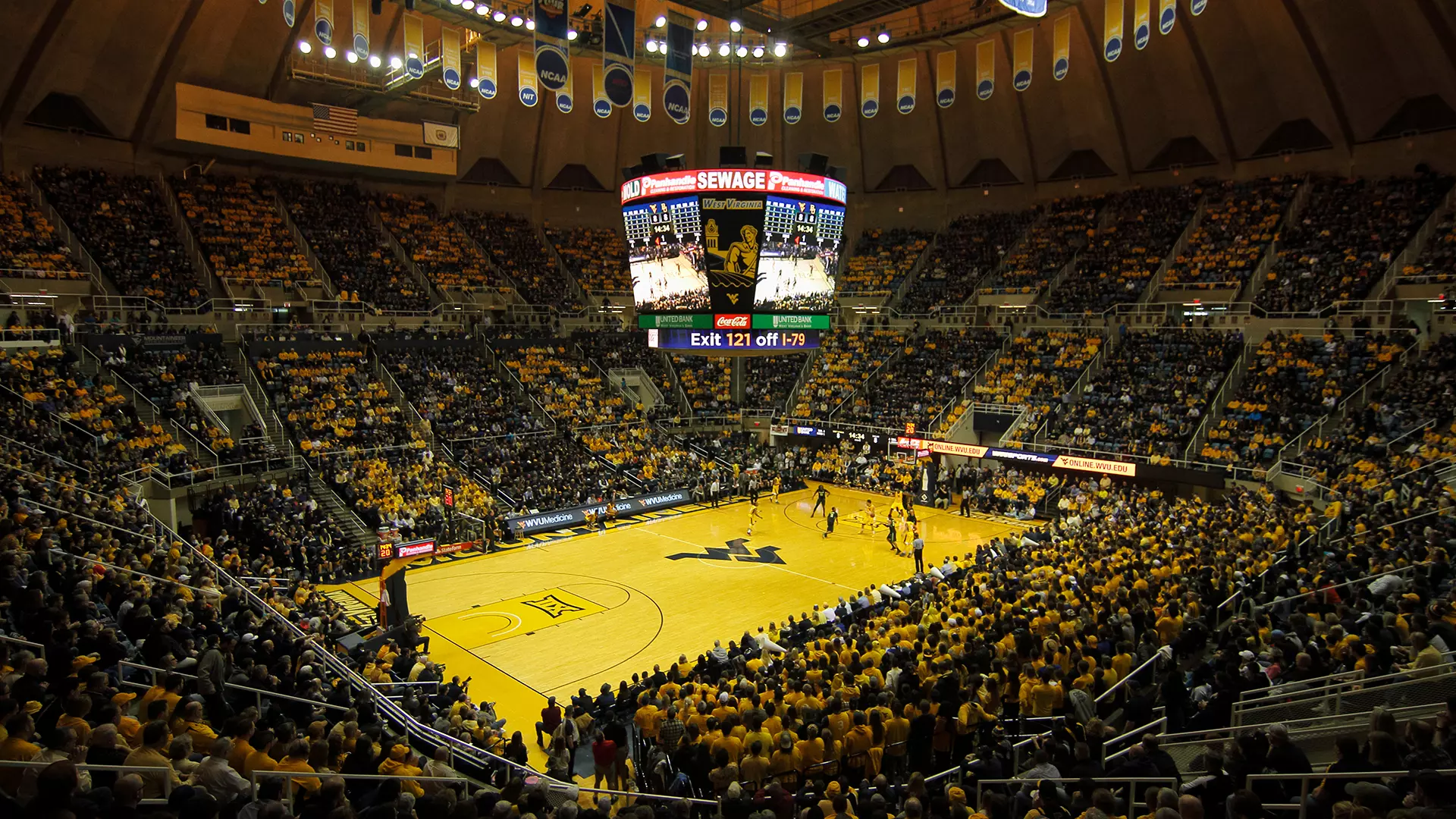
That culture has deep roots. West Virginia basketball dates to 1903, and its mythology was written by Jerry West — the Logo himself — who carried the 1959 team to the national championship game, a 71–70 loss to California that still aches in Morgantown. The Coliseum, opened in 1970 and renamed Hope Coliseum in 2025, has been one of the great home courts in the sport: 14,000 strong, old gold and blue, deafening.
The Huggins era from 2007 to 2023 gave the modern program its identity: Press Virginia, the full-court pressing machine that reached the 2010 Final Four — falling to eventual champion Duke — and became the program’s defining brand of the 2010s. Hodge’s version is different — less pressing, more half-court strangulation — but the throughline is the same: defense as identity, toughness as non-negotiable.
The 2026–27 question is whether year one was the floor. Hodge’s system historically gets better in year two — players learn the rotations, the recruiting compounds, and the portal keeps delivering winners. The Big 12 won’t get easier, but West Virginia finally has something it hasn’t had in years: a coach, a system, and a roster that fit together. In Morgantown, after four years of chaos, stability feels like a superpower.
The Big 12 context makes 21 wins more impressive than it looks on paper. This is a league that plays every night like a prizefight — Kansas, Houston, Arizona, Iowa State, Texas Tech, all hunting. Going 9–9 in that meat grinder with a roster that had never played together, built entirely from the portal in a single spring, is one of the best first-year coaching jobs in recent conference history.
And the culture fit is undeniable. Hodge’s teams defend the way Morgantown likes its basketball played — hard, smart, and mean. The Coliseum crowds that once roared for Press Virginia’s full-court chaos have embraced the half-court strangle instead, because the underlying promise is identical: nobody will outwork West Virginia. After four years of coaching turnover, the Mountaineers finally have an identity again — and an identity, in the Big 12, is everything.


