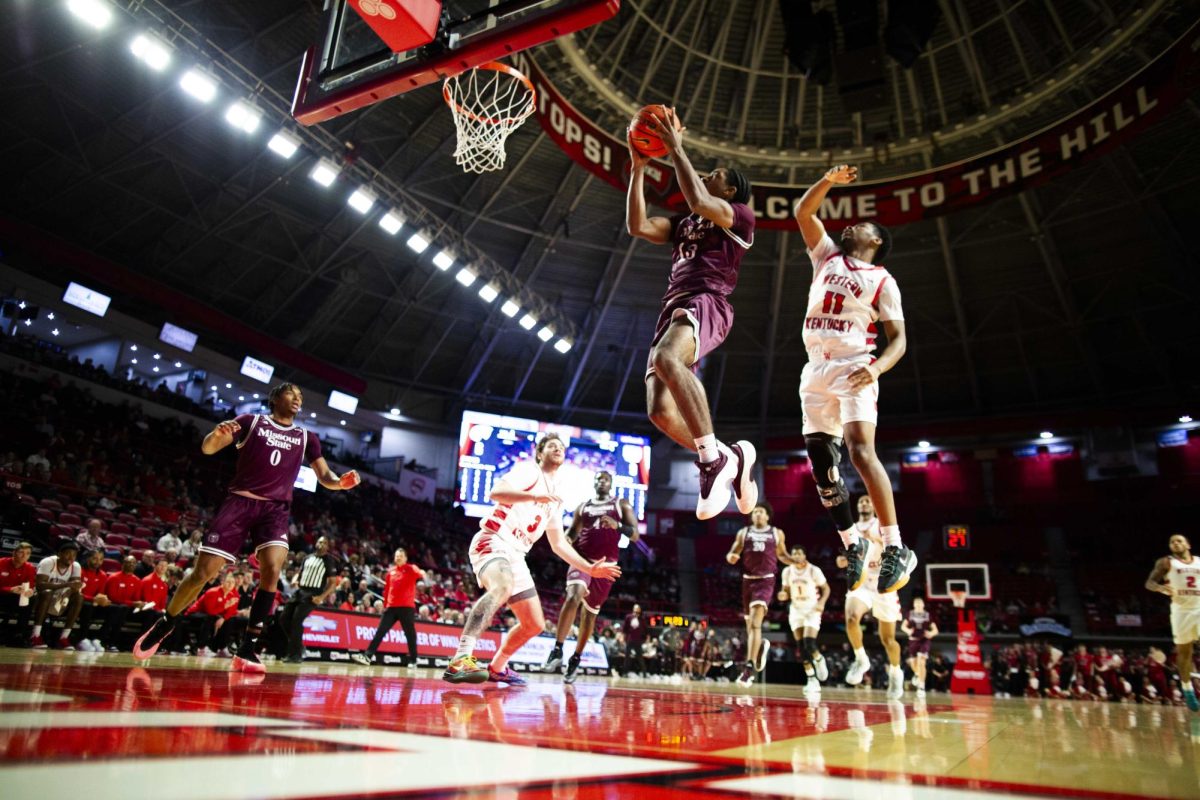
Only 18 programs in Division I men’s basketball history have more wins than Western Kentucky — and that’s the entire list. The Hilltoppers’ 1,919 victories put them among the true bluebloods of the sport’s middle class: a program winning since 1914, a Final Four on the résumé, 34 conference tournament banners and 29 regular-season titles. In Bowling Green, basketball isn’t a winter diversion. It’s the institution’s heartbeat.
Hank Plona is the latest steward of that legacy, and his first two seasons have been a study in Hilltopper basketball’s eternal tension: the standard is enormous, and the present is always measured against it. Plona, promoted in 2024, went 17–15 in year one and 18–14 with an 11–9 Conference USA mark in 2025–26 — 35–29 across two seasons, both ending in first-round exits in the CUSA tournament, the latest a 96–87 loss to Kennesaw State.
The 2025–26 Hilltoppers were one of the most distinctive teams in the country — and not always in ways that showed up in the win column. They finished last in Conference USA in field-goal percentage at 41 percent, a number that cost them repeatedly in close games. But they were relentless where effort lives: 12.8 offensive rebounds per game, among the league’s best; second in CUSA at the free-throw line at 75 percent; top-50 nationally in free throws made and attempted. When the shots didn’t fall, WKU went and got the ball back — and got to the line.
The offense ran through Teagan Moore, and his story is the season’s best one. After missing all of 2024–25 with an injury, Moore returned without missing a step: 18.2 points per game, double figures in 13 of the first 14 games, the team’s leader in scoring and second in assists. The on-off numbers were stark — 79.8 points per game with Moore on the floor, 64.0 in the three games he missed in concussion protocol. He was the offense, full stop.
The future showed up too: freshman Armelo Boone earned four CUSA Freshman of the Week selections, averaging 12.2 points, 5.9 rebounds, 2.0 assists, and 1.6 steals — a two-way wing who looks like a multi-year cornerstone. Around them, guards Ryan Myers and Terrion Murdix gave the backcourt depth and a defensive edge.
To understand what WKU is chasing, you go back. The 1971 team reached the Final Four — later vacated by the NCAA, a complicated footnote on a brilliant season — behind Jim McDaniels and Clem Haskins. The Sweet Sixteens span six decades: 1940, 1960, 1962, 1966, 1978, 1993, 2008. The 2008 team, with Courtney Lee, won in the NCAA tournament and took the program to the brink of the Elite Eight. The 2024 team won the CUSA tournament and returned the Hilltoppers to the Big Dance.
The coaching lineage is a roll call: John Oldham built the modern program; Gene Keady passed through on his way to Purdue; Clem Haskins returned as a hero; Ralph Willard, Dennis Felton, Ken McDonald, Ray Harper, Rick Stansbury — who recruited at a high-major level for seven seasons — and Steve Lutz, who delivered the 2024 league title, each added layers. Plona’s task is to restore the part of the legacy that matters most in Bowling Green: winning in March.
The setting is part of the magic. E.A. Diddle Arena — 7,326 seats named for the legendary coach who won 759 games at WKU — sits on the hill 232 feet above the Barren River that gives the Hilltoppers their name. And then there’s Big Red: the furry red blob created by student Ralph Carey in 1979 to embody the spirit of the student body, now one of the most beloved mascots in college sports. A night at Diddle, with Big Red bouncing and the red-and-white roaring, is one of the great mid-major atmospheres in America.
The 2026–27 outlook hinges on the obvious: shoot it better, keep the identity. If the Hilltoppers pair their offensive-rebounding, free-throw machine with even league-average shooting, they’re a top-four CUSA team with March upside. Moore’s health, Boone’s sophomore leap, and Plona’s third-year roster construction will decide whether this is the year the standard reasserts itself. In Bowling Green, 18–14 is never the goal. The goal is banners — and there are 63 of them hanging already, waiting for company.
The 2026–27 math is simple: the Hilltoppers were 12–4 at E.A. Diddle Arena last season and 5–7 everywhere else. Protecting home court while stealing a few on the road is the formula — and with Moore leading the offense, Boone ascending, and Plona’s system now in its third year, the pieces are in place for the leap Bowling Green expects. The standard at WKU isn’t 18–14. It’s banners.
The 2024 Conference USA tournament title — Steve Lutz’s team cutting down the nets and returning WKU to the NCAA tournament — is the recent proof that the formula still works in Bowling Green: defend, rebound, get hot in March. Plona was on that staff’s sideline before the promotion, and his roster-building has followed the same blueprint — length, toughness, and guards who can get to the line when the offense stalls.