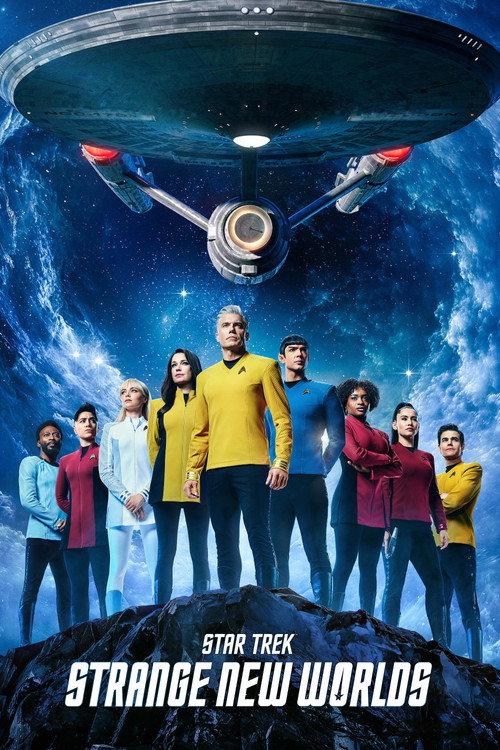
Star Trek: Strange New Worlds
Follow Captain Christopher Pike, Science Officer Spock and Number One in the years before Captain Kirk boarded the U.S.S. Enterprise, as they explore new worlds around the galaxy.
Before Kirk, there was Pike. Strange New Worlds follows Captain Christopher Pike, Science Officer Spock, and Number One in the years before Kirk boarded the U.S.S. Enterprise, as they explore new worlds around the galaxy. And in doing so, it did something nobody had managed in years: it remembered what Star Trek was actually about. Not the lore. Not the timeline. The optimism — the radical, unfashionable belief that the future is worth exploring.
What works is the format, which turned out to be the whole argument. Episodic storytelling — strange new worlds, new civilizations, a different tone every week — is not nostalgia; it is the show's thesis about what science fiction is for. Pike as captain is the other masterstroke: a leader defined by kindness and haunted by knowledge of his own fate, which gives every warm scene an undertow. And the young Spock, caught between logic and feeling, finally gets the room to be a character instead of an icon.
What does not always work is the prequel problem, which no amount of craft fully dissolves. We know where these people end up; the show has to earn surprise inside inevitability. It mostly does — by making the journey matter more than the destination — but there are episodes where the canon does the heavy lifting and the drama coasts. The 7.9 rating reflects a show that is beloved more than it is flawless, and honestly, that is the healthier thing to be.
Who is it for? Everyone who drifted away from modern Trek and everyone who never left. It is the rare franchise entry that works as an on-ramp: you need no homework, no timeline, no prior allegiance — just a willingness to believe that people can be better. Lapsed fans will feel the old magic; new viewers will wonder what took them so long.
Culturally, this is the show that ended the 'is Trek dead' discourse. For years the franchise chased darkness, serialization, and prestige-TV homework; Strange New Worlds proved the future it was selling all along was hope, delivered weekly. Its cultural footprint is bigger than its rating — it changed the conversation about what the franchise is for. In an era of bleak science fiction, here is a show that looks at the stars and smiles. That is not naive. That is the point.
The ensemble is the other reason the show works. Anson Mount’s Pike is the great corrective to a decade of tortured TV captains — a leader whose defining trait is decency, made tragic by the one thing he can’t outrun: he has seen his own future, a disfigured fate in a delta-ray accident he knows is coming, and he commands anyway. Ethan Peck’s Spock finally gets to be a person instead of a monument, caught between Vulcan logic and very human feeling, most sharply in his doomed, lovely entanglement with Nurse Chapel (Jess Bush). Rebecca Romijn gives Number One — Una Chin-Riley — steel and warmth in equal measure, and the reveal of her Illyrian heritage is the rare secret-identity twist that deepens a character instead of cheapening her. Around them: Celia Rose Gooding’s young Uhura, finding her voice literally and figuratively; Christina Chong’s La’an Noonien-Singh, carrying the weight of the Khan bloodline and the show’s best standalone hour (a time-travel two-hander with Paul Wesley’s Kirk); Babs Olusanmokun’s Dr. M’Benga, hiding a warrior’s past; Melissa Navia’s Ortegas, the pilot with the fastest mouth on the ship; Martin Quinn’s baby-faced Scotty; Carol Kane’s gloriously weird engineer Pelia; and Melanie Scrofano’s Captain Batel, giving Pike something to lose.
The seasons read like a love letter to the original series’ playbook — a different genre every week, and proud of it. Season one (2022) gave us first contact gone sideways (“Strange New Worlds”), a comet with a consciousness (“Children of the Comet”), a Gorn horror episode (“Memento Mori”), a body-swap comedy (“Spock Amok”), a full-cast fantasy detour (“The Elysian Kingdom”), and a finale — “A Quality of Mercy” — that showed Pike the future where he escapes his fate and proved to him, and us, that the price of changing it is a war. Season two (2023) went bigger and weirder: “Those Old Scientists,” the animated-to-live-action Lower Decks crossover that should not have worked and absolutely did; “Subspace Rhapsody,” the first musical episode in franchise history, which used its songs to detonate the season’s romantic subplots instead of pausing them; “Under the Cloak of War,” a brutal Klingon-war reckoning for M’Benga; and “Hegemony,” a Gorn cliffhanger that left the crew — and the audience — hanging. Season three arrived in 2025 and kept the genre-hopping mandate, with the showrunners promising surprises rather than formulas.
Behind it: created by Akiva Goldsman, Alex Kurtzman, and Jenny Lumet, run by Goldsman and Henry Alonso Myers, and made for Paramount+ with a feature-film effects budget that it actually puts on screen. The reception was about as close to unanimous as genre TV gets — a 98% Rotten Tomatoes score, critics falling over each other to declare the franchise healed, and an audience that includes both lifers and people who had never watched an episode of Star Trek in their lives. The spin-off logic is instructive: Pike, Spock, and Number One were introduced in Discovery’s second season, and the fan response was so overwhelming that Paramount essentially had no choice but to build them a show. This is the rare case of the audience being right.
And here’s the thing the think pieces keep circling without quite landing: Strange New Worlds didn’t save Star Trek by being nostalgic. It saved it by being confident. The episodic format isn’t a retreat from prestige TV — it’s a flex, a show so sure of its characters that it can drop them into a comedy, a horror story, a musical, and a war drama in consecutive weeks and trust you to follow. In an era when every franchise is terrified of letting an episode just be an episode, here’s one that treats “strange new worlds” as a weekly promise and keeps it. The optimism isn’t the aesthetic. It’s the argument — and for the first time in a long time, the franchise is winning it.