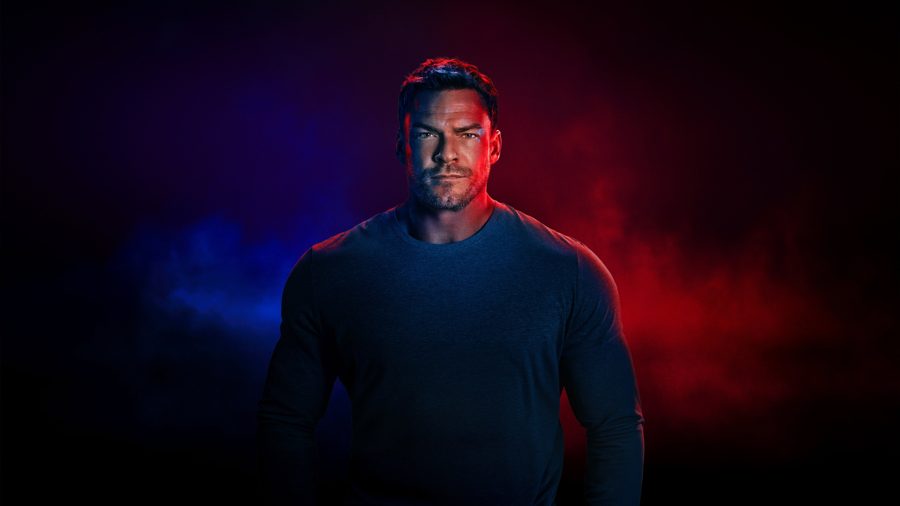
Reacher (2022)
Jack Reacher, a veteran military police investigator, has just recently entered civilian life. Reacher is a drifter, carrying no phone and the barest of essentials as he travels the country and explores the nation he once served.
Vivian’s take
No phone. No baggage — literally. A drifter the size of a doorframe wanders into a small town, and the town regrets it. Reacher is the platonic ideal of dad TV, and its greatness lies in the fact that it knows exactly what it is and has never once apologized for it.
01The Hook
No phone. No baggage — literally. A drifter the size of a doorframe wanders into a small town, and the town regrets it. Reacher is the platonic ideal of dad TV, and its greatness lies in the fact that it knows exactly what it is and has never once apologized for it.
The formula is airtight: drifter arrives, corruption surfaces, Reacher dismantles it with his hands and his considerable brain. It is the western reskinned for the interstate era — the stranger rides in, the stranger sets things right, the stranger rides on. Genres do not get purer than this.
02The Deep Cut
What works is conviction. The show respects the procedural bones of its source material — Reacher is a military police investigator, and the series lets him actually investigate, deducing his way through conspiracies with a veteran’s patience — and it stages action with a blunt, unfussy physicality that feels like a rebuke to a decade of weightless CGI brawling. When Reacher hits someone, the show makes sure you feel the invoice.
What does not work is surprise, by design. Airtight can mean predictable; the pleasures here are ritual pleasures, and rituals do not shock. You will never watch Reacher wondering what kind of show it is trying to be. The 8.1 is the score of an audience that considers that a promise, not a limitation — and they are right, as far as it goes.
Who it is for: everyone who ever said “they don’t make ’em like they used to” — they do, it is this — and anyone who believes competence is the most underrated special effect in television.
03Cultural Context
Reacher is the flagship of streaming’s great discovery: the vast, underserved audience that wants clarity, competence, and a hero who solves problems instead of quipping through them. It is not prestige TV, and that is precisely its power — it is better at being what it is than most prestige TV is at being what it claims.
It also represents the revenge of the straightforward adaptation. After years of reimaginings that sanded the edges off beloved properties, Reacher’s fidelity — to the size, the silence, the method — plays like a statement of principles. The drifter with no phone turned out to be the most connected show on television.
04The Ledger
The show’s other masterstroke is structural: one book per season, no filler, no mythology creep. Season one adapts Killing Floor — Lee Child’s 1997 debut — across eight episodes released February 4, 2022: Reacher drifts into Margrave, Georgia, gets arrested for a murder he didn’t commit, and dismantles a counterfeiting conspiracy with Officer Roscoe Conklin (Willa Fitzgerald) and his old Army colleague Frances Neagley (Maria Sten). Season two takes the eleventh novel, Bad Luck and Trouble, and goes weekly from December 15, 2023 to January 19, 2024: members of Reacher’s old 110th MP Special Investigators unit are being murdered, and the survivors — Karla Dixon (Serinda Swan), David O’Donnell (Shaun Sipos) — reunite to find out why. Season three adapts the seventh book, Persuader (premiered February 20, 2025), sending Reacher undercover into a criminal empire, with Anthony Michael Hall as the season’s heavy. Season four — Gone Tomorrow, the thirteenth novel — was ordered in October 2024 before season three even aired, and a Neagley spin-off with Sten is on the way. That’s the confidence of a show that knows its engine works.
And the engine is Alan Ritchson, who understood the assignment better than anyone had a right to expect. In the books, Reacher is 6-foot-5 and 250 pounds of coiled menace — a physical fact the two Tom Cruise films (2012’s Jack Reacher, from One Shot, and 2016’s Never Go Back) had to work around, to the eternal grumbling of the readership. Ritchson — late of Smallville, Blue Mountain State, and Titans — is the rare case of casting as apology and correction: the size is real, the stillness is real, and the show lets him do the quietest thing on television, which is think. Developed by Nick Santora, it holds a ~96% critics’ score on Rotten Tomatoes, and season three became Prime Video’s biggest returning series to date — the dad-TV juggernaut as an actual, measurable phenomenon.
Verdict: B+. The most honest show on television — a formula executed with total conviction, and proof that knowing exactly what you are is a kind of genius.