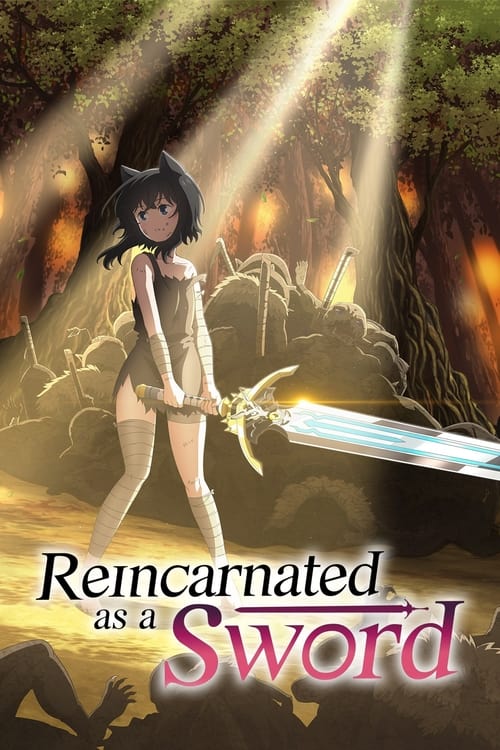
Reincarnated as a Sword
Reincarnated as a sentient weapon with memories of his past life, but not his name, a magical sword saves a young beastgirl from a life of slavery. Fran, the cat-eared girl, becomes his wielder, and wants only to grow stronger, while the sword wants to know why he is here. Together, the strange duo's journey has only just begun!
Vivian's Take
Let's address the logline, because the logline is doing a lot: a man dies, wakes up reincarnated as a sentient magical sword with his memories but not his name, and gets picked up by Fran — a young cat-eared beastgirl escaping slavery who wants only to grow stronger. Together they set off on a journey. This is isekai at its most gloriously unhinged, the genre folding in on itself until the protagonist isn't even a person anymore. And yet — and yet — Reincarnated as a Sword turns out to be one of the warmest, most functional action-fantasy series of its wave. The gimmick is a dare. The show accepts it.
The deep cut
What works is the relationship — and the show is wise enough to know it's the only thing that matters. Teacher (called Shishou, or Master, in the Japanese) is a sentient magical sword with a past life he can't fully remember: a man from our world who died and woke up as a blade stuck in the ground in the middle of a monster-infested nowhere, unable to move on his own, surviving by telekinetically dragging himself around and absorbing the magic crystals of the monsters he kills. It's a premise that sounds like a joke the light-novel industry told itself — and in a sense it was: Yuu Tanaka's original web novel, published on Shōsetsuka ni Narō in 2015 before Gentosha picked it up as a light novel in 2016 with illustrations by LLO, arrived at the exact moment isekai was eating itself, when "reincarnated as a vending machine," "reincarnated as a slime," and "reincarnated as a spider" had already proven that the genre's engine was no longer the fantasy world but the gimmick.
The miracle is that the gimmick becomes a person. Teacher's immobility is the show's secret weapon: he is powerful — absurdly, escalatingly powerful, able to level up by devouring crystals — and completely dependent on someone else to carry him. Enter Fran, a young Black Cat beastkin who finds him while enslaved, being transported in chains to be sold. Fran is the show's other masterstroke: quiet, stoic, ferociously determined, a child who has lost her parents and watched her tribe — the Black Cats, looked down on by every other beastkin clan — treated as lesser. Her dream is evolution itself: to become strong enough that no one can ever chain her again, and to restore honor to her people. When she pulls Teacher from the earth and he chooses her as his wielder, the contract they form is the emotional core of everything that follows. He gives her strength, skills, and tactical counsel from the hilt; she gives him legs, purpose, and the one thing a sword can't forge for itself — a family.
The anime adaptation, produced by studio C2C and directed by Shinji Ishihira, premiered October 5, 2022, running twelve episodes and streaming internationally on HIDIVE. It understood the assignment: keep the action crisp, keep the power fantasy satisfying, and never let the spectacle drown the duo. Ai Kakuma voices Fran with a flat, wounded steadiness that makes the girl's rare smiles land like hammer blows; Shinichiro Miki — one of anime's great veteran voices — gives Teacher warmth and dry humor without ever letting you forget he's a weapon learning to be a parent. The first season follows their rise through the adventurer ranks, Fran's liberation from slavery, and the slow revelation that the world around them — its gods, its dungeons, its politics of beastkin and human — is more layered than the standard isekai backdrop.
What doesn't work is the premise's own ceiling. "Man becomes sword" is a joke the show has to keep justifying as a drama, and the memory-loss mystery — who was he, why here — dangles longer than it should. The power scaling occasionally tips into the genre's familiar problem: when your protagonist can absorb his way past every obstacle, tension has to come from elsewhere, and the show leans on Fran's emotional stakes to supply it. It mostly works, because Fran's stakes are real: every fight is about her dignity, her tribe, her future.
Who it's for: isekai completionists, action-fantasy fans, anyone who wants their power fantasy with an actual emotional core. If the premise made you laugh, the show will make you stay.
Where it sits
Reincarnated as a Sword is peak late-stage isekai absurdity — the genre got so comfortable that "what if the protagonist is a weapon" became a viable pitch, and the miracle is that it works. It belongs to the wave of object-protagonist isekai that turned the genre's power fantasy inside out: the fantasy isn't being the strongest hero, it's being useful to someone you love. The show also rides the larger anime trend of the found-family action series, where the party matters more than the plot. Fran and her sword are one of the genre's better odd couples, and their dynamic — mentor and student, weapon and wielder, father and daughter in everything but name — gives the series a dramatic engine most of its peers lack.
And the story isn't over. After a four-year wait, the second season premiered September 30, 2026 on HIDIVE, with C2C returning and a new key visual promising a dungeon arc stacked with powerful monsters and new regions to explore. For a series that began as a web-novel joke about a sword in the dirt, that's a remarkable second act — proof that sincerity, executed well, outlasts novelty every time.
The verdict
A ridiculous premise executed with surprising sincerity. The sword-and-girl duo carries everything — the action is fun, the growth is real, and the show never forgets that the gimmick is just the door. What's inside is a found-family story about a girl who refuses to be chained and the blade that chose to be her strength.
The verdict: B+ — The absurd premise is just the door; inside is a genuinely warm sword-and-girl adventure with real dramatic engine.