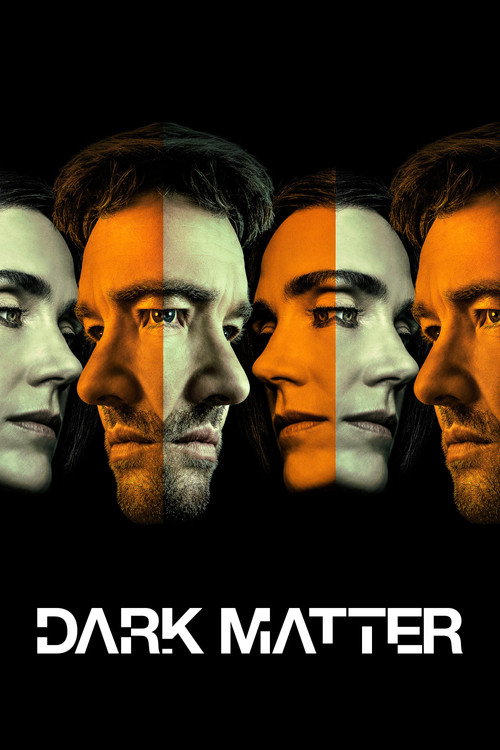
Dark Matter
Jason Dessen is abducted into an alternate version of his life. To get back to his real family, he embarks on a harrowing journey to save them from the most terrifying foe imaginable: himself.
The multiverse is Hollywood's favorite punching bag, and Dark Matter walks in anyway with the one version of it that actually hurts: what if the life you did not choose was the better one? Jason Dessen is abducted into an alternate version of his own life, and his journey back to his real family forces him to face the most terrifying foe imaginable — himself. Strip away the quantum mechanics and this is the oldest story there is: the road not taken, with teeth.
What works is the discipline. Where most multiverse stories drown in branching timelines and easter eggs, this one stays stubbornly personal. One man, one choice, one family. The science fiction is the delivery mechanism for a midlife crisis with infinite stakes — every alternate Jason is a referendum on the compromises the real one made. That focus is what keeps the concept from collapsing into gimmickry, and it is why the show lands emotionally even when the physics gets hand-wavy.
What does not fully work is the middle stretch, where the premise's own rules start doing the heavy lifting. Multiverse stories have a structural curse: the more versions of a character you meet, the less any single version matters. The show fights this with real craft, but there are passages where the plot is clearly buying time between revelations. And the final act has to answer a question the genre almost never answers well — why this life, and not the better one? — without flinching.
Who is it for? Viewers who want their science fiction to start with the heart instead of the hardware. If you like your speculative drama built around a marriage and a family rather than a fleet and a war, this is your lane. It is also the perfect entry point for multiverse skeptics: proof that the concept still has one great story left in it, as long as somebody remembers it is about people.
Culturally, Dark Matter arrives at the tail end of a decade of multiverse fatigue — the era when every franchise decided infinity was a plot device. Its trick is restraint. While the blockbusters were stacking universes, this show asked the smaller, harder question: what does it cost to be happy with the life you have? A 7.8 audience rating suggests viewers met it exactly where it was aiming — not a phenomenon, but a keeper.
Dark Matter: the multiverse story that finally has a pulse

The premise
Jason Dessen is a physics professor in Chicago with a comfortable marriage, a teenage son, and a nagging question he has spent fifteen years not asking: what if he had made the other choice? One night, walking home from celebrating his wife's birthday, he is abducted at gunpoint, knocked unconscious, and wakes up in a version of his life where he never had the family at all — a world in which he became the celebrated physicist he might have been, and the Dessens simply do not exist. The machine that did it is called the Box, a quantum device that sends the traveler into the landscape of lives they could have lived. Getting home means walking through an infinite corridor of alternate selves, each one a referendum on the choices the real Jason made — and none of them are going to sit quietly by while he takes his pick.
The series is adapted by author Blake Crouch from his own 2016 novel, one of the defining sci-fi bestsellers of the last decade, and it hews closely to the book's emotional core: the abduction is not really the subject; the marriage is. The show's central insight is that a multiverse story only matters if the universe the hero is fighting for is the one the audience believes in. So Dark Matter builds its credibility the unglamorous way — Jason and Daniela's marriage is written like a real one, with real history, real resentment, and real love, before the multiverse is allowed to start tearing at it. When the physics gets strange, the relationship holds the center.
Cast and characters
The show is anchored by Joel Edgerton, who plays Jason Dessen across multiple versions of the character — and who also serves as an executive producer on the series. The role is a pressure cooker: Edgerton has to make the audience track which Jason is which across parallel timelines, sometimes within a single scene, without ever losing the character's desperation to get back to one specific woman and one specific kid. Opposite him is Jennifer Connelly as Daniela Dessen, a part that asks for something subtler than it looks — she is the fixed point the entire show revolves around, and Connelly makes Daniela's grief and growing paranoia the season's emotional spine.
The supporting ensemble deepens the world on both sides of the split: Alice Braga plays Amanda Lucas, the physicist who travels with one of the Jasons and becomes his lifeline through the corridor of worlds; Jimmi Simpson is Ryan Holder, Jason's friend and the man who, in one timeline, ends up with the life Jason gave up; Dayo Okeniyi plays Leighton Vance, the brilliant and ambitious figure behind the Box itself; Oakes Fegley is Charlie, the Dessen son whose existence is the show's true stake; and Amanda Brugel rounds out the cast as Blair Caplan, with an expanding role in the second season's larger chessboard.
Seasons
The first season premiered on Apple TV+ on May 8, 2024, with nine episodes that adapt Crouch's novel across its full arc — from the abduction, through the journey into the Box, to the devastating final chapters in which dozens of alternate Jasons converge on the Dessens' world, each one certain he belongs in it. Apple moved fast: the series was renewed for a second season within four weeks of the premiere, an unusually confident bet for a prestige sci-fi drama.
Season two premiered on August 28, 2026, and it is where the show becomes genuinely new territory. With ten episodes running weekly through October 30, 2026, the second season picks up with the Dessen family settling into a quiet life in a world that finally seems safe — until the unimaginable forces them to run once again. Jason's obsession with the Box deepens, Daniela's growing paranoia threatens to tear their fragile stability apart, Amanda and Ryan join forces in a desperate attempt to find their way home, Blair is determined to stop Jason, and Leighton relentlessly chases his grand vision of creating a perfect world. The show has also grown beyond the screen: this season launched "Dark Matter: The Official Podcast," hosted by Crouch himself and executive producer Jacquelyn Ben-Zekry, digging into the show's biggest moments and the real science of the multiverse. Crouch has said the adaptation was planned as a three-season arc — so the road not taken still has road ahead.
Critical reception
Critics met the first season with broadly positive reviews, and the fast renewal told the story of Apple's confidence. Reviewers singled out the two leads: Edgerton's performance was praised for carrying the show's enormous tonal range — domestic drama, thriller, high-concept science fiction — often within a single episode, while Connelly's work was flagged as the series' emotional ballast. The consensus held that the show's discipline set it apart from the era's multiverse fatigue: where franchise blockbusters treated infinity as a plot device, Dark Matter treated it as a question about commitment.
Season two's reception has continued in that vein, with reviewers noting that the show has grown more interesting the further it gets from the book — it has moved past a straightforward chase story into something more interested in identity, grief, ambition, and family. The fifth episode, "Love and Be Loved," which tells the story of a Jason who lost his family, has drawn particular attention. Season one carries a strong audience rating around 7.8, and the season-two conversation suggests the show is landing exactly where it aims: not a phenomenon, but a keeper.
Cultural impact
Dark Matter arrived at the tail end of a decade of multiverse fatigue — the era when every franchise decided infinity was a narrative shortcut — and its trick was restraint. While the blockbusters stacked universes, this show asked the smaller, harder question: what does it cost to be happy with the life you have? The 2016 novel celebrated its 10th anniversary this year, and the series has driven a new wave of readers back to Crouch's books, alongside his companion thrillers like Recursion and Wayward Pines. More importantly, the show demonstrated something the genre keeps forgetting: the multiverse is not interesting because of the physics. It is interesting because of the regrets. Dark Matter is the rare entry that remembers which part the audience actually feels — and it is built to make them feel it for three full seasons.