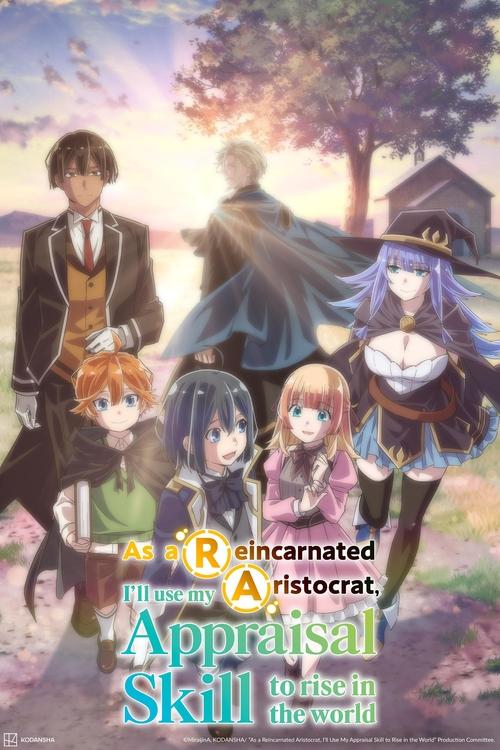
As a Reincarnated Aristocrat, I'll Use My Appraisal Skill to Rise in the World (2024)
Ars Louvent is reincarnated in another world as the young son of a minor noble who owns a small domain. Ars is not particularly strong or intelligent, but he was born with the Appraisal Skill that's able to see others' abilities and statuses. He uses his skill to find the best hidden talents in the world to make their small, weak domain into the best.

The premise
Ars Louvent dies an ordinary salaryman and wakes up as the infant son of a minor noble in a fantasy empire — with one extraordinary gift. He is not strong. He is not brilliant. He cannot swing a sword or cast a spell. What he can do is appraise: with a glance, he can see any person's abilities, aptitudes and hidden potential laid out like a stat sheet. In a world where talent is buried under bad luck — the orphan with a general's mind, the servant girl with a once-in-a-generation gift for magic — that is the most powerful skill of all. Ars inherits a small, weak domain from his father, and instead of training harder than everyone else (the isekai standard), he does something much rarer: he becomes a recruiter. One by one, he finds the extraordinary people the world overlooked — Ritsu Muses, the first and most loyal of his retainers; Charlotte Wraith, a magical prodigy; Rosell Kischa, a tactical mind in a child's body; Mireille Grangeon; Fam — and builds a household, then a domain, then a power, out of other people's potential. The fantasy here is not the hero's journey. It is the manager's.
The cast
The Japanese voice cast is stacked with talent that mirrors the show's theme. Natsumi Fujiwara voices Ars with earnest warmth — a kid who knows he is out of his depth and compensates by trusting his people. Taito Ban is Ritsu Muses, the orphan whose appraisal numbers are off the charts and whose devotion to Ars becomes the emotional backbone of the series. Narumi Kaho voices Charlotte Wraith, Miho Okasaki is Rosell Kischa, Kana Hanazawa brings her signature steel-and-silk to Licia Plaid, Hitomi Nabatame plays Mireille Grangeon, and Haruka Tomatsu voices Fam. Hiroki Touchi doubles as Ars's father Raven and the narration, and Yuki Tanaka voices Selena Bandol. Season three adds Sumire Morohoshi as Musia Trick and Hinata Tadokoro as Zaht Brozd, new pieces on Ars's ever-growing board.
Season by season
The anime adaptation was announced in May 2023 and arrived in three waves. Season one (April 7 – June 23, 2024, 12 episodes) covers Ars's childhood and his first great recruitment drive — finding Ritsu, Charlotte and Rosell, and proving that a weak domain with the right people can punch far above its weight. Season two (September 29 – December 22, 2024, 12 episodes) raises the stakes as the Louvent domain gets drawn into the empire's larger conflicts, and Ars's talent for finding talent gets tested against enemies who have armies of their own. Season three premiered September 27, 2026, with a notable behind-the-scenes change: animation production moved from Studio Mother, which handled the first two seasons, to GeyeG Pictures, with the rest of the staff — director Takao Kato, series composer Yasuhiro Nakanishi, character designer Yuko Yahiro, composer Kujira Yumemi — returning.
Behind the camera
The series adapts the light novels by Miraijin A (illustrated by jimmy), which began as a web novel that racked up more than 30 million views; the manga adaptation by Natsumi Inoue won the U-Next Prize at the 2021 Next Manga Awards, and by September 2024 the franchise had five million copies in circulation. The anime aired on the brand-new Agaru Anime programming block across the JNN affiliates, with Crunchyroll streaming it worldwide outside East Asia. The music has been a quiet highlight across all three seasons: "Blue Days" by TRUE opened season one with Kana Hanazawa's "Finally" closing it; season two brought PassCode's "Skillawake" and Yuki Tanaka's "Familiar"; season three opens with Rico Sasaki's "Still Water" and closes with Akuruyo no Hitsuji's "Hibi o Koete."
Reception
The show holds a 7.4 audience score on TMDB — the mark of a cozy, well-liked genre piece rather than a phenomenon. Anime News Network's Richard Eisenbeis found the first episodes a "simple and predictable pattern" but noted that the story gets more interesting as Ars's weakness becomes clear, concluding that the anime blends comedy and heartwarming moments around the hope that one good leader can bring peace and prosperity to a failing empire. That is the show's thesis in a sentence: it is not really about the Appraisal Skill, it is about what a decent person does with an unfair advantage — share it.
Cultural context
As a Reincarnated Aristocrat belongs to the quieter wing of the isekai boom: the management fantasy. Where the genre's power fantasies hand their heroes swords and spells, this one hands its hero a spreadsheet — and argues, episode after episode, that the real cheat code is leadership. In a decade of anime about being the strongest, there is something genuinely refreshing about a protagonist whose whole deal is making other people strong. It is the cozy isekai: less adrenaline, more warmth, and a domain-building slow burn that rewards patience.
Grade: B. The cozy isekai — less power fantasy, more management sim, and all the better for it.
Vivian's take
In a genre built on overpowered heroes, this one's superpower is HR. A reincarnated noble who can't fight and isn't a genius — but can spot talent nobody else sees.
01The hook
The isekai genre — ordinary person wakes up in a fantasy world — has become an industrial complex, churning out power fantasies at a rate the audience can barely track. Most of them hand their hero a cheat skill and a sword. This one hands its hero an eye for talent. Ars Louvent isn't strong or brilliant; he's a recruiter. His Appraisal Skill lets him see people's abilities and statuses, and his grand plan is glorified team-building: find the overlooked, assemble the undervalued, turn a weak little domain into the best one around.
It sounds like a spreadsheet. It plays like a warm bath. That's the show's whole gambit — and its whole charm.
02The deep cut
What works: the low stakes are the point. Where most isekai escalate toward godhood, this one finds its drama in logistics — the right person in the right role, the overlooked kid who just needed someone to see them. There's something genuinely moving about a fantasy that treats recognition as the magic. The ensemble grows on you precisely because the show bothers to make each recruit a person rather than a stat block.
What doesn't: if you come for action, you'll be checking your watch. The conflicts are administrative, the victories are organizational, and the pacing is aggressively gentle — comfort food that occasionally forgets to add salt. The appraisal gimmick also does a lot of narrative heavy lifting; skeptics will call it a cheat code for character development. Who it's for: isekai fans who are tired of power levels, cozy-watch devotees, and anyone who ever got more satisfaction from building the perfect team than winning the fight.
03Cultural context
This show is interesting as a symptom. The isekai boom started as escapism for the powerless — wake up special — and it's maturing into something stranger: escapism for the competent. The fantasy isn't being the strongest anymore; it's being the one who sees clearly in a world that misjudges everyone. In an era of optimization culture and talent discourse, a hero whose power is literally evaluation feels less like fantasy than like the world's most relaxing LinkedIn daydream. The genre will keep making sword gods. This one made something rarer: a hero whose victory condition is other people thriving.
Verdict: B. The cozy isekai — less power fantasy, more management sim, and better for it.