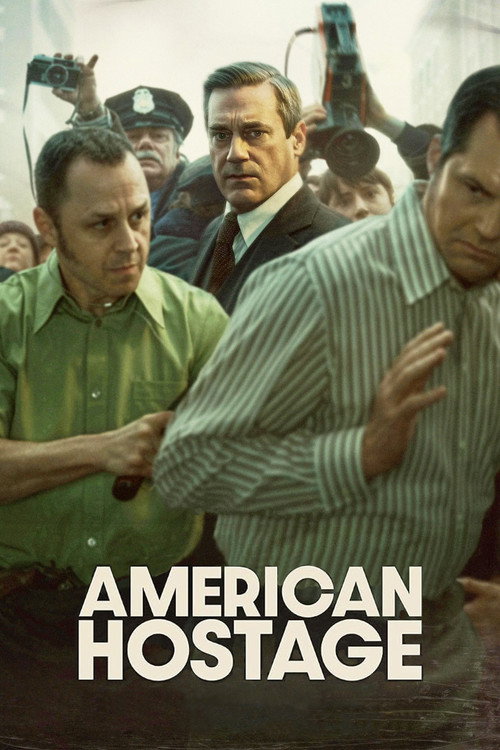
American Hostage (2026)
A psychological thriller anthology series focusing on a different hostage case every season.
Vivian's Take
Strong bones and a smart format, still waiting on the season that truly breaks it open.
One hostage case per season, no filler, no mercy. American Hostage is a psychological thriller anthology that treats each season as a self-contained pressure cooker — a different crisis, a different set of people, the same ticking clock. In a streaming landscape drowning in eight-episode mysteries that should have been movies, the anthology format is the show's smartest decision: every season gets a clean slate and a full tank of dread.

The true story
On a freezing February day in 1977, a man named Tony Kiritsis walked into the Indianapolis office of mortgage broker Richard "Dick" Hall carrying a sawed-off 12-gauge shotgun — and a contraption. The gun was rigged with a wire running from its trigger, around Hall's neck, to Kiritsis's own wrist: the "dead man's wire." Anybody who shot Kiritsis would kill Hall too; any sudden move by either man would do it. Kiritsis, convinced Hall's family business had cheated him on a property deal and foreclosed him into ruin, marched his hostage out onto the winter streets — and then made his one demand. He didn't want money. He wanted an audience. Specifically, he wanted Fred Heckman, the trusted news director of local radio station WIBC, to interview him live on the air. What followed was a 63-hour standoff that Indianapolis listened to in real time, with Heckman caught between journalism and negotiation, between the biggest story of his career and the possibility of broadcasting a man's violent death live.
The cast
Jon Hamm plays Heckman — and he had already played him once before, voicing the character in the original American Hostage podcast the series is based on. Hamm's Heckman is a classic newsman in the Walter Cronkite mold, more interested in substance than sensation, and the performance is a slow pressure-cooker: restrained, increasingly frayed, revealing things about himself he would otherwise keep private. Giovanni Ribisi plays Kiritsis with a volatility that the audience gradually, uncomfortably, starts to understand — "delightfully unhinged" in the early notices, announcing himself as a madman on his first call into WIBC and then revealing the wounded grievance underneath. Kristoffer Polaha, who gained 25 pounds for the role, plays hostage Dick Hall — a man who, in real life, didn't talk about the ordeal for forty years. Mireille Enos plays Heckman's wife and William Jackson Harper his producer, the two people who have to live with what the crisis is doing to the man in the middle of it.
Season one
The eight-episode first season premiered on MGM+ on September 20, 2026 — with the first two episodes, "My Town Indy" and "McMahon, Martinis & Madness," dropping together — after a preview screening in the Primetime program at the 2026 Toronto International Film Festival. New episodes air Sundays at 9 p.m. ET, with the season running through "Break the Bank" on November 1. The season stays close to the three-way relationship at the heart of the crisis: the captor, the hostage, and the voice on the radio. It is a three-day story told at a near-real-time simmer, and the show understands that the most dramatic room is not the one with the shotgun — it is the WIBC studio, where a newsman has to decide, on air, how much of a desperate man's grievance the public gets to hear.
Behind the camera
The series was created by Shawn Ryan (The Shield, The Night Agent) and Eileen Myers, with Ryan taking over as creative lead from the podcast's original creator Shawn Christensen. Adam Arkin and Nina Lopez-Corrado direct, and the executive producer roster includes Ryan, Myers, Hamm himself, Connie Tavel, Marney Hochman, Sharon Hoffman, Christensen, Gabriel Mason, Arkin, Lopez-Corrado and Jen Roskind, with MiddKid Productions, Criminal Content, Furious Agreement Productions and Sony Pictures Television producing. It was shot in Winnipeg, standing in for 1977 Indianapolis, with a period grain that the show wears well — this is a series about radio, and it sounds as carefully built as it looks.
Reception
The early notices have been strong — critics have singled out Hamm's restrained, pressurized performance and Ribisi's live-wire turn, and the show is being talked about as one of the fall's more grounded true-crime dramas. The TMDB audience score sits at 6.6, which reads about right for a show this deliberately paced: viewers who want a slow-burn character study of a media crisis are finding it; viewers who wanted a tactical-team thriller are not. The anthology format is the long game — one hostage case per season, a clean slate each time, cast for the story instead of the franchise.
Cultural context
American Hostage lands at the intersection of two obsessions: the true-crime boom, which has trained a generation to mainline real-life crisis narratives, and the growing prestige-TV fascination with media ethics — the reporter as participant, not observer. The Kiritsis standoff was one of the first hostage crises to unfold as live media spectacle, and the show is really about that hinge moment: the instant a newsman realizes he is no longer covering the story, he is the story. There is also a wry undercurrent the writers clearly enjoy — the absurdity of a man who believes his mortgage troubles deserve a broadcast audience is played straight, and the straightness is what makes it land.
Verdict: C+ — Strong bones and a smart format, still waiting on the season that truly breaks it open.