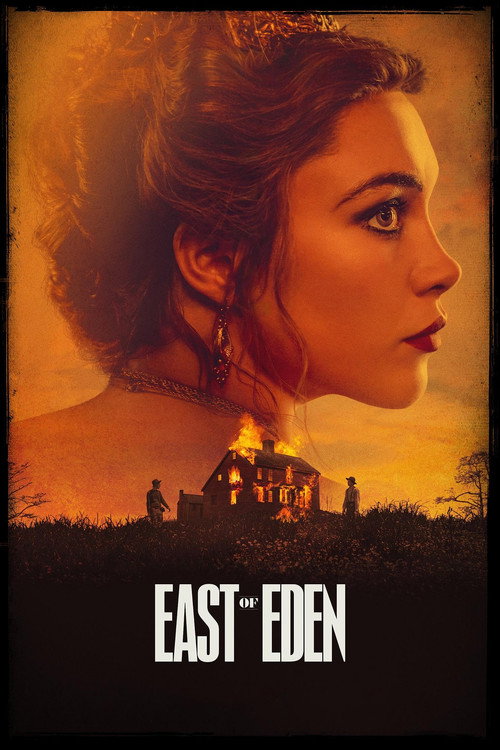
In the early 1900s, a fiercely independent woman drives a rift between two brothers, igniting a saga that unfolds across two generations.
TMDB rating: 8.0/10 · Genres: Drama
B+
Vivian’s gradeThe rare literary adaptation that trusts the novel and the audience in equal measure.
About the series
Previously’s series guide: the facts on East of Eden — the premise, the cast, the season, and why it matters.
Florence Pugh as Cathy Ames in Netflix’s seven-episode adaptation of Steinbeck’s East of Eden.
The show
East of Eden is a seven-episode Netflix limited series — all seven episodes dropped globally on October 1, 2026. A historical drama rated TV-MA with episodes running 51 to 68 minutes, it was created and written by Zoe Kazan, who co-showruns with Jeb Stuart; the scripts were written with Alexander Chee. Garth Davis (Lion) directs episodes one through four, Laure de Clermont-Tonnerre (Lady Chatterley’s Lover) directs the final three, with music by Laura Karpman. It is produced by Collab Productions, Anonymous Content, and Fifth Season, and filmed in New Zealand, which doubles for California’s Salinas Valley. The red-carpet premiere was held September 30 at The Plaza Hotel in New York City.
The premise
This is the first screen adaptation to take on Steinbeck’s full 1952 novel. The 1955 Elia Kazan film covered only the final act; the series spans the whole saga, from the Civil War through World War I, following the Trask and Hamilton families across two generations: gentle Adam Trask, his volatile brother Charles, Adam’s marriage to the manipulative Cathy Ames, and then Adam’s fraternal twin sons, Caleb and Aron, who compete for their father’s love — a retelling of Cain and Abel. And there is a family story behind the camera: Zoe Kazan is the granddaughter of Elia Kazan, the director of the 1955 film. She is the second person in her own family to tackle the novel. The series recenters Cathy Ames as an antiheroine with her own fierce quest for agency in a world constantly trying to control her, rather than treating her as a stock villain.
Early reviews have been strong and awards-flavored. Variety critic Alison Herman called Pugh and Hoon Lee the beating heart of a rich adaptation; The A.V. Club went further, hailing the series as Pugh’s best performance to date and her Cathy as one of the most alluring characters on recent television; ScreenHub declared her phenomenal in a superbly layered new take. Netflix bills the show as a limited series, so no second season is expected — this is a one-and-done prestige event. As a cultural object it is doing double duty: reviving a mid-century American epic for the streaming age, and completing a family circle seven decades in the making — a granddaughter re-adapting the book her grandfather filmed, this time with the whole novel, and with Cathy’s story finally centered.
Vivian’s take
Our critic Vivian on East of Eden — sharp, unfiltered, and graded.
Some novels are too big for movies and have been waiting a century for television to catch up. East of Eden — the great American novel of fathers, sons, and the war between good and evil — finally gets the long-form treatment it was always owed, and the early-1900s saga of two brothers split by a fiercely independent woman plays like prestige TV remembering what it is for.
01The Hook
Some novels are too big for movies and have been waiting a century for television to catch up. East of Eden — the great American novel of fathers, sons, and the war between good and evil — finally gets the long-form treatment it was always owed, and the early-1900s saga of two brothers split by a fiercely independent woman plays like prestige TV remembering what it is for.
The two-generation structure is the whole argument for doing this as a series: this is a story about inheritance — of land, of sin, of the choice to be better than your blood — and inheritance needs time to curdle. Television’s slow burn is not a compromise here; it is the point.
02The Deep Cut
What works is the recentering. For decades the culture read this story’s central woman as its villain; putting her fierce independence at the ignition point of the saga — rather than as a problem to be solved — lets the adaptation argue with its own source material in the most productive way. The brother-rift at the center gives every episode a wound that will not close.
What does not work is reverence, the silent killer of literary adaptations. There are passages where you can feel the show genuflecting instead of dramatizing, where a scene exists because it is in the book rather than because the episode needs it. An 8.0 is a strong score, but it is the score of a show people respect slightly more than they devour.
Who it is for: viewers who still believe television can be literature, and readers who have strong opinions about timshel and are ready to fight about them again. Everyone else should know this is a slow fire, not an explosion — it rewards patience with interest.
03Cultural Context
This is the classy end of the IP era. While studios strip-mine every franchise with a logo, the prestige-literary adaptation has quietly become television’s most reliable flex — proof that the canon still moves units when treated as living text rather than homework. East of Eden has haunted Hollywood since the 1955 film; the small screen finally gives it room to breathe.
It also arrives as the culture renegotiates its classics in public. A saga about two brothers, a formidable woman, and whether anyone can escape their father’s shadow is not a period piece in 2026; it is a family group chat with better costumes.
Verdict: B+. Faithful without being embalmed — the rare literary adaptation that trusts both the novel and the audience, even when it occasionally mistakes respect for drama.
The full story
The Previously desk on East of Eden — premise, cast, season guide, reception, and why this one matters.
The premise
John Steinbeck’s sprawling American tragedy has returned to television — and this time, the monster gets the microphone. Netflix’s East of Eden, a seven-episode limited series that dropped in full on October 1, 2026, is a fresh interpretation of Steinbeck’s 1952 masterpiece that puts Florence Pugh’s Cathy Ames closer to the center of the story than any previous adaptation dared. Where Steinbeck described Cathy in monstrous terms, creator Zoe Kazan’s reframing asks viewers to question tidy definitions of good and evil — preserving the Trask family’s multigenerational battle with love, jealousy, inheritance, and morality while giving literature’s most notorious femme fatale a history that contextualizes, without excusing, her terrible choices.
The series spans from the late 19th century to World War I, following Cathy’s entanglement with half-brothers Adam and Charles Trask in Connecticut, and then her sons — the fraternal twins Caleb and Aron — in California’s Salinas Valley. Netflix’s official synopsis begins the story in the early 1900s, with Cathy’s presence driving a rift between the brothers and setting the family’s multi-generational saga in motion. Kazan made decisive structural choices to fit seven hours: large portions of the Hamilton family material were trimmed, while the backstory of Lee — the Trask family’s Chinese-American servant, played by Hoon Lee — was substantially expanded. The through-line is the novel’s enduring tension between free will and inherited trauma: whether anyone, Cathy included, gets to choose who they become.
Pugh, who also serves as an executive producer, has described the role as an opportunity to understand her character’s decision-making and have empathy for her rather than reduce her to her worst actions — “one of the things I’ve taken pride in is being able to give unlikable characters another chance.” Kazan’s most provocative choice is portraying an early incident in Cathy’s childhood as abuse; Pugh saw that history as the key to the performance: “I can’t imagine for a moment after that abuse that she’ll ever be the same person again.”
The cast
There was never a Plan B for the lead. “I didn’t have a backup,” Kazan told Netflix of casting Pugh. “Truly, and I don’t use this word lightly, I think she’s a genius.” Opposite her, Christopher Abbott plays Adam Trask and Mike Faist — the West Side Story and Challengers breakout — plays Charles Trask, the brothers whose lives become entangled with Cathy. Hoon Lee plays Lee in what reviewers have singled out as a quietly powerful turn; Tracy Letts plays Cyrus Trask, Martha Plimpton plays Faye, and Ciarán Hinds plays Samuel Hamilton. The younger generation is played by Joseph Zada as Cal and Joe Anders as Aron.
Behind the camera, the credits read like a statement of intent. Kazan — the acclaimed actor and playwright (Ruby Sparks, Wildlife) making her biggest swing as a television creator — wrote the adaptation with Alexander Chee and co-showruns with Jeb Stuart. Garth Davis (Lion, Top of the Lake) directed the first four episodes; Laure de Clermont-Tonnerre (The Mustang) directed the final three. Laura Karpman composed the score; Stuart Dryburgh and Sam Chiplin shot it; the production companies are Collab Productions, Anonymous Content, and Fifth Season. Episodes run 51 to 68 minutes — this is maximalist prestige television, unhurried by design.
The shoot itself became part of the story: reviewers uniformly applauded the production design and cinematography evoking the Salinas Valley, while noting the production was moved to New Zealand as a cost and logistics choice. If you can’t tell the difference on screen, the gamble paid off.
The season
All seven episodes arrived together on October 1, 2026 — a full-season drop, Netflix’s vote of confidence that this is a devour-in-a-weekend proposition rather than a slow conversation. As a limited series, it is conceived as a complete, self-contained telling: no second season is planned or expected, which gives the ending the freedom to land as Steinbeck intended, reframed through Cathy’s eyes.
The adaptation’s relationship to its most famous predecessor is worth stating plainly, because Kazan’s lineage makes it irresistible: her grandfather, Elia Kazan, directed the legendary 1955 film version that launched James Dean into the stratosphere — a film that famously prioritized the sweating fraternal rivalry between Cal and Aron and largely sidelined the matriarchal darkness at the story’s heart. This is not a sequel to that film. It is a new adaptation of the novel, and in a very real sense a correction of it: the granddaughter flipping her grandfather’s script with surgical precision, seventy-one years later.
Critical reception
The reviews, arriving with the October 1 drop, have been admiring with reservations — the classic profile of an ambitious literary adaptation. Florence Pugh’s performance is uniformly cited as the series’ anchor: a chilling, high-voltage turn that carries the reframing on its back. Hoon Lee’s expanded Lee earns consistent praise as the show’s quiet soul, and the supporting cast — Letts, Plimpton, Hinds — has been widely applauded. The craft categories are near-unanimous wins: production design and cinematography that make New Zealand pass for the Salinas Valley without a flicker of doubt.
The recurring drawbacks are structural: slow pacing, heavy melodrama, and the compression inherent in squeezing Steinbeck’s 600-page multigenerational epic into seven hours. And the reframing itself has renewed the oldest debate in adaptation — fidelity to Steinbeck versus modern interpretation of his themes. Does giving Cathy a traumatic backstory illuminate the novel’s questions about free will and inherited evil, or soften a character Steinbeck meant to be unknowable? The show wants you to argue about it; critics have obliged. It holds an 8.0 on TMDB, and FandomWire ranked it first among October’s Netflix arrivals on the strength of the cast and Kazan’s personal connection to the material.
Cultural impact
East of Eden lands at the intersection of three live cultural currents: the streaming era’s appetite for literary prestige (the limited series as the new serious novel), the ongoing reexamination of “monstrous women” in classic literature through a modern lens, and Hollywood’s fascination with legacy as text — a Kazan adapting the book her grandfather filmed. The premiere itself became a pop-cultural moment, with Pugh arriving in what fans dubbed “Garden of Eden glamour,” a custom ethereal gown in sharp ironic contrast to the cold architect of chaos she plays on screen.
Whether the reframing ultimately persuades the Steinbeck faithful, the series has already done the thing adaptations are supposed to do: sent viewers back to the book, arguing. In the streaming age, where prestige dramas evaporate in a week, a show that restarts a seventy-year-old argument about good, evil, and whether anyone gets to choose — that’s the rarest kind of hit. Timshel, as Lee would say: thou mayest.