The full story
The premise
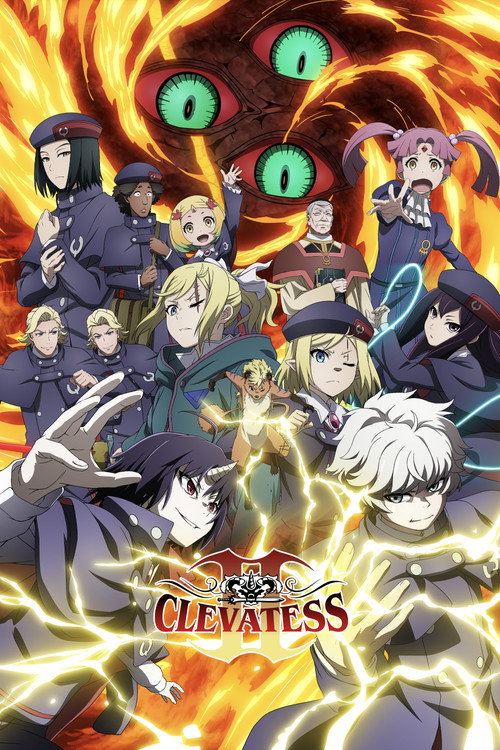
Clevatess is a dark fantasy anime with one of the genre’s great elevator pitches: one of the Lords of Dark Beasts, Clevatess’s reign shatters when he revives a hero he personally slew — and then adopts an orphaned humanoid baby, the last hope to save a dying world. Now bound together, what fate awaits this unlikely trio? Crunchyroll’s official logline barely hints at the show’s real subject, which is the blurred line between monster and savior, and whether redemption is something you earn or something thrust upon you.
The anime is based on the action-fantasy manga by Yuji Iwahara, the creator of King of Thorn, which launched on the LINE Manga platform in August 2020 before Kadokawa began serializing it under the Alive+ label on ComicWalker in July 2024. Twelve digital volumes had been released by March 2026, with Yen Press licensing the series in English. Iwahara’s original is praised for its intricate world-building — humanity clinging to survival amid powerful dark beasts and shifting moral landscapes — and the anime adaptation has been faithful to that vision: detailed monster and creature designs, medieval-inspired environments with heavy atmosphere, cinematic battle choreography, and a tone that stays serious even when the premise invites absurdity.
The cast and crew
The voice cast is led by Yuichi Nakamura as the titular Clevatess, Haruka Shiraishi as Alicia, Mutsumi Tamura as Clen, and Saya Aizawa as Luna, with Tomoyo Kurosawa as the wizard Naie — who received her own character visual ahead of the second season — alongside Tomokazu Seki, Megumi Han, and Tomokazu Sugita in supporting roles. The second season expanded the ensemble significantly: Misaki Kuno as Sarasa, Koutarou Nishiyama as Edison, Akira Sekine as Mirea, and Shirō Sano as Romaine were announced with the new key visual and second promotional video, joined by Shuichiro Umeda as Ray, Yurina Kikuchi as Mary Merry, Tatsumaru Tachibana as Andrew, Ryouta Suzuki as Tiegel, and Hiromu Mineta as Leon.
Behind the scenes, the creative team has been a model of consistency: Kiyotaka Taguchi directs both seasons at studio Lay-duce, with Keigo Koyanagi handling series composition, Soichiro Sako returning as character designer (joined for season two by sub-character designer Natsuko Kondo), and Nobuaki Nobusawa composing the music. The season two ending theme, “Awake Anew,” is performed by MYTH & ROID, the music unit whose dark-fantasy credentials are well established. The adaptation was first announced by Kadokawa in July 2024, and Crunchyroll streams the series in both subtitled and dubbed formats.
The seasons
Season one aired in Summer 2025 — twelve episodes from July 2 to September 2025 — and ended with the announcement of a second season, which Crunchyroll confirmed it would carry. Clevatess II premiered on July 8, 2026, picking up as a direct continuation with most of the principal staff returning, a new setting that broadens the world, and the same serious tone that defined the original. Some viewers noted the change of scenery; most welcomed the chance to explore new parts of the world rather than repeat earlier arcs.
The sequel preserves the visual identity established in the first season — the expressive character animation during emotional scenes, the soundtrack’s balance of large-scale action and quieter dramatic moments — while pushing deeper into the manga’s mythology. For a franchise still in its first decade, the pace is remarkable: manga launch in 2020, anime in 2025, second season in 2026, with the English-language manga edition arriving via Yen Press to catch the wave.
Critical reception
Early reception to the second season has been positive, particularly among fans of the first, with consistent animation quality, strong voice performances, expanded worldbuilding, and character-driven storytelling drawing the most praise. The common thread in viewer response is that Clevatess earns its darkness: this is a series that emphasizes character development alongside large-scale conflict, with a morally gray protagonist whose choices carry genuine consequences rather than genre-mandated edge.
The show has also picked up the kind of comparison that functions as both compliment and burden: ScreenRant has framed it as a potential successor to Berserk in the dark-fantasy anime space — high praise that speaks to the hunger for serious, adult fantasy animation, and a standard the series seems determined to meet on its own terms rather than by imitation.
Cultural impact
Clevatess is a case study in the modern anime pipeline: a LINE Manga webtoon-style launch in 2020, a Kadokawa serialization deal, a swift anime adaptation by a mid-size studio, day-one global streaming on Crunchyroll, and an English print edition timed to the anime’s momentum. It’s the vertical integration of manga-to-anime working exactly as designed — and it arrives as the dark-fantasy boom shows no sign of slowing, with audiences rewarding series that treat the genre as a vehicle for moral complexity rather than just spectacle.
The show’s signature move — making the monster the protagonist and the hero’s corpse the inciting incident — puts it squarely in the lineage of fantasy that asks uncomfortable questions about who the real beasts are. In a genre crowded with chosen ones, a Lord of Dark Beasts raising a baby as the world’s last hope is the kind of inversion that sticks. Two seasons in, Clevatess has established itself as one of the most distinctive dark fantasies of the decade — and Iwahara’s manga still has plenty of story left to tell.
Clevatess
TV Series
One of the Lords of Dark Beasts, Clevatess’s reign shatters when he revives a hero he personally slayed and adopts an orphaned humanoid baby—the last hope to save a dying world. Now bound together, what fate awaits this unlikely trio?
Year 2025
Genres Action, Animation, Sci-fi
TMDB rating ★ 8.0/10 audience score
One of the Lords of the Dark Beasts has had a very bad millennium: the hero Clevatess personally slew gets revived, and now he's stuck adopting an orphaned humanoid baby — the last hope of a dying world. A demon lord, a resurrected enemy, and an infant walk into the apocalypse. At 8.0, this is dark fantasy anime operating at full power.
The hook
One of the Lords of the Dark Beasts has had a very bad millennium: the hero Clevatess personally slew gets revived, and now he's stuck adopting an orphaned humanoid baby — the last hope of a dying world. A demon lord, a resurrected enemy, and an infant walk into the apocalypse. At 8.0, this is dark fantasy anime operating at full power.
The killer-adopts-the-orphan inversion is one of fiction's most reliable engines, and Clevatess straps it to the end of the world. The comedy writes itself — an apex predator doing childcare — but the show is after something richer: what does mercy cost a being built for cruelty, and what does it do to the hero who has to accept protection from his own murderer?
The deep cut
What works is the trio geometry. Three characters who should never share a scene — the beast, the revived hero, the baby who might save everything — bound together by circumstance and forced to negotiate every step. The revived hero's perspective is the show's secret weapon: he remembers dying by Clevatess's hand, and now he has to co-parent the apocalypse with him. That tension never fully resolves, which is exactly right.
The dying world gives every episode a clock. This isn't a quest through a healthy land; it's a journey across something already ending, which lends even the quiet moments a low thrum of dread. The action, when it comes, has the weight of a world with nothing left to lose.
What doesn't: the tonal tightrope is real — cosmic horror plus childcare comedy is a blend that curdles if the measurements are off, and a few episodes wobble. The premise is also stronger than any plot summary can sell, which means the show has to earn its weirdness weekly rather than coasting on it.
Cultural context
Clevatess belongs to anime's villain-redemption era — the ongoing fascination with monsters who have to live with what they've done. It also rides dark fantasy's full mainstream conquest: the genre that used to be a niche is now one of animation's dominant modes, and audiences have developed a real appetite for stories that treat damnation as a character arc rather than a costume.
Who it's for: dark fantasy devotees, anyone who thinks the best found families are the least likely ones, and viewers who want their apocalypses with a pulse. Weird in the best way.
The verdict
Grade: A−. A beast, a baby, and a dead world: the year's most unlikely found family.