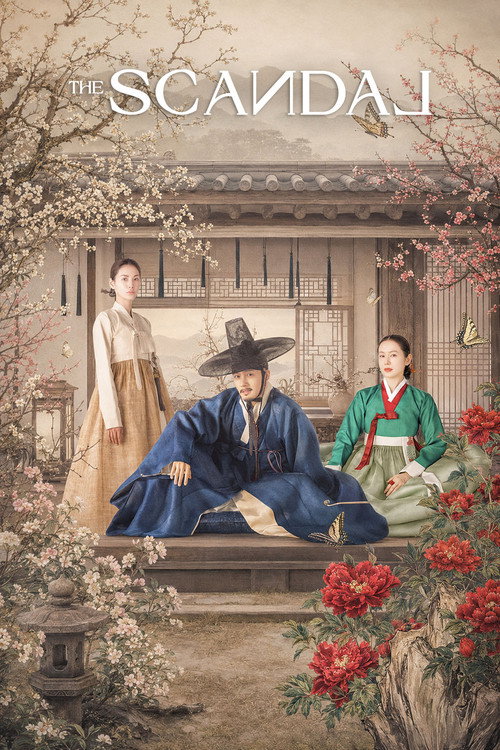
The Scandal (2026)
In Joseon, a secret proposal ignites hidden desires in a gifted noblewoman, a famed lover and an unsuspecting lady caught in their dangerous game.
Network: Netflix (all 8 episodes, Sept 18, 2026) Director: Jung Ji-woo
Starring: Son Ye-jin, Ji Chang-wook, Nana · Based on Untold Scandal (2003) and Les Liaisons dangereuses (1782)
Vivian's Take
Beautiful, simmering, and almost entirely predictable — a handsome genre exercise.
Joseon has never looked this dangerous. The Scandal opens on a secret proposal that lights a fuse between a gifted noblewoman, a famed lover, and an unsuspecting lady caught in their game — palace intrigue with the safety off. In a year when the global appetite for Korean drama shows no signs of slowing, this is the genre doing what it does best: taking a world of ritual and hierarchy and setting a match to it.

The premise
The Scandal (스캔들) is Netflix's eight-episode South Korean period romance, released worldwide on September 18, 2026, with all episodes dropping at once. Set in the rigid social world of the Joseon era, it follows three people caught in a dangerous game of love, lies, and desire. Lady Cho — played by Son Ye-jin, in the role director Jung Ji-woo says she was his only choice for — is a gifted noblewoman whose talents in writing and painting have almost no outlet in a society that gives women very little freedom. She secretly proposes a wager to her cousin Cho Won (Ji Chang-wook), Joseon's most notorious seducer: a seduction game with a target. The target is Hui-yeon (Nana, credited as Im Jin-ah), a young widow who has chosen to remain chaste after her husband's death and wants nothing to do with romance. What begins as an entertaining challenge curdles into something far more complicated and dangerous, as the boundaries between calculated seduction and genuine feeling blur beyond recognition.
The lineage
This is one of the most-adapted stories in literature wearing a hanbok. The spine is Pierre Choderlos de Laclos' 1782 French novel Les Liaisons dangereuses — the Marquise de Merteuil and the Vicomte de Valmont, transplanted from pre-revolutionary Paris to pre-modern Korea. More directly, the series is a television expansion of the 2003 Korean film Untold Scandal, directed by E J-yong and starring Bae Yong-joon, Jeon Do-yeon, and Lee Mi-sook, which drew more than 3.5 million admissions in South Korea and has been lodged in the national memory ever since. Director Jung Ji-woo — known for Happy End (1999) and Eungyo (2012) — has said the series was rebuilt from the original novel rather than remade scene-for-scene from the film, which is the right call: eight hours lets the wager breathe in a way two hours never could. One telling detail: the 2003 film's full Korean title carried the phrase 남녀상열지사 — "words of men and women's mutual delight," a historical insult Joseon scholars used to dismiss love songs as indecent, repurposed as a badge of honor. The series drops it for a cleaner global title, which makes commercial sense and quietly erases the wink.
The production
Netflix commissioned the series and announced it in March 2025 (via Deadline and Variety), with Jung Ji-woo directing and Movie Rock producing. Principal photography ran from March to September 2025. The cast met the press on September 9, 2026, at the JW Marriott Dongdaemun Square in Seoul, nine days before the September 18 premiere at 5 p.m. KST. Son Ye-jin — the Crash Landing on You star — described Lady Cho (originally written as Jo Yoon) as a woman whose independent personality formed long before her era's restrictions could define her, and said the series format let her explore the character's growing complexity in a way a film couldn't. Ji Chang-wook gets a very different kind of period role here: charm and emotional conflict rather than action-hero stoicism, and the director praised his warmth on set. Nana, as the widowed Hui-yeon caught between the rules she's followed and feelings she can't ignore, earned the director's admiration for her work ethic — and she carries the story's hardest job, making virtue dramatically interesting.
What works, what doesn't
The triangle is the engine, and the show knows it. Every glance is currency, every secret is a weapon, and the series is at its best when it lets the tension do the talking instead of the dialogue. The production wears its budget well — the costumes, the court settings, the candlelit interiors are the kind of sumptuous you can feel through the screen, and the more daring atmosphere the press promised is genuinely there. Son Ye-jin, as the reviews have noted, essentially shoulders the series; her Lady Cho is the rare period-drama heroine whose intelligence is the plot rather than the decoration.
What does not work is familiarity. If you have watched more than a handful of palace romances — or any prior version of Dangerous Liaisons, of which there are many — you will recognize the beats before they land. The wager structure is 240 years old and it shows: the seduction, the complication, the reversal, the ruin. Pacing is the other friction point. The middle stretch leans on misunderstandings that a single honest conversation could solve — the genre's oldest sin — and Cho Won's charm occasionally reads as the script telling us he is charming rather than showing it. Hui-yeon, the most interesting moral question in the story, gets the thinnest material in the early episodes, though Nana does a great deal with restraint. But when the show commits to the danger — the moments where you remember that in Joseon, desire is not just scandalous, it is potentially fatal — it genuinely crackles.
Why it matters
The cultural math is simple: period K-drama is one of the most reliable engines in global television. Western audiences who once needed subtitles explained to them now schedule their weeks around release drops, and the Joseon court has become as familiar a setting as the boardroom or the precinct. Netflix's Korean slate is a machine at this point, and The Scandal is the machine doing prestige romance — a classic Western text, a beloved Korean film, and three of the country's biggest stars, aimed squarely at the global audience that made Squid Game and Crash Landing on You phenomena. It does not reinvent the form; it polishes it. For the devoted, that is plenty — eight hours of beautiful people in beautiful clothes playing a dangerous game, executed with total craft. For the curious, it is a handsome, easy entry point into the genre. And for anyone who saw the 2003 film on a rainy afternoon and never forgot it, the invitation is explicit: the cast has said they hope the series pulls in younger viewers who never saw the original, while giving fans of the film a fresh interpretation to argue about. The wager at the center of the story is about whether a game can become real feeling. The wager around the story is whether a 240-year-old plot can still seduce a 2026 audience. On the evidence, it can — just don't expect to be surprised.
Verdict: C+ — Beautiful, simmering, and almost entirely predictable — a handsome genre exercise.