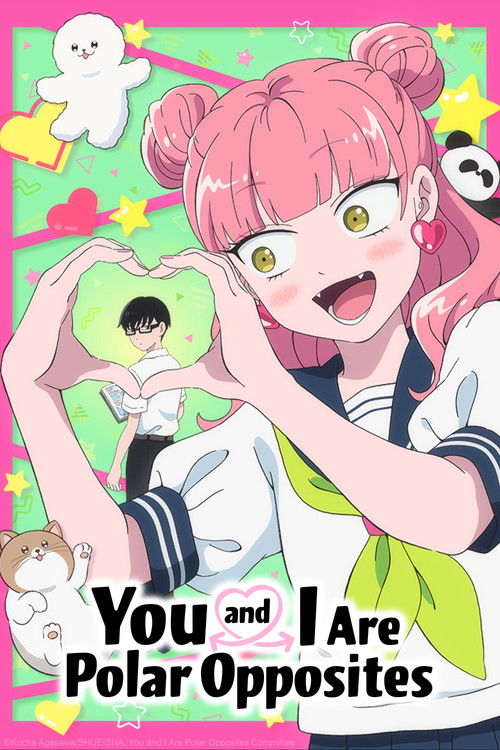
You and I Are Polar Opposites (2026)
Suzuki's a high school girl in love, but the guy she's fallen for is nothing like her! While she's cheerful, outgoing, and always trying to fit in, her classmate Yusuke Tani is stoic, quiet, and doesn't seem to care what people think of him. Will Suzuki be able to overcome her anxieties and ask him out, or will she discover that opposites really don't attract?
Vivian's take
She's sunshine working overtime to fit in. He's a stone wall who couldn't care less. An 8.6 says this opposites-attract anime is doing something right — and two full seasons in 2026 say the industry agrees.

01The hook
The opposites-attract romance is one of anime's favorite machines, and You and I Are Polar Opposites runs it with unusual honesty. Miyu Suzuki is cheerful, outgoing, and quietly exhausted from performing belonging; Yuusuke Tani is stoic, silent, and genuinely indifferent to the audience. She's in love with him. He may not have noticed. The 8.6 audience score — genuinely high in a crowded field — says this isn't just formula. It's formula with feeling.
What elevates it: the show knows the real story isn't the contrast. It's Suzuki's anxiety — the fear that the person she performs isn't the person who deserves to be loved. Tani's bluntness is the mirror she needs: someone who says exactly what he means, which is the one thing her people-pleasing won't let her do.
02The source
The anime adapts Kocha Agasawa's manga Seihantai na Kimi to Boku, which began as a one-shot on Shueisha's Shōnen Jump+ in January 2021, serialized from May 2022 to November 2024 across 65 chapters, and collected into eight volumes with 1.35 million copies in circulation. The manga was a critical darling before a single frame was animated: top ten in the male-readers division of the 2023 Kono Manga ga Sugoi! rankings, Best for Beginners in MyAnimeList's 2024 You Should Read This Manga list, and a nominee for the 16th and 17th Manga Taisho awards. Viz Media licenses it in English; Manga Plus carries it digitally. The anime was announced the week the manga ended — a baton pass, not a revival.
03The production
Studio Lapin Track (Undead Girl Murder Farce, SHOSHIMIN: How to Become Ordinary) animates, a smart match — the studio's bubbly, unfussy style is a natural fit for Agasawa's clean, expressive linework. Takayoshi Nagatomo directs, Teruko Utsumi handles series composition, Miyakomako designs the characters, and the music comes from tofubeats, whose electronic warmth gives the show a distinctly modern pulse. Shochiku organizes production; Crunchyroll licenses it for the West, airing on JNN (MBS, TBS) in Japan.
The voice cast is led by Sayumi Suzushiro as Suzuki and Shogo Sakata as Tani, with Yuna Taniguchi, Konatsu Hirabayashi, Anji Iwata, Miyuri Shimabukuro, Wataru Katoh, Cocoro Omori, and Tomori Kusunoki rounding out the friend group — and the friend group matters here, because the manga's great strength is that the side couples get real arcs, not filler. Season one ran January to March 2026; season two was announced March 29 and aired July 5 to October 4, 2026, completing a 24-episode adaptation of the full manga. The season-two campaign even crossed the Pacific: Anime Expo 2026 hosted a panel, "After Class Hijinks with Suzuki and Tani," at the Peacock Theater on July 3, with Suzushiro and Sakata premiering the season for the audience and performing live dubbing.
04The deep cut
What works: the characterization is specific where the genre is usually generic. Suzuki's people-pleasing isn't a quirk; it's the wound, and the show treats it with a seriousness that gives the comedy weight. Her arc — learning that the performance of belonging is not the same as belonging — is one of the most psychologically accurate things in recent romcom anime. Tani's indifference, meanwhile, reads less as cool-guy posturing and more as its own kind of freedom — the thing she envies. When the comedy comes from that dynamic rather than from gags, it lands twice as hard.
What doesn't: the premise is a slow burn by design, and slow burns test patience — the "will she say it" engine can feel like it's idling if the episodic material doesn't vary. The genre's gravity also pulls toward familiar resolutions; the adaptation's challenge was earning an ending that honors Suzuki's growth rather than just delivering the couple. Two seasons and 24 episodes gave it the room the manga earned, and the finale lands because the show never rushed the interior work.
Who it's for: romcom anime devotees, anyone who was the anxious kid performing confidence, and viewers who like their sweetness with psychological accuracy. If Horimiya was your show, this is your next one — with the volume turned down and the honesty turned up.
05Cultural context
The high-school romcom remains anime's most reliable export because adolescence is the one universal drama — everyone remembers the performance of fitting in. This show's particular resonance comes from naming the performance: Suzuki isn't just shy, she's strategic about belonging, and that's a distinctly modern anxiety in an era of curated selves, read receipts, and social batteries. An 8.6 in a crowded field means it's connecting beyond the genre faithful. The opposites-attract formula is ancient. Doing it with this much emotional honesty — and finishing the whole story in a single year, two seasons, no filler arcs, no movie-ending cop-out — is not. In a landscape of endless seasonal churn, a complete, faithful, 24-episode adaptation of a beloved manga is its own kind of event.
Verdict: A-. The opposites-attract formula, executed with total sincerity — sweet, sharp, and psychologically real.