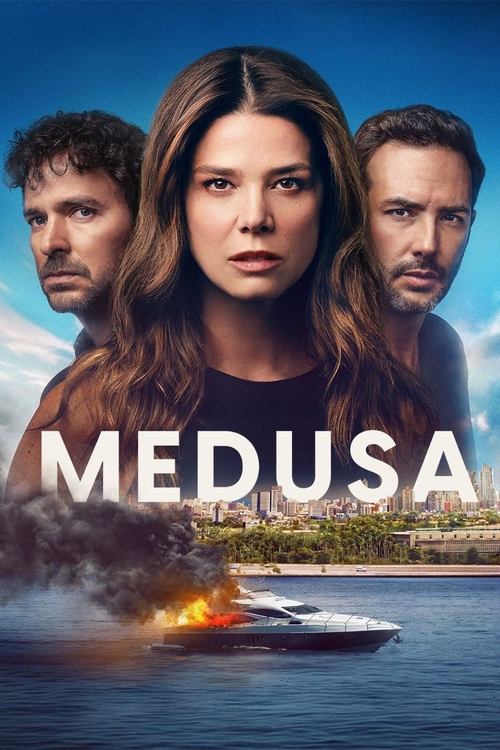
Medusa
Somebody wants to kill CEO Bárbara Hidalgo. Can she find the culprit as her family schemes ruthlessly for control of their Colombian business empire?
The premise. Somebody wants to kill CEO Bárbara Hidalgo. On the very day she is set to take over as chief executive of Medusa, her family's massive conglomerate on Colombia's northern coast, her luxury yacht explodes at sea. Everyone assumes the millionaire drowned. She survives — pulled from the water and saved by a native healer — but the accident steals her memory, and what comes back first is the cold understanding that it was no accident at all. Teaming up with Detective Danger Carmelo, Bárbara sets out to unmask whoever orchestrated the attack, while her ruthless family circles the empire she was supposed to inherit. The title tells you everything: this is a show about a woman surrounded by snakes, and she might be the most dangerous one there.
The cast. Juana Acosta leads as Bárbara Hidalgo, "the most feared woman in Barranquilla" — a biologist-turned-executive whose appointment as CEO detonates every buried rivalry in the Hidalgo dynasty. Acosta (known for Carlos, Anna, La Fianza) plays her with the particular steel the role demands: Bárbara is no innocent. Before the explosion, she had gathered damaging information on nearly everyone in her family and used it as blackmail to secure the CEO chair in the first place. Manolo Cardona plays Detective Danger Carmelo, the investigator who becomes her partner in the hunt — the classic hard-eyed detective dropped into a world where the clues wear designer clothes. Sebastián Martínez (Rosario Tijeras, La Pola) is Esteban, Bárbara's husband and Medusa's purchasing director, which puts him at the exact intersection of love and suspicion. Around them: Mabel Moreno as Úrsula, Carlos Torres, Diego Trujillo as Damián, Adriana Arango, Laura Archbold, Jacqueline Arenal, Luis Fernando Hoyos, and Juanita Molina — a deep Colombian ensemble built for a twelve-episode war of attrition.
The season. Twelve episodes, all released at once on Netflix on March 5, 2025. Created and written by Said Chamie and Claudia Sánchez Morales — a veteran telenovela writer with hundreds of episodes to her name (La Diva, Mentiras Perfectas, Secretos de Familia) — and directed by Felipe Cano and María Gamboa. Filmed on location in Barranquilla, the Caribbean port city that gives the show its sun-bleached, moneyed texture. Despite the yacht explosions and boardroom warfare, Netflix is explicit on one point: Medusa is a fictional original, not based on a true story and not adapted from a book. The Hidalgo dynasty is invented — though reviewers were quick to note the show's clear, unnamed parallels to Colombia's real elite families, the kind of dynastic power the country knows intimately.
The reception. The reviews landed in the zone this genre always lands in: admiring, exasperated, and unable to stop watching. The show's blend of telenovela emotion and thriller mechanics makes it a textbook guilty pleasure — gripping in its best stretches, uneven when the heightened drama collides with the slow-burn tension a mystery needs. Ratings hover around 6.9 to 7.3, which is exactly the score of a show that thrills more often than it surprises. The season-one ending, with its genuinely unsettling closing twist about who really tried to kill Bárbara, sent fans into full dissection mode — recap-and-explained pieces are still doing numbers. The most common complaint is the arithmetic of the genre itself: audiences who have seen every double-cross twice need their twists to work harder, and the family-scheming half of the premise needs a human cost to keep ruthlessness from curdling into camp. The most common praise is simpler: it is fun. Luxurious, venomous, soapy fun.
The cultural footprint. Medusa is a case study in the global telenovela's prestige era. Non-English drama is not "international content" anymore — it is just television, competing on the same shelf as everything else, and the family-empire saga is arguably the most exportable genre on Earth. What Medusa adds is specificity: Barranquilla instead of a generic boardroom, a Colombian ensemble instead of dubbed imports, and a heroine whose power comes with genuine moral rot. The show also understands something about its moment: in an era of true-crime saturation, the domestic-corporate thriller — the marriage with a secret, the family with a body count — is the defining suspense mode. And the Medusa metaphor does real work. Betrayed and left for dead, Bárbara comes back with a vengeance, terrifying everyone who thought they had silenced her. The snake bites, and the bite travels.
What comes next. The first season closes with its central question answered but its world very much alive — the kind of ending that invites a second season without begging for one. Netflix has not rushed to announce anything, which is either patience or the standard streaming-era silence. Either way, the Hidalgo empire has enough buried bodies to fuel another twelve episodes, and Bárbara Hidalgo is the rare protagonist who gets more interesting the more you learn about her. If a second season comes, the smart money says it goes deeper into the family's past rather than inventing a new conspiracy — the show's best material has always been the rot inside the house, not the threats outside it.
Who it's for. The Succession viewers who wished the Roys had better weather and sharper knives. If you like your power struggles operatic, your family dinners tactical, and your CEOs one step ahead of the assassin — and if you have ever wanted to watch a woman blackmail her way into the corner office and then survive the consequences — Medusa is pouring exactly what you ordered. It is also a strong entry point for viewers discovering that the best television melodrama is no longer in English.