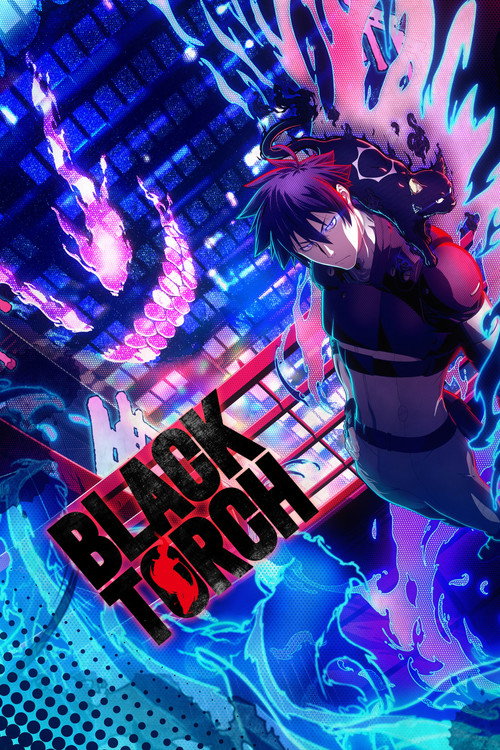
BLACK TORCH (2026)
Jiro Azuma is no average high schooler. A descendant of ninjas and trained in the ancient warrior art of the shinobi, Jiro is also able to talk with animals. After a mysterious encounter with an injured cat named Rago, Jiro discovers the feline is actually the legendary Black Star of Doom! Joined by the Bureau of Espionage, they fight off swarms of mononoke lying in wait to exploit Rago’s powers.
Vivian's take
A ninja descendant who talks to animals. An injured cat who turns out to be the legendary Black Star of Doom. BLACK TORCH is shonen with the weirdness dial up.
01The premise
Shonen anime runs on a formula so reliable you could set your watch by it: gifted kid, hidden power, escalating monsters, found family. BLACK TORCH knows the formula cold — and then it does something the formula rarely does: it gets weird. Jiro Azuma is a high schooler descended from a long line of shinobi, trained in the warrior arts, and gifted with the ability to talk to animals. His soft spot for furry critters gets him into serious trouble when a suspicious injured stray cat fuses with him, granting him exceptional power — because the cat is Rago, the legendary Black Star of Doom, a mononoke of apocalyptic billing. Now Jiro is inducted into the Bureau of Espionage, a shadow agency fighting humanity's hidden war against powerful, menacing spirits, and every faction — enemies and allies alike — wants a piece of Rago. That is not a premise. That is a dare.
The engine underneath is the fusion itself: Jiro learning to control the powers the merger grants him, while forces on all sides seek to subdue or destroy Rago out of revenge, fear, or ambition. It is a brisk remix of the Naruto-and-Kurama dynamic — the kid bonded to the monster inside him — but with the weirdness dial turned past anything the genre's giants attempted in their first seasons.
02The cast
The Japanese voice cast is stacked with names that tell you exactly what tier of production this is. Ryōta Suzuki voices Jiro Azuma, playing the rough-and-tumble exterior with the compassionate core the role needs — Jiro's power is connection, and the performance has to sell that the animal-talking isn't a gimmick but the character's whole philosophy. Yōji Ueda voices Rago, threading menace through the cute: this is the rare mascot with genuine apocalyptic weight behind it. Sayaka Senbongi is Ichika Kishimojin, Junya Enoki is Reiji Kirihara, Reina Ueda is Hana Usami, and Junichi Suwabe is Ryosuke Shiba — all Bureau of Espionage personnel, all announced to fanfare at Jump Festa '26. The heavy hitters round it out: Toshiyuki Morikawa as the formidable Amagi, Nobuhiko Okamoto as Koga, Shinpachi Tsuji as Jiro's grandfather Toshimasa Azuma, Yuko Kaida as Toko Kusumi, and Hochu Otsuka as Banjuro Tokieda.
The English dub, streaming on Crunchyroll, is equally considered: A.J. Beckles as Jiro, Keith Silverstein as Rago, Erin Yvette as Ichika, Kyle McCarley as Reiji, Julie Nathanson as Hana, and Ryan Colt Levy as Shiba. In an era when dubs can make or break a show's Western afterlife, BLACK TORCH arrived with both tracks ready on day one.
03The season
One season, twelve episodes, broadcasting in Japan from July 4 to September 19, 2026 — the classic single-cour summer run, and a shape that fits the source material perfectly. The anime adapts Tsuyoshi Takaki's manga, which ran in Shueisha's Jump Square from December 2016 to 2018: nineteen chapters, five collected volumes, a complete story. That completeness is the adaptation's secret weapon. Unlike the monolithic franchises that have to invent filler or stall for the manga to catch up, BLACK TORCH is a limited affair by design — a sprint, not a marathon — and the anime treats it that way, approaching the manga's hyper-stylized visuals with obvious relish.
The production is 100studio, directed by Kei Umabiki (ClassicaLoid, Quality Assurance in Another World), with character designs by Gō Suzuki (Sword Art Online the Movie: Ordinal Scale), series composition and scripts by Gigaemon Ichikawa, and music by Yutaka Yamada — the composer behind Tokyo Ghoul, Babylon, and Vinland Saga, whose score gives the mononoke battles a horror edge the genre rarely bothers with. Crunchyroll streams it across North and South America, Europe, Africa, Oceania, the Middle East, and the CIS. The anime was announced in March 2025, built its cast through Jump Festa and AnimeJapan 2026 reveals, and landed as one of the summer season's most anticipated premieres.
04The reception
The 8.1 audience score says the dare pays off. Viewers have responded to exactly the things the show does differently: the animal-talking as thematic core rather than gimmick, the horror-tinged mononoke action, and a protagonist whose strength is listening in a genre built on punching harder. The Naruto-replacement framing that followed the Crunchyroll announcement — ScreenRant and others positioning it as the next home for viewers raised on the ninja generation — turned out to be both a blessing and a fair comparison: the Jiro-Rago bond genuinely echoes the Naruto-Kurama dynamic, but compressed into a twelve-episode sprint with weirder textures.
The honest criticism is the shonen skeleton showing through the weird skin. The escalation logic — bigger threats, hidden reserves of power — is genre-standard, and viewers who have mainlined a decade of battle anime will recognize the rhythms. The Bureau of Espionage framing is functional rather than inspired, and nineteen chapters of manga only gives an adaptation so much room to breathe. But the show's commitment to its strangeness papers over most of that: it never apologizes for the apocalypse cat, and that confidence is infectious.
05Cultural context
The anime adaptation pipeline is at full roar, and the shows that break through are the ones with a hook you can explain in one sentence at a party. "Ninja kid, talking animals, apocalypse cat" is that hook — BLACK TORCH understands the modern attention economy without dumbing itself down for it. It also fits the genre's quiet evolution: the new wave of shonen keeps the battles but softens the lone-wolf myth, replacing it with heroes whose power is relational. Jiro doesn't win alone; he wins with a cat, a bureau, and every animal that ever trusted him. In 2026, that's practically a philosophy.
There is also the manga's own backstory to appreciate. Takaki's series ran for less than two years and ended in 2018 — a blip by Jump standards — and spent years as a cult recommendation, the thing manga readers pressed into friends' hands. Its anime adaptation eight years later is part of a real trend: the industry mining its back catalog for complete, adaptable stories instead of betting everything on endless serializations. For viewers, the payoff is a shonen anime with an actual ending. In this genre, that is the rarest power of all.
Verdict: B+. Classic shonen fuel with a weirder engine than most — the apocalypse cat alone is worth the watch.