Stuart Fails to Save the Universe
TV Series
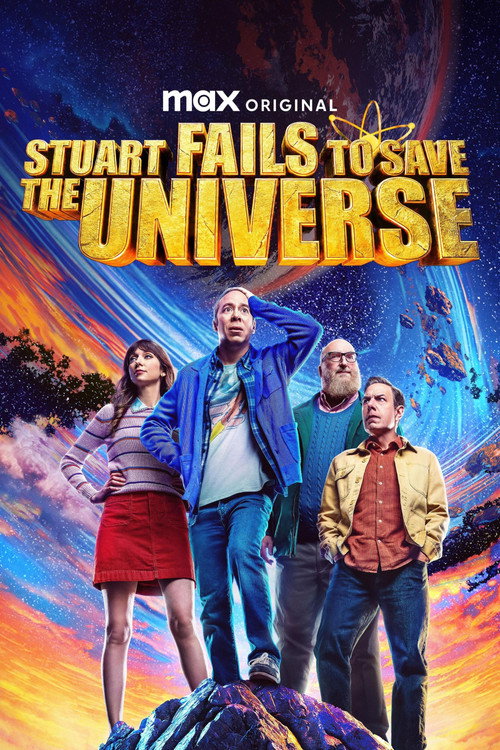
After accidentally creating a new multiverse, comic book store owner Stuart Bloom must locate a quantum-interference device to restore reality.
Year 2026
Genres Comedy, Sci-fi
TMDB rating ★ 8.4/10 audience score
Comic book store owner Stuart Bloom has done it now: one accident, one brand-new multiverse, and suddenly the guy who couldn't get a date is reality's last best hope. Stuart Fails to Save the Universe hands the cosmos to the franchise's resident sad sack and asks him to find a quantum-interference device before everything unravels. The spinoff nobody asked for is sitting at 8.4 — the audience has spoken.
The premise
Stuart Fails to Save the Universe is the fourth entry in the Big Bang Theory franchise, and the first built for streaming. It premiered on HBO Max on July 23, 2026, with ten episodes rolling out weekly on Thursdays through September 24. The premise is stated in the title as a dare: comic book store owner Stuart Bloom (Kevin Sussman) breaks a device built by Sheldon Cooper and Leonard Hofstadter, accidentally triggering a multiverse Armageddon — and then has to put reality back together.
Stuart does not go alone. He is joined by his girlfriend Denise (Lauren Lapkus), geologist friend Bert Kibbler (Brian Posehn), and quantum physicist Barry Kripke (John Ross Bowie) — four supporting players from the original series promoted to a full ensemble. Their journey across the fractured multiverse brings them face to face with alternate-universe versions of characters viewers have known for nearly two decades, which is the show's structural genius: every episode can reinvent a familiar face, and every reinvention is both a joke and a little character study. The official logline promises meetings with "alternate-universe versions of characters we've come to know and love," and co-creator Bill Prady told the Los Angeles Times in July 2026 exactly why that works: "You imagine each of these worlds and in each of these worlds, there's a version of you and me, there's a version of everybody. They just had a different backstory and a different life because the world was different, but you can encounter anyone."
The cast
Kevin Sussman is the center of gravity, and the casting is the show's thesis statement. Stuart Bloom appeared in 84 episodes of The Big Bang Theory, debuting in season two and gradually becoming the show's resident sad sack — the broke, depressed comic shop owner whose trajectory kept sinking while everyone else's rose. Sussman himself described the arc: "As the seasons went on, the other characters started to develop as people, get into normal relationships, and advance in their careers. As their trajectory was going up, Stuart was devolving, and his situation was getting worse — to the point where, at one point, the comic book store burns down, and a big chunk of the ceiling falls right next to him. He looks at it and he's like, 'That could have killed me. [Pauses] I can't catch a break.'"
Around him: Lauren Lapkus returns as Denise, introduced in the final two seasons of the original show and now Stuart's girlfriend and co-worker at the comic book store. Brian Posehn is back as Dr. Bert Kibbler, the rock-loving Caltech geologist — fourteen episodes of deadpan in the original, now a series regular. John Ross Bowie returns as Barry Kripke, the quantum physicist and all-around pain in the ass whose speech impediment and ego made him one of the franchise's best recurring irritants. The trailer teased cameos from Christine Baranski (Beverly Hofstadter), Riki Lindhome (Ramona Nowitzki), and Teller (Larry Fowler). As for whether Jim Parsons and Johnny Galecki appear, co-creator Chuck Lorre would only say it was "a closely guarded piece of information" he had "taken a blood oath regarding" — which is either a denial or a promise, and the ambiguity is the marketing.
How it got made
The series was a long time coming. It had been in the works for years before HBO gave it the official green light in July 2025, and the premiere date was locked during the Warner Bros. Discovery upfront presentation in New York in May 2026, where Sussman, Lapkus, Posehn, and Bowie announced it together. It is created, written, and executive produced by Chuck Lorre, Zak Penn (The Avengers), and Bill Prady — Lorre and Prady being the architects of the original series — and produced by Chuck Lorre Productions in association with Warner Bros. Television.
Formally, this is a break from the franchise's past. The Big Bang Theory was a multi-camera studio-audience sitcom; Stuart Fails to Save the Universe is single-camera, cinematic, and loaded with CGI — the production moved, as the coverage put it, beyond the original's traditional studio audience format into action-driven storylines with high stakes across multiple alternate worlds. The theme music comes from Danny Elfman, whose television theme credits run from The Simpsons to Desperate Housewives to Wednesday — a composer who understands that a great theme tells you what kind of show you're watching before a single line of dialogue.
Season one
The trailer set the comic engine in one exchange: Stuart declares he is "the chosen one who'll set things right," and when asked what his plan is, answers, "I don't really have one." At a CCXP Mexico City panel in April 2026, Posehn distilled the show even further: "The fun is watching him fail every week." Sussman added that Stuart "takes on a leadership role but he's not very good at it," and called the character "more of a hero, albeit a reluctant hero."
That reluctant-hero framing is doing real narrative work. The show's best joke — the least qualified man alive holding the universe together — doubles as its emotional spine: Stuart discovering that knowing about heroism and doing it are different skills. Lapkus told PEOPLE in May 2026 that longtime fans have plenty to look for: "There's a lot of good Easter eggs, throwing back to the first series." The weekly Thursday rollout through late September gave the show room to breathe in a way the binge model rarely allows, letting each alternate-universe encounter land and be argued about.
The reception
The audience score sits at 8.4 on TMDB, which for a spinoff of a beloved but divisive sitcom is a genuine achievement. The number says the show mostly threads the needle: it is funnier than its high concept, and it stays grounded in the least qualified savior imaginable rather than drowning in cameos and canon the way lesser multiverse stories do. The risk the show keeps dodging is multiverse fatigue — the premise has to earn its spectacle, and the episodes that lean on reality-hopping when the character comedy is the actual draw are the season's weakest.
What the 8.4 really measures is affection. Stuart was always the most human character in the Big Bang Theory universe — the one whose problems (money, loneliness, depression played for laughs) felt closest to real life. Handing him the multiverse is the franchise's most narratively honest move: of course the lore guy breaks the lore. The audience showing up for him, specifically, is the whole story.
Cultural context
This is spinoff culture's new math. Not the star vehicle, but the deep cut — the supporting player promoted because the audience's affection was real, part of the same wave that realized the weirdo at the edges is often more interesting than the hero at the center. It also belongs to the streaming-spinoff era, where a franchise's fourth entry can be its most formally ambitious: single-camera, effects-heavy, and built for a weekly conversation rather than a laugh track.
And it lands in the middle of the multiverse decade — Loki, Spider-Verse, Doctor Strange — where the novelty of "what if this character, but different" has to be earned rather than assumed. Stuart earns it by making the multiverse personal: every alternate version of a familiar character is really a question about the Stuart we know, the one who couldn't catch a break, and whether he was paying closer attention than the geniuses all along.
The verdict
Grade: A−. The rare spinoff that understands the assignment: let the weirdo drive. Sussman carries it, the multiverse gives it room to play, and the title is a lie — or a dare. Watch to find out which.
The full picture: Stuart Fails to Save the Universe
Premise & development
Nineteen years after The Big Bang Theory premiered in 2007, the franchise got its first direct sequel — and it handed the cosmos to the comic-book store guy. Stuart Fails to Save the Universe follows Stuart Bloom, played by Kevin Sussman, who breaks a device built by Sheldon Cooper, Leonard Hofstadter and Howard Wolowitz and accidentally triggers a multiverse Armageddon. Aided by his girlfriend Denise, geologist friend Bert Kibbler and quantum physicist Barry Kripke, Stuart has to undo the damage before every reality goes off the rails. As the title warns, things do not go well.
The series was created, written and executive produced by Chuck Lorre and Bill Prady alongside Zak Penn, from Chuck Lorre Productions and Warner Bros. Television. It premiered on HBO Max on July 23, 2026, as a 10-episode single-camera sci-fi comedy released weekly on Thursdays at 9 p.m. ET. The single-camera format is a deliberate break from the original sitcom’s multi-camera stage setup: the show looks more cinematic, leans into action, and plays the multiverse as genuine spectacle rather than a living-room gag.
The casting carries a 19-year full-circle story. Sussman originally auditioned for the role of Sheldon back in 2007, and John Ross Bowie auditioned for Leonard — both lost the leads and instead built Stuart Bloom and Barry Kripke into two of the franchise’s most beloved supporting characters. The spinoff finally puts them front and center.
Cast & characters
Kevin Sussman headlines as Stuart Bloom, the anxious comic-shop owner who knows everything about fictional universes and nothing about saving his own. Lauren Lapkus returns as Denise, Stuart’s girlfriend; Brian Posehn as Bert Kibbler, the geologist friend; and John Ross Bowie as Barry Kripke, the quantum physicist and all-around thorn in everyone’s side. Cameos from Kaley Cuoco and Kunal Nayyar keep the new show tethered to the original series.
The season’s strangest swing comes in episode 9, when the group gets trapped inside a comic-book universe and is rescued by the Flash — Jay Garrick, played by Andy Ridings — with Eric Allan Kramer appearing as Mr. Freeze. The original plan was reportedly a Green Lantern crossover, but HBO passed on the Lanterns tie-in and the production went with the Flash instead.
Season 1: the arc and that finale
Across its ten episodes the quartet ricochets through warlord dystopias, AI-governed utopias, a universe governed by magic, the DC Universe, a comic-book reality and a post-apocalyptic wasteland — plus one deeply unsettling reality in which they discover a comic book documenting their own journey in real time. The throughline is the race to repair the device and close the breach Stuart opened, with alternate-universe versions of familiar Big Bang Theory faces turning up along the way.
The finale, cheekily titled “Spoiler: Filmed Before a Live Studio Audience,” goes full meta. The group reaches a featureless void where a character named Kyle names their enemy the Adversary — an ancient, malevolent consciousness that existed in silence before the Big Bang and has resented every multiverse disruption Stuart’s accidents have caused. Then the laugh track starts. What surrounds them is not another alternate universe but a working taping of Stuart Fails to Save the Universe itself, with actors who look exactly like them performing their lives for a studio audience. The characters walk off the Warner Bros. soundstage into the Burbank night, deviceless and unsure whether any of it was real. In post-finale interviews, Lapkus suggested the sitcom universe might simply be one more alternate reality rather than a definitive “it was all fiction” reveal, while Sussman floated the Inception-like possibility that the actors themselves could be fictional in someone else’s simulation. The show was built to hold both readings.
Reception
HBO Max called the launch one of its biggest comedy debuts ever globally — the platform’s second-biggest comedy launch, with the caveat that it had not debuted a new original comedy in nearly three years and its international footprint was still expanding into markets like the U.K. and Germany. FlixPatrol ranked it No. 2 globally behind House of the Dragon, and No. 2 on HBO Max’s U.S. top 10, ahead of Last Week Tonight, Real Time with Bill Maher and A Killer Story. Critics landed around 77% on the Rotten Tomatoes Tomatometer with audience scores in the low 80s; IMDb sits at 7.1/10 from thousands of ratings.
The renewal came fast: in August 2026, just four episodes into the ten-episode run, HBO Max ordered season 2. “We’re delighted with how this hilarious, genre-bending show from Chuck, Zak, and Bill has connected with the audience, both devotees of The Big Bang Theory and new fans alike,” said Amy Gravitt, EVP of HBO Programming. Warner Bros. Television Group chairman Channing Dungey called it “a completely original take on one of the most beloved franchises of all time.”
Cultural impact
This is spinoff culture’s new math: not the star vehicle, but the deep cut. After two prequels (Young Sheldon, Georgie & Mandy’s First Marriage), the franchise finally moved the timeline forward — and did it by promoting the supporting player the audience genuinely loved. Stuart spent twelve seasons as the franchise’s most human character, the weirdo who was paying closer attention than the geniuses; giving him the multiverse made it official. The finale’s simulation-hypothesis ending also gave the show a second life as a philosophy talking point, with viewers debating whether the characters discovered they were fictional or simply found one more universe. Either way, the least qualified savior in television is holding the universe together with tape — and season 2 is already on the way.