The Final Problem
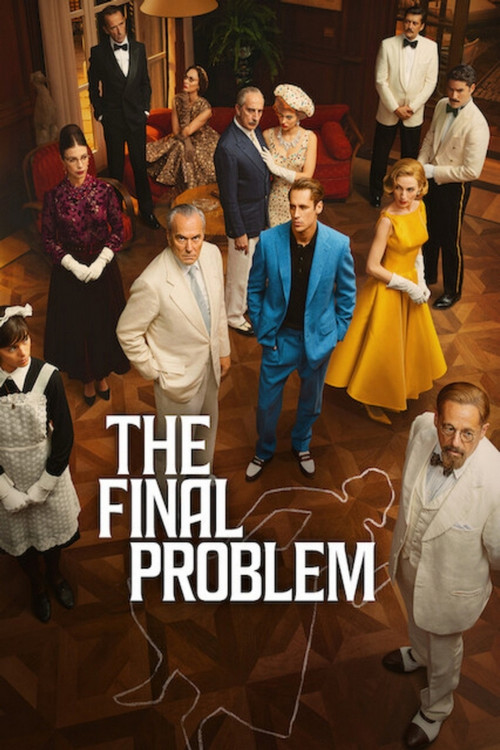
TV Series
In the spring of 1959, a retired actor, who previously played Sherlock Holmes, must investigate a murder at a small hotel on a tiny island near Mallorca.
Year 2026
Genres Crime, Mystery
TMDB rating ★ 7.2/10 audience score
There is a special pleasure in watching a man who pretended to be Sherlock Holmes discover that pretending was the easy part. The Final Problem drops a retired actor onto a tiny island off Mallorca in the spring of 1959, where a murder at a small hotel forces him to do the thing for real.
The premise
The Final Problem is a four-episode Spanish limited series that arrived on Netflix on September 25, 2026 — all four episodes at once, the way a locked-room mystery deserves to be consumed. It is based on El problema final, the bestselling 2023 novel by Arturo Pérez-Reverte, and it opens with one of the great high-concept hooks in recent mystery television: in the spring of 1959, a violent storm traps thirteen people at a tiny hotel on an islet near Mallorca. When an English tourist is found dead, the only person in the building with any "detective experience" is Basil — a retired actor once famous for playing Sherlock Holmes on screen. Having played Holmes and solving a murder are two very different things. Now he has to do the second one for real.
The title is doing double duty. It nods to Arthur Conan Doyle's "The Final Problem" — the 1893 story in which Holmes meets Moriarty at Reichenbach Falls — and it describes the show's central duel: a fake Holmes against a real killer who knows the game. The setup is deliberately old-fashioned. Thirteen people are stranded. One of them is found dead. Nobody can leave. Everybody becomes a suspect. What looks like suicide tilts toward murder, and then — because what is a good murder mystery without multiple bodies — two more murders follow.
The cast
José Coronado anchors the series as Basil, and the performance is the show's foundation: weary, sharp, a faded star who arrives in Mallorca hoping to revive his career and instead finds himself playing detective for real. Coronado — one of the most durable leading men in Spanish film and television — plays the gap between the man and the role he once wore, and the reviews single out his steady lead work as the thing that carries the slower stretches.
The ensemble is stacked with Spanish screen power. María Valverde plays Adela Figueroa, the wealthy friend who checked in with the dead woman — the only other guest with an obvious personal connection to her. Martiño Rivas is Foxá, a crime writer who appoints himself Basil's Watson, making their partnership one of the series' central dynamics. Maribel Verdú is hotel manager Mrs. Ausländer, the steeliest presence in the building and the most eager to shrug the death off as anything but murder. Gonzalo de Castro plays Fonseca, Basil's suspicious producer friend; Cristina Kovani is Vicky, his young actor girlfriend; Pepón Nieto is Doctor Seruya, whose examination turns apparent suicide into probable murder; José Condessa is Toni, the handsome hotel staff member the dead woman was last seen flirting with — and the primary suspect. Paloma Bloyd plays Elisa Mander, the English tourist whose death starts everything. And then there is the German couple, Señor and Señora Klemmer (Michael Stobbe and Yaiza Guimaré), alleged former SS members whose mere presence sends tension through the room.
How it got made
The series was directed by Félix Viscarret, with scripts by Alberto Macías, Carlos Molinero, and Marisol Farré alongside Pérez-Reverte himself — the novelist in the writers' room, which is usually a good sign for an adaptation. Fernando Bovaira and Urko Errazquin produced. It is rated TV-MA, and the craft credits run deep: cinematography by David Omedes, editing by Fernando Franco, music by Lucas Vidal.
The adaptation had a strong foundation to build on. Pérez-Reverte's novel was a bestseller precisely because the premise is so clean — a locked room, a fake detective, a real killer — and the series plays it straight: period detail, storm-battered atmosphere, and a cast that understands the assignment. Netflix released it globally on the same day, which is how a Spanish period mystery becomes a worldwide conversation overnight.
The four episodes
All four episodes dropped September 25, and the runtimes tell you about the pacing: Episode 1 runs 57 minutes, Episode 2 a tight 35 — the series breathes where it needs to and hurries where it should. Episode 1: Basil arrives in Mallorca hoping to revive his career, but a death at the isolated hotel turns the retired actor into an amateur detective, and the guests quickly become suspects. Episode 2: a murder weapon is discovered in Basil's own room, the investigation takes a more dangerous turn, and Vicky makes an accusation that the evidence doesn't quite fit. Episode 3: Basil and the other guests try to piece together the events surrounding Elisa Mander's death. Episode 4: the solution — which, per the reviews, brings ambition, class, and exploitation in show business into the story, giving Basil's former profession a reason to matter beyond the Holmes connection.
The structure is classic whodunnit architecture with a modern pressure valve: every clue shifts the story, every conversation can change Basil's view of someone rather than simply adding another name to his list. The locked-room mechanics are the draw, but the show's real subject is performance — who these people are pretending to be, and what happens when a storm strips the pretense away.
The reception
Early signals point to a strong, stylish mystery that rewards attention to detail. The critical response has been generally positive for the atmosphere, the cast, and the faithful-adaptation energy — this is a slow-burn puzzle with a payoff, not a flashy action ride. The Gazettely review praised how the investigation works hardest when a conversation changes Basil's view of someone, and noted that the eventual explanation gives the four-episode mystery a proper endpoint while letting the actor-detective premise pay off.
The honest caveats are the ones the premise invites. A faded star playing detective for real is a wonderful hook, but the show has to keep earning it — the stretches where the machinery shows are carried by Coronado and the handsome 1959 setting. And much of the thematic weight, particularly around the power a producer or established actor can hold over someone seeking a career, arrives through the late explanation rather than the earlier relationships. For mystery fans who like clues, red herrings, and reveals, that tradeoff is more than acceptable.
Cultural context
The Final Problem belongs to the great locked-room revival — the ongoing cultural appetite for the closed-circle mystery, from Knives Out to the current golden age of the whodunnit series. What distinguishes this one is the meta-layer: the detective is a man who played a detective, and the show keeps asking whether Basil is actually detecting or only performing detection. In an era of true-crime podcasts and armchair sleuths, that question has teeth.
It also belongs to the Spanish prestige wave on global streaming — the pipeline that has made Spanish-language thrillers a reliable Netflix bet. And it carries the Pérez-Reverte pedigree: a novelist whose best work has always been about honor, deception, and the codes people live by. Setting all of that in 1959, on an island, in a storm, with thirteen suspects and a fake Sherlock, is about as pure a genre pleasure as television currently offers.
The verdict
Grade: B+. A handsome, well-acted locked-room mystery with a killer hook — the fake Holmes forced to do it for real. Coronado carries it, the storm does the rest, and the solution earns the buildup.
The full picture: The Final Problem

Premise & development
The Final Problem is a Spanish limited series that premiered globally on Netflix on September 25, 2026, with all four episodes dropping at once — a single-afternoon binge by design. It is based on Arturo Pérez-Reverte’s bestselling 2023 novel El problema final, adapted by Alberto Macías, Carlos Molinero and Marisol Farré alongside Pérez-Reverte himself, and directed by Félix Viscarret. Producers are Fernando Bovaira and Urko Errazquin, with cinematography by David Omedes, editing by Fernando Franco and music by Lucas Vidal.
The hook is deliciously meta. In the spring of 1959, thirteen people are trapped by a violent storm at a secluded hotel on a small island off the coast of Mallorca. When Elisa Mander, a quiet English tourist, is found dead, the first reading is suicide — the second is murder. The man pushed into the investigator’s chair is Benjamin Basil: a retired actor who became famous years earlier for portraying Sherlock Holmes on screen, now fading from the limelight. Having played Holmes and solving a murder are two very different things, and the series makes that gap its whole subject.
Basil teams up with Foxá, an aspiring thriller writer, while the rest of the guests close ranks: the mysterious traveler Adela Figueroa, hotel manager Mrs. Ausländer, and a full roster of suspects — because in a place where no one can leave and no one can arrive, every guest and every member of staff is on the list. The title nods to Arthur Conan Doyle’s “The Final Problem,” and the story is structured as a duel between a fake Holmes and a killer who knows the game. Episodes run roughly 45 minutes (57 for the opener, 35 for the second), and the series is rated TV-MA.
Cast & characters
José Coronado — one of Spain’s most durable leading men — stars as Benjamin Basil, and his steady, lived-in performance carries the show: Basil isn’t Holmes, and the series never lets you forget it, but fragments of Holmes surface in him at exactly the moments that matter. María Valverde plays the enigmatic Adela Figueroa, Martiño Rivas is Foxá the would-be writer who becomes Basil’s Watson-by-default, and Maribel Verdú is Mrs. Ausländer, the hotel manager watching her establishment become a crime scene. The ensemble is filled out by Gonzalo de Castro, Pepón Nieto, Cristina Kovani, José Condessa, Daniel Holguín and Michael Stobbe.
The central dynamic — Basil and Foxá circling each other as detective and chronicler — is also the show’s thematic engine. The series is as interested in performance as in deduction: what it means to have played a genius, what residue a role leaves in a man, and whether years of wearing the costume taught Basil anything real about seeing.
Reception
The show arrived to the kind of reception old-fashioned mysteries dream of: called “a good old-fashioned mystery with one clever idea at its center” and “worth your time,” with several critics singling out a final episode you won’t soon forget. It holds a 6.4 on IMDb — respectable for a subtitled four-parter — and the page’s TMDB audience score sits at 7.2. Reviewers have praised the handsome 1959 Mallorca setting and Coronado’s lead turn, noting the investigation works hardest when a conversation changes Basil’s view of someone rather than simply adding another name to his list.
The eventual solution has drawn particular attention for folding ambition, class and exploitation in show business into the mystery — giving Basil’s former profession a reason to matter beyond the Holmes connection, and asking the finale to reveal depths in people the earlier episodes kept carefully out of sight. Comparisons have run from Agatha Christie to Knives Out: a closed circle, a theatrical detective, and a solution with actual weight behind it.
Limited series & cultural context
Netflix conceived and labeled the show as a limited series, and the four episodes tell a self-contained story with a definitive ending — the killer is identified and the case closes. There has been no renewal announcement, and given the format, a second season is considered unlikely: this was built as one elegant locked room, not a franchise.
Culturally, the series lands in the middle of a full-blown Holmesian moment — but its angle is the freshest in years. Instead of another young Sherlock or another modernized consulting detective, it asks what happens when the actor has to do the detecting: a story about fiction’s residue on real life, set in a 1959 that Pérez-Reverte — Spain’s master of the historical thriller — renders with salt air and suspicion. For mystery fans, it is four episodes, one island, thirteen suspects, and a detective who only ever played one on television. That’s the whole pitch, and it’s enough.