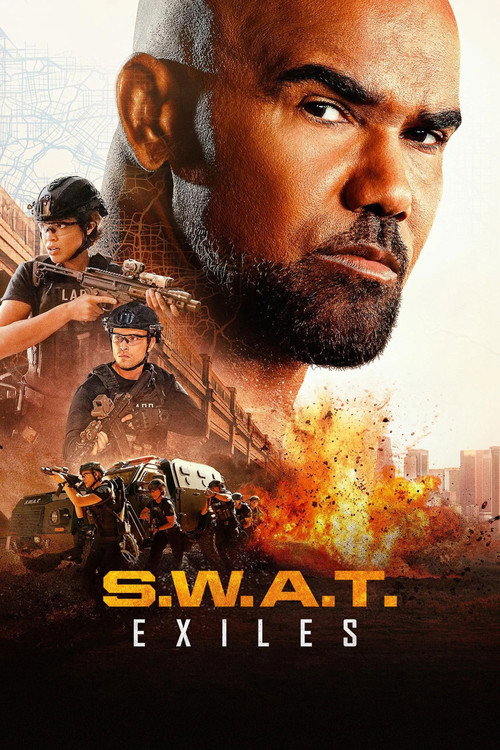
S.W.A.T. Exiles
After a high-profile mission goes sideways, Daniel 'Hondo' Harrelson is pulled out of forced retirement to lead a last-chance experimental SWAT unit made up of untested, unpredictable young recruits. Hondo must bridge a generational divide, navigate clashing personalities, and turn a squad of outsiders into a team capable of protecting the city and saving the program that made him who he is.
Hondo is back. After a high-profile mission goes sideways, Daniel 'Hondo' Harrelson is pulled out of forced retirement to lead a last-chance experimental SWAT unit — a squad of untested, unpredictable young recruits. The assignment: bridge the generational divide, navigate the clashing personalities, turn outsiders into a team, protect the city, and save the program that made him who he is. It is a lot of jobs for one man. It is also exactly the kind of job television was built for.
The premise
S.W.A.T. Exiles is the sequel-spinoff of S.W.A.T., the CBS procedural that ran for eight seasons from 2017 to 2025 — and it picks up the story after everything fell apart. The series premiered on Starz on September 25, 2026, with ten episodes airing Fridays at 10 p.m. ET through November 27. It is set two years after the original series ended, and Daniel "Hondo" Harrelson (Shemar Moore) is in ruins: a catastrophic botched raid killed young operator Nico Reyes and forced Hondo out of the LAPD. He's divorced, living alone, and working as a private bodyguard for wealthy Los Angeles tech billionaires — about as far from a badge as a man like Hondo can get.
Then comes the last-chance offer. Former commanding officer LAPD Commander Robert Hicks gives Hondo one final shot at redemption: build and lead an experimental S.W.A.T. unit made entirely of outsiders — young, untested, unpredictable recruits overlooked by everyone else. It is a lot of jobs for one man: bridge the generational divide, navigate the clashing personalities, turn outsiders into a team, protect the city, and save the program that made him who he is. It is also exactly the kind of job television was built for.
The cast
Shemar Moore is back as Sergeant II Daniel "Hondo" Harrelson Jr., and he is also executive producing — this is his franchise as much as anyone's. Around him is a new generation: Lucy Barrett as Sammy Bishop, Freddy Miyares as Ethan Cole, Zyra Gorecki as Cassidy Reed, Ronen Rubinstein as Jude Callan, and Adain Bradley as Malik Anderson — the experimental unit, talented but raw, the friction the show runs on.
The bridge to the original series is real. Jay Harrington returns as David "Deacon" Kay and Patrick St. Esprit returns as Commander Robert Hicks for the premiere, with David Lim expected as Victor Tan later in the season. The generational math is the point: the old guard hands the franchise to the new blood, with Hondo caught in the middle — too experienced to start over, too stubborn to quit.
How it got made
The road to Exiles is one of the wildest development stories in recent television. CBS canceled S.W.A.T. in March 2025 after multiple near-cancellations across its run — the show had already been canceled after season six and revived twice, with Moore taking the fight to social media both times. When the eighth season ended the run in May 2025, Sony Pictures Television moved fast: that same month, it ordered ten episodes of a spinoff with Moore reprising Hondo, initially without any domestic or international distribution partner attached. Filming commenced in September 2025 in California with the entire crew of the original series.
Jason Ning serves as showrunner and developer, with executive producers Neal H. Moritz and Pavun Shetty of Original Film, James Scura, Jon Cowan, Kevin Tancharoen, and Moore himself. The series is produced by Original Film and Sony Pictures Television. Starz came aboard as the network — a meaningful move upmarket for a broadcast procedural — and the confidence showed early: in August 2026, a month before the premiere, Starz renewed Exiles for a second season. The composer is Marcelo Zarvos, and the camera setup is single-camera — a long way from the bright broadcast gloss of the CBS years.
The look
Moore has been explicit that this is not the same show with a new logo. "There's a darkness to this show in how it looks," he told ScreenRant, reaching for a classic reference: "There's a more human real element. The last show was wonderful, but it was bright, it was very James Bond-y and techie. All that bright is gone, all that techie is gone. It doesn't look like a James Bond layer, it's bad furniture, it looks like we took over the Hill Street Blues set, if you're old enough to remember Hill Street Blues."
That Hill Street Blues comparison is doing real work. It's a promise of grungy urban realism and in-depth character work over gadgetry — the procedural as workplace drama rather than action showcase. Moore also talked about the economics of the shorter season with unusual candor: "In the old show, we were doing 22 episodes, 19, 22 episodes, that was 10 and a half months... and now, thankfully, we're doing 10 episodes... I've got to bust my a—, I got 40 days of being a superhero, and 40 days of acting." Ten episodes means every hour has to count, and the show is built like it knows that.
The reception
Two episodes are out as of this writing (September 25 and October 2), and the early read is exactly what the premise promised: comfort-food television in tactical gear, but with the lights turned down. What works is the engine — one of TV's most reliable, the veteran redeems the misfits — given fresh friction by the generational divide. Hondo's old-school code against recruits who learned the job from a different world: done right, every episode is a negotiation between two eras of policing, two eras of masculinity, two eras of what a team even is.
The honest caveat is novelty, and the show doesn't seem particularly interested in it. You know the beats, you know the arc, you know the speech before the breach. The risk was never failure — with this cast and this machine, competence was assured — it was invisibility, the fate of every capable procedural that never gives the culture a reason to talk about it. The Starz move, the darker look, and the genuine stakes of Hondo's fall are the show's answers to that risk.
Cultural context
Exiles is two evergreen TV instincts in one uniform: the "one last job" mentor story and the generational-divide workplace drama. Both endure because both are true — every institution is currently negotiating exactly this handoff, and Hondo bridging that divide with a tactical vest on is the fantasy version of a conversation happening in every precinct, office, and family in America.
It's also the latest chapter in one of broadcast TV's great survival stories. S.W.A.T. was canceled three times and came back twice on the strength of Moore's public campaigns and a loyal worldwide audience — "We got cancelled, and I ran my mouth on social media," Moore recalled, "the passion was there from us, and the passion was there from the fan base." That the franchise's next life is on Starz, darker and leaner, feels like the earned third act: the show that wouldn't die finally gets to be the show it always wanted to be.
The full picture: S.W.A.T. Exiles

Premise & development
S.W.A.T. Exiles is the sequel series to CBS’s S.W.A.T., which ran for eight seasons from 2017 to 2025. After the network’s third cancellation attempt finally stuck in 2025, Sony Pictures Television moved fast: by May 2025 a spinoff was in the works with Shemar Moore set to reprise Daniel “Hondo” Harrelson, and the studio ordered ten episodes before it had even signed a domestic or international distribution partner. Filming began in September 2025 in California with the entire crew of the original series, and Starz emerged as the show’s home. The series premiered on Starz on September 25, 2026, airing Fridays at 10 p.m. ET.
The setup is a clean break with a familiar spine. Set two years after the original’s finale, the story finds Hondo pulled out of forced retirement — a fatal decision on a high-profile mission cost him his career — by LAPD Commander Robert Hicks (Patrick St. Esprit). His assignment: build an experimental, last-chance S.W.A.T. unit out of Los Angeles’s overlooked talent. The pilot, “Clean Entry,” gives him one shot at redemption. The catch, which Hondo figures out fast, is that the team was handpicked to fail — and there’s a mole working against his new group.
Developed by showrunner Jason Ning, the series is executive produced by Ning, Neal H. Moritz and Pavun Shetty of Original Film, past S.W.A.T. executive James Scura, Jon Cowan, Kevin Tancharoen and Moore himself, from Original Film and Sony Pictures Television. The score comes from composer Marcelo Zarvos. Producers and Moore describe Exiles as darker and more serialized than the CBS procedural — layered character work and ongoing storylines rather than stand-alone weekly cases.
Cast & characters
Shemar Moore is the bridge: he has played Hondo since S.W.A.T. premiered in 2017, and he carries the character into the spinoff as both star and executive producer. Moore has said goodbye to his longtime co-stars was “hard,” but the new show lets him explore new sides of the character: “It’s still Hondo, but now you’re gonna see a more human element of perseverance and finding purpose.” His mission statement for the new unit is pure Hondo: take a bunch of untested “Bad News Bears rugrats” — LAPD rejects the machine set up to fail — and defy the odds by forging them into something nobody thought possible.
The new ensemble around him: Ronen Rubinstein, Freddy Miyares, Lucy Barrett, Zyra Gorecki and Adain Bradley as the young, inexperienced recruits Hondo must turn into a team. Most of the original 20-Squad exists in this universe but won’t be seen on screen — this is Hondo’s chapter now, with a new unit and a conspiracy-tinged serialized spine.
Reception
Critical reception has been mixed-to-positive, exactly the split you’d expect for a star-led revival. Metacritic aggregates a 55 — “mixed or average” — from the first four reviews: Variety (70) found that while the show doesn’t reinvent the wheel, “Moore is commanding and earnest as he steps back into Hondo’s shoes”; Screen Rant (60) argued the new cast can make the series their own; TheWrap (50) felt there wasn’t enough new to feel meaningfully different, “but just enough has changed to make us miss the faces we’d grown to know”; Decider (40) called it more of the same with more generic characters under Hondo’s command.
The business story is the louder one. Starz renewed Exiles for a second season in August 2026 — before the premiere — a vote of confidence in the Sony/Starz bet on star-led revivals, shorter season models and serialized cable storytelling. Moving from broadcast CBS to premium Starz changes the show’s grammar: ten episodes, TV-14, single-camera, and a throughline about a unit built to fail with a mole inside it.
Cultural context
S.W.A.T. was famously the show CBS couldn’t kill — canceled and uncanceled twice before the third cancellation stuck — which makes Exiles less a resurrection than a relocation. The franchise’s near-decade run built one of broadcast’s most loyal audiences around Hondo’s particular brand of principled, community-rooted policing, and the spinoff’s gamble is that the audience will follow the character rather than the call sign.
That gamble mirrors a broader industry pattern: legacy IP, a beloved lead, a new premium-cable home, and a harder serialized edge. Whether Exiles becomes its own thing or lives forever in the original’s shadow will come down to the new squad — the recruits are still finding their footing, by most critics’ accounts, but the machine that built them to fail just met the one man in Los Angeles who specializes in proving machines wrong.