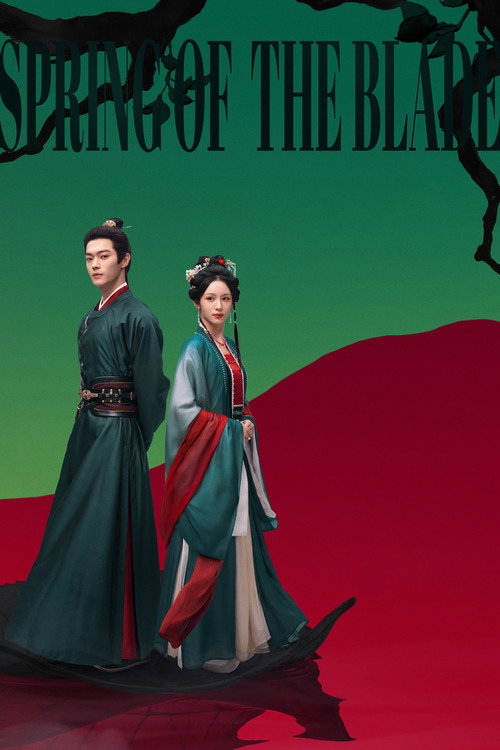
Spring of the Blade
After losing her mother as a child, Xie Qingyuan returns years later to uncover the truth and seek justice. Reuniting with Shen Run, once a fallen youth and now a righteous court official, they join forces to expose corruption and right past wrongs. Through shared dangers and unwavering support, they grow closer, devoting their lives to protecting each other and their people.
Vivian's Take
Some dramas shout; Spring of the Blade draws the sword slowly. Xie Qingyuan lost her mother as a child. Years later she returns — not for closure, but for truth, and for justice — and reunites with Shen Run, once a fallen youth, now a righteous court official. Together they move against the corruption that shaped both their lives, through shared danger toward something neither of them quite dares to name. This is the historical epic in its classical form: fate, rectitude, devotion, and revenge served at the genre's stately, deliberate pace. The 9.5 TMDB rating is the audience telling you it landed exactly as intended.

The deep cut
What works is the patience of the storytelling. Xie Qingyuan's return — years after losing her mother, coming home to uncover the truth and seek justice — is given room to breathe, and the series understands that revenge dramas live or die on the weight of what's owed. The reunion with Shen Run, the fallen youth remade as a righteous court official, gives the show its spine: two people shaped by the same corruption, approaching it from opposite sides of power. Their alliance feels earned rather than fated, and the court intrigue is staged with the deliberate, chess-match pacing the genre demands. A 9.5 TMDB score doesn't happen by accident; this is an audience that found exactly what it was looking for.
What doesn't work is mostly a matter of appetite. The family-genre tag is doing real work here — this is as much about devotion and protection as politics — but viewers expecting breakneck plotting will find the middle stretches stately. The corruption-exposing machinery occasionally runs on genre convention: villains who monologue a beat too long, allies who arrive exactly on cue. These are the genre's native rhythms, though, not flaws — you don't watch this kind of drama for surprise, you watch it for satisfaction.
Who it's for: the C-drama faithful, the historical-intrigue crowd, anyone who wants their justice slow-cooked. If you wept at the genre's greats, clear your schedule.
The players
Xu Kai carries the male lead as Shen Run / Yan Rui — the fallen youth grown into a powerful, righteous official, and the show's magnetic center. Xu Kai has headlined costume epics since Story of Yanxi Palace, and the role plays to his strengths: quiet authority, buried feeling, and a moral compass that never quite points where the court wants it to. Zhou Ye plays Xie Qingyuan / Chen Yunya, the heroine who lost her mother as a child and returns years later to uncover the truth. Both characters carry dual names, and the reasons unfold as the story's own twists — the show is careful not to hand you the answer early.
The supporting bench is deep: Xu Zhenxuan as Li Congxin, Estelle Chen as Xie Qingrong, Ke Ying as Xie Qingru, Bai Shu as Shen Che, Hu Yunge as Fan Zhong, Zhang Bozhi as Xie Zhengjun, Su Qi as Dong Fangchun, with Fu Dalong in a special appearance. It's an ensemble built for court intrigue — every household needs its schemers and its sympathizers, and Spring of the Blade stocks both sides generously.
Behind the camera: the series adapts the novel Yi Ou Chun (also translated as A Cup of Love) by You Sijie, directed by Pan Anzi from a screenplay by Qiang Li, and produced by Mingqian Gao. The source novel gives the adaptation its spine — the childhood promise, the single penny Shen Run leaves Xie Qingyuan before he departs for the army, the vow to survive and find a way forward. Those small, talismanic details are what elevate the story from plot machinery to something viewers carry with them.
The run
Thirty episodes, roughly 43 to 45 minutes each, premiered September 17, 2026 on iQIYI and Youku in China, with the premiere day dropping six episodes at once — the standard SVIP front-load that turns an opening weekend into an event. Two episodes a day followed, and the full run was complete by September 30, 2026. International viewers could follow along on iQIYI International with English subtitles, and the show travelled quickly: India, Southeast Asia, and the diaspora audiences that now make or break a costume epic's global footprint.
That tight, two-week sprint matters to how the show was received. A 30-episode arc consumed in a fortnight keeps the emotional temperature high — there's no time for the audience's attention to wander, and the revenge plot's dominoes fall in satisfying succession. The format is the modern C-drama's answer to the binge model: structured like a broadcast, paced like a limited series.
The reception
The headline number is the 9.5 TMDB score — a figure that puts Spring of the Blade among the highest audience-rated Chinese dramas of 2026. Scores that high don't come from casual viewers; they come from the faithful — the C-drama audience that knows exactly what it wants from a revenge romance and rewards execution over novelty. Episode-by-episode, the series tracked its central promise: Xie Qingyuan's schemes at the Xie Residence, Yan Rui seeing through them, the slow burn of a trust neither party can quite afford. The audience stayed because the show never bluffed about what it was.
Critics and reviewers in the C-drama press framed it as a genre exemplar rather than a genre reinventor — and that's the compliment. The historical revenge romance is one of the most competitive slots in Chinese television, and landing at the top of it in a year crowded with big-swing productions is the substance behind the score.
Where it sits
Spring of the Blade arrives at the crest of the C-drama's global wave — historical epics that have quietly become some of the most-watched television on earth, powered by diaspora audiences and converts who discovered the genre through streaming. The justice-seeking heroine returning to right old wrongs is one of the tradition's foundational stories, and this telling plays it with full classical confidence: no irony, no revisionism, just the machinery of fate and rectitude running at full power.
The 'family' tag is worth noting, too. In a genre often filed under romance or politics, this is a drama about what people owe each other — the dead mother, the shared cause, the vow to protect. That emotional directness is the show's real engine, and it's why the rating is what it is. Audiences can feel the sincerity.
The verdict
Classical, patient, and devastating in the way only this genre can be. The intrigue is chess, the emotions are opera, and the 9.5 is earned — this is historical drama operating at the peak of its powers, made for viewers who want justice the slow, satisfying way.
The verdict: A — The historical epic at full classical power: patient intrigue, operatic emotion, and justice served the slow, satisfying way.