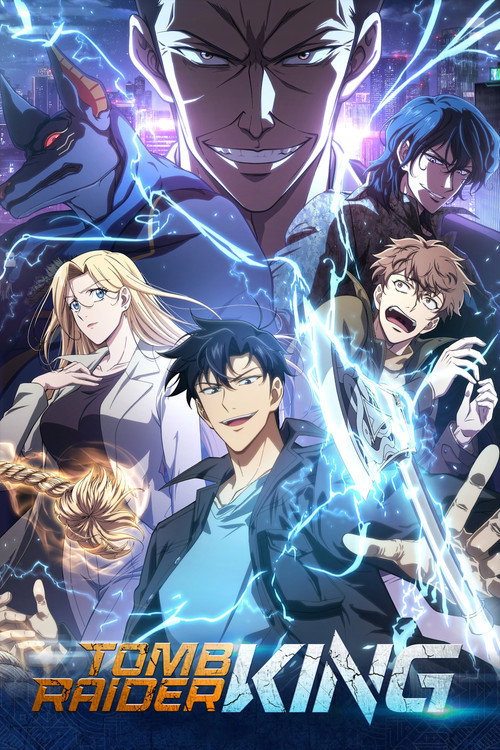
Tomb Raider King (2026)
Chaos ensues overnight when mysterious tombs suddenly surface, filled with divine relics granting overwhelming power, triggering a global power struggle to claim them for dominion. Among the havoc, a raider, Jooheon Suh, is betrayed and left for dead until a second chance brings him back years before the relics. Fueled by fury and future knowledge, he sets out to raid each tomb before they arise.
Vivian's Take
The perfect revenge-loop engine: relentless, propulsive, and engineered for one-more-episode nights.
Tombs surface overnight. Divine relics grant overwhelming power. The world starts fighting over them. And Jooheon Suh — betrayed, left for dead — gets a second chance: thrown back to before the relics appeared, armed with fury and future knowledge, raiding every tomb before it rises. Tomb Raider King is the revenge-loop dungeon crawler as pure narrative engine, and it is one of the most propulsive animated series of the year.

The source material
The anime has a decade of story to draw on. Tomb Raider King began as a web novel by Sanji Jiksong (SAN.G), serialized on KakaoPage from November 2016 to May 2018 — and the webtoon adaptation, illustrated by 3B2S with story adaptation by Yuns of REDICE STUDIO, ran on KakaoPage from June 2019 to March 2023, ending at a staggering 412 chapters across a dozen collected volumes. Yen Press licensed it in English under its Ize Press imprint (announced at Anime Expo 2022), with Tapas carrying the digital chapters, and a sequel manhwa, End Line, launched in July 2026. The premise is elemental: God's tombs appear all over the world, each containing relics that grant their wielders power. Tomb raider Seo Joo-Heon is betrayed by his employer and left for dead — then wakes up 15 years in the past, with a second chance to steal every tomb before anyone else gets to them.
The production
The anime is a Korean production built for a Japanese broadcast: animation by Studio EEK, produced by Kadokawa, with Seung Wook Woo directing and handling series composition — a dual role that kept the adaptation's raid logic tight. Character design and chief animation direction come from Hyun Joung Lee, with Hyung Jun Heo also serving as chief animation director; Ju Young Kim composes the score. K-pop band QWER performs both the opening theme, "SHOW DOWN," and the ending theme, "To Be Continued" — the kind of full-package music commitment that signals how seriously the production takes its summer-season positioning.
The voice cast spans both industries. The Japanese dub, produced by Kadokawa, stars Yoshimasa Hosoya as the protagonist (localized as Ryouga Gouriki; the Korean and English releases use the manhwa's original name, Jooheon Suh, with Hwang Chang-young voicing him in Korean), Saori Hayami as Irene Holton, and Junichi Suwabe as Taisei Ougawara, with Miyu Irino, Nobuhiko Okamoto, and Yuko Kaida rounding out the ensemble. The series premiered July 8, 2026 on Fuji TV's B8station block and Kansai TV in Japan, airing on Korea's Aniplus, and streaming worldwide exclusively on Crunchyroll — day-and-date with the Japanese broadcast.
The season
Season one ran 12 episodes, airing weekly on Wednesdays from July 8 through a finale on September 30, 2026 (pushed back one week from the original September 23 date). The rollout was deliberate summer counter-programming: with Solo Leveling between seasons, Tomb Raider King was openly positioned as the show to scratch that same itch — a betrayed protagonist, a power-progression engine, tombs instead of gates. The comparison was inevitable and, for the most part, flattering: where Solo Leveling is a solo power fantasy, Tomb Raider King is a heist series wearing a dungeon crawler's skin, and the foreknowledge device gives every raid a chess-match layer the genre's power fantasies usually skip.
No second season has been announced yet — but the sequel manhwa End Line is already running, and the 412-chapter source gives Studio EEK years of runway if the numbers justify it. For now, all 12 episodes are streaming on Crunchyroll, and the tomb is open.
Why it works
The structure is the star. The time-rewind setup turns every episode into a heist with foreknowledge: Suh knows where the traps are, who the traitors are, and which relic matters, and the pleasure is watching him play a game he has already lost once. The raid-of-the-week rhythm keeps the action relentless without ever feeling random — each tomb is a puzzle, each relic a power-up with a price. The betrayal fuel gives the whole thing an emotional spine: this is not grinding for loot, it is settling scores.
The 8.3 rating is doing real work here — this is a show the audience has stress-tested and approved. The risks are the genre's risks: power escalation can turn into a numbers game, and the I-know-the-future device needs constant fresh complications to avoid feeling like a cheat code. The animation has to sell tombs that feel ancient and powers that feel divine, and mostly it does — though the biggest set pieces occasionally outrun the budget. None of it matters much when the momentum is this good.
Culturally, Tomb Raider King rides the biggest wave in modern animation: the webtoon and manhwa adaptation boom. A generation raised on vertical-scroll storytelling is now the core anime audience, and series built on those rhythms — the system-like progression, the betrayal-and-return structure, the raid logic — are defining what action animation looks like in the 2020s. This is dungeon-crawler logic as prestige entertainment, and the global audience has made it clear: the tomb is open, and everyone is going in.
Verdict: B+ — The perfect revenge-loop engine: relentless, propulsive, and engineered for one-more-episode nights.