A Different World
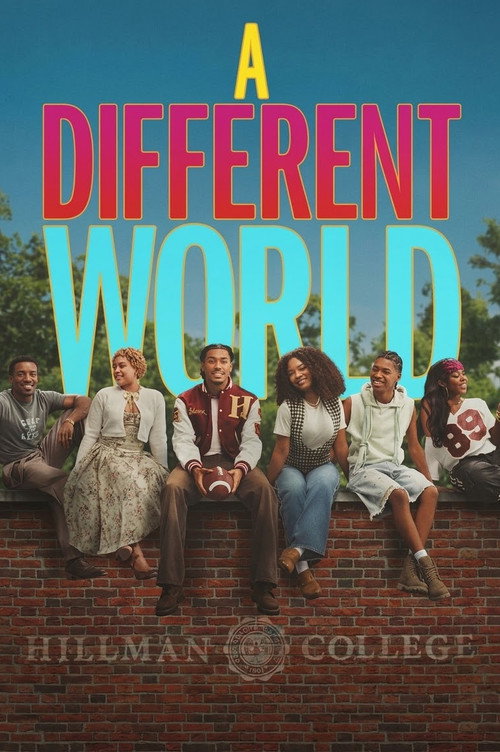
TV Series
Netflix's sequel to the landmark 1987 sitcom: Deborah Wayne (Maleah Joi Moon), daughter of Dwayne Wayne and Whitley Gilbert, enters her freshman year at Hillman College — her parents’ HBCU alma mater — determined to build her own legacy alongside a new generation of Hillman’s best and brightest. Ten half-hour episodes premiered September 24, 2026, exactly 39 years after the original’s debut.
Premiered September 24, 2026
Episodes 10 (half-hour)
Showrunner Felicia Pride
Starring Maleah Joi Moon, Alijah Kai, Cornell Young IV, Jordan Aaron Hall, Kennedi Reece, Chibuikem Uche
Returning Jasmine Guy, Kadeem Hardison, Cree Summer, Darryl M. Bell
Hillman College is open for enrollment again — on Netflix, 39 years to the day after the original premiered. A Different World (2026) follows Deborah Wayne (Maleah Joi Moon), the daughter of Dwayne Wayne and Whitley Gilbert, walking into her parents’ HBCU alma mater with their legend hanging over her like a marching-band banner — determined to build her own legacy alongside a new generation of Hillman’s best and brightest, while having the time of her life. Showrunner Felicia Pride calls it a “hopeful dramedy,” and that hope is the whole pitch.
The hook
September 24, 1987: A Different World premieres on NBC, a Cosby Show spinoff that becomes one of the most consequential sitcoms ever made — a show that measurably moved HBCU enrollment and gave a generation its image of Black college life. September 24, 2026 — 39 years to the day: Netflix premieres the sequel. Ten half-hour episodes. Same fictional Hillman College. New century, new kids, same promise: a place where Black excellence isn’t the special episode, it’s the air.
The legacy-kid setup is the revival’s smartest decision. Deborah Wayne (Maleah Joi Moon, the Tony winner bringing Broadway gravity to the small screen) isn’t just any freshman — she’s Dwayne and Whitley’s daughter, which gives the show a built-in engine: escape the shadow without disrespecting it. It’s a perfect metaphor for what a revival actually is — loving something enough to want your own version of it. Deborah doesn’t want to be her parents. She wants Hillman to mean what it meant to them, on her terms.
The players
Maleah Joi Moon anchors the new generation as Deborah, and the casting is the show’s thesis statement: a performer with real stage pedigree playing a character who has to earn her own spotlight in the shadow of two of sitcom history’s most beloved figures. Around her: Alijah Kai as Rashida Duvall, Cornell Young IV as Shaquille Johnson, Jordan Aaron Hall as Amir Rodale, Kennedi Reece as Hazel Henry, and Chibuikem Uche as Kojo Achebe — a new Hillman ensemble built to carry the late-night dorm debates, the probate-season pageantry, and the professors who see exactly who you’re trying to be.
And then the cavalry: Jasmine Guy (Whitley herself), Kadeem Hardison (Dwayne), Cree Summer, and Darryl M. Bell all return, with original producer Tom Werner and the legendary Debbie Allen — who ran the original series during its golden years — executive producing alongside showrunner Felicia Pride, Reggie Rock Bythewood, Gina Prince-Bythewood, and Mandy Summers. That’s not stunt casting; that’s a continuity of care. The old guard isn’t here to relive their glory days — they’re here to hand over the keys.

The deep cut
What works is the setting itself and the showrunner’s stated mission. Felicia Pride describes the series as a “hopeful dramedy,” and that hope is doing structural work: in a television landscape that treats young adulthood as a trauma delivery system, a show about brilliant Black kids having the time of their lives at an HBCU — while taking their futures seriously — feels quietly radical. When the show trusts its new kids, it crackles: the ensemble scenes have the lived-in rhythm the original took seasons to find.
The comedy-drama balance is still calibrating. Some episodes lean on the original’s greatest hits when they should be writing new ones, and the tonal shifts between campus farce and genuine stakes can wobble. Deborah’s arc gives the season a spine, but the show is at its best when it stops auditioning for the legacy and starts living in the present. The audience score (6.8 on TMDB) says “promising” rather than “arrived” — fair, for a first season still pledging.
Give it the season. Revivals that survive are the ones that stop asking permission, and you can feel this one getting braver episode by episode.
Cultural context
The original A Different World didn’t just entertain — it moved numbers. Researchers have credited it with a measurable lift in HBCU applications during its run; it gave a generation its image of Black college life and treated an HBCU as a universe, not a backdrop. The sequel lands in the middle of HBCU culture’s mainstream moment — the bands, the classics, the homecomings finally getting their flowers on the national stage. The timing isn’t nostalgic; it’s strategic.
It also lands in a television era that desperately needs what Hillman offers. The college sitcom was declared dead by the streaming era — too expensive, too young-skewing, too hard to sustain. Netflix betting ten episodes on a hopeful HBCU dramedy is a statement that the genre’s obituary was premature, and that the audience for warm, smart, Black-centered storytelling never went anywhere. If the sequel can do for 2026 what the original did for 1987 — make a generation see itself on a college quad — the grade won’t matter. The legacy will.
Who it’s for: the original’s devotees, a generation of students who see their own campus in Hillman, and anyone who believes the college sitcom deserved better than the streaming era gave it. Watch it with someone who can quote the original — you’ll need a sparring partner.
The verdict
Grade: B. Still pledging, but the letters are starting to fit — a hopeful dramedy with a killer premise, a real ensemble, and Hillman’s future looking bright. The old guard handed over the keys; the new kids are learning to drive.