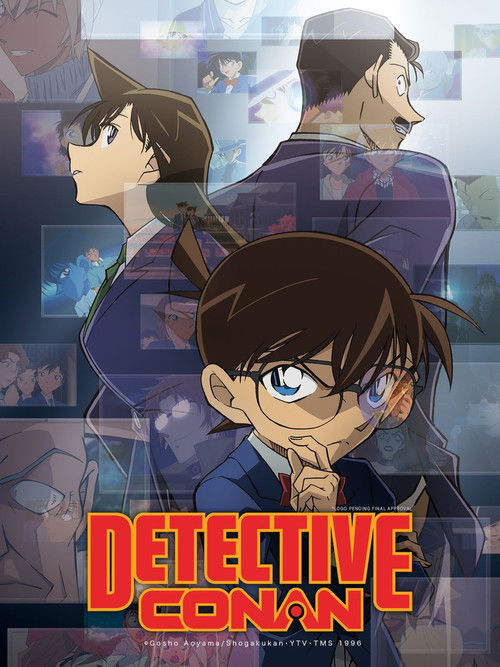
Detective Conan
The son of a world famous mystery writer, Jimmy Kudo, has achieved his own notoriety by assisting the local police as a student detective. He has always been able to solve the most difficult of criminal cases using his wits and power of reason.
Vivian's Take
There is anime, and then there is Detective Conan — a show that has been on television since 1996, outlived entire genres, and will probably still be airing when your grandchildren ask you what a 'locked room' is. The setup is famous enough to be folklore: brilliant teen detective Jimmy Kudo, poisoned by a shadowy syndicate, wakes up in a child's body and spends the ensuing decades solving murders one impossible crime at a time while pretending to be a grade-schooler. It sounds like a fever dream. It is, in fact, one of the most disciplined machines in the history of the medium.
The deep cut
What works is the formula — and I mean that as the highest compliment. Conan is a mystery engine built on classical rules: fair clues, clever misdirection, a solution you could have reached if you were paying attention. The show treats the whodunit with a reverence that Western television largely abandoned; every episode is a little contract with the viewer. The comedy lands because the characters are drawn broad enough to survive a thousand repetitions, and the long-running Black Organization arc gives the endless case-of-the-week structure a spine of genuine dread. An 8.0 across three decades of ratings is not an accident. It's tenure.
What doesn't work is the thing everyone knows: it never ends, and it was never going to. The central promise — Jimmy gets his body back, the syndicate falls — has been dangled for so long that it's become architecture rather than story. Newcomers face an episode count that reads like a typo, and the animation's quality swings with the budget of whatever year you're watching. Some cases are masterpieces of construction; some are the writers visibly filling a quota. You learn to love it anyway, the way you love a diner that's been open forty years.
Who it's for: mystery obsessives, anime lifers, and anyone who wants a show that will simply always be there. You don't finish Conan. You move in.
Where it sits
Conan is the bridge between two worlds: the golden age of the detective story and the anime boom. It carried the locked-room mystery into the 21st century and kept it alive through the era of the prestige antihero, when sincerity was supposed to be dead. Its influence on mystery anime is total — every clever-deduction series since lives in its shadow — and its cultural footprint in Japan is civic-institution level: the show has its own town, its own museum, its own place in the national furniture.
Globally, it's the quiet giant. While other anime broke through with spectacle, Conan broke through with consistency, becoming a gateway for viewers who didn't think they liked anime and a comfort object for those who'd already converted. In an age of eight-episode seasons and endless reboots, there's something almost radical about a show that just keeps showing up and doing the job.
The verdict
Three decades in, it's still the best argument for the case-of-the-week format ever televised. The endlessness is a feature and a flaw at once — but the mysteries are real, the deductions are fair, and no show in the genre has ever respected its audience's intelligence this consistently. A landmark, full stop.
The verdict: A — The eternal mystery machine: thirty years of fair-play whodunits, and still the gold standard of the form.
The full story
PREMISE · CAST · SEASONS · RECEPTION · IMPACT

The premise
Seventeen-year-old high school detective Shinichi Kudo — the “Modern Sherlock Holmes” — is poisoned by a shadowy crime syndicate while investigating them and wakes up in the body of a seven-year-old. To hunt the Black Organization without exposing the people he loves, he takes a new name — Conan Edogawa, borrowed from Arthur Conan Doyle and Edogawa Rampo — and moves in with his childhood friend Ran Mouri and her hapless private-detective father, Kogoro. From behind a bow tie that doubles as a voice changer, Conan solves the murders that keep landing at Kogoro’s door, tranquilizing the “sleeping” detective and delivering the deductions himself. It is a premise built to run forever: a serialized conspiracy (the syndicate, the shrunken scientist Ai Haibara, the slow-burn identity war) wrapped around an inexhaustible supply of fair-play whodunits — locked rooms, dying messages, alibi tricks — constructed with a reverence for the classical detective story that television largely abandoned.
The cast
The voice cast has been a constant for three decades: Minami Takayama as Conan Edogawa, Kappei Yamaguchi as Shinichi Kudo, Wakana Yamazaki as Ran Mouri, Megumi Hayashibara as Ai Haibara, and Kenichi Ogata as Professor Hiroshi Agasa, the inventor behind Conan’s gadgets. Kogoro Mouri was voiced by Akira Kamiya until 2009, when Rikiya Koyama took over — one of the rare recastings in a series defined by continuity. In English-speaking markets the series is known as Case Closed, a title adopted for legal reasons, with the dub carried for years by Funimation and the films and select episodes now streaming on platforms including Crunchyroll and Netflix.
Seasons
The manga by Gosho Aoyama began in Weekly Shōnen Sunday in January 1994 and is still running, with over a hundred collected volumes and more than 270 million copies in circulation — one of the best-selling manga series in history. The anime, produced by TMS Entertainment, premiered January 8, 1996 and has aired weekly ever since, passing 1,200 episodes with no end in sight. The theatrical films are an institution of their own: twenty-eight and counting, released almost every Golden Week in Japan, routinely ranking among the year’s highest-grossing domestic films. Spin-offs include the Zero’s Tea Time and The Culprit Hanzawa manga adaptations and the Wild Police Story arc.
Critical reception
Detective Conan holds an 8.0 on TMDB — a remarkable score to sustain across three decades of weekly output. Critics and fans credit the same thing: the mysteries are genuinely fair. Clues are planted, misdirection is honest, and the solutions reward attention rather than punishing it. The long game with the Black Organization — Vermouth, Gin, the slow reveal of the syndicate’s reach — gives the case-of-the-week engine a spine of real dread, and the series’ willingness to let its enormous cast age emotionally, if not physically, keeps the melodrama earned. The knock is the one everyone knows: the central promise has been deferred so long it has become architecture, and the episode count reads like a typo to newcomers. The fandom’s answer is that you don’t finish Conan — you move in.
Cultural impact
In Japan, Conan is civic infrastructure. The town of Hokuei in Tottori — Aoyama’s birthplace — rebranded itself “Conan Town,” complete with bronze statues, a Conan-themed train station, and the Gosho Aoyama Manga Factory museum. The character is a national mascot on the level of Doraemon, and the annual film release is a box-office ritual. Globally, the series carried the locked-room mystery into the 21st century and kept the classical whodunit alive through the prestige-antihero era, when sincerity was supposed to be dead. Every clever-deduction anime since lives in its shadow, and its quiet-giant international audience — built on consistency rather than spectacle — made it a gateway drug for viewers who didn’t think they liked anime. Thirty years in, it remains the best argument ever televised for the case-of-the-week format.