Bleach

TV Series
For as long as he can remember, Ichigo Kurosaki has been able to see ghosts. But when he meets Rukia, a Soul Reaper who battles evil spirits known as Hollows, he finds his life is changed forever. Now, with a newfound wealth of spiritual energy, Ichigo discovers his true calling: to protect the living and the dead from evil.
Year 2004
Genres Action, Animation, Sci-fi
TMDB rating ★ 8.4/10 audience score
For as long as he can remember, Ichigo Kurosaki has been able to see ghosts — and then he meets Rukia, a Soul Reaper who hunts evil spirits called Hollows, and his life changes forever. Bleach is one of the big three, the 2004 phenomenon that helped drag anime into the global mainstream, and at 8.4 it still converts new believers two decades later.
The hook
For as long as he can remember, Ichigo Kurosaki has been able to see ghosts — and then he meets Rukia, a Soul Reaper who hunts evil spirits called Hollows, and his life changes forever. Bleach is one of the big three, the 2004 phenomenon that helped drag anime into the global mainstream, and at 8.4 it still converts new believers two decades later.
The afterlife as bureaucracy remains one of shonen's great inventions. The Soul Society isn't heaven; it's a military government with paperwork, politics, and captains who'd stab you over protocol. Dropping a hot-headed teenager with a giant sword into that machine — and letting him break it, repeatedly, for the right reasons — is a premise with infinite fuel.
The deep cut
What works, twenty years on: Ichigo's arc from punk kid to reluctant guardian still plays, because the show never lets power come cheap — every transformation costs him something. The Soul Society remains one of anime's great settings, a whole civilization built from the question “what if death had middle management?” And the style — the coats, the swords, the sheer swagger of it — is substance here, not decoration. Bleach understood that cool is a narrative device.
The Rukia-Ichigo dynamic is the show's quiet heart: the professional and the amateur, the duty-bound and the defiant, each undoing the other's certainties. The series is at its best when it's about what protection costs the protector.
What doesn't: the filler arcs are legendary, and 366 episodes is a genuine commitment. New viewers should know the lore — the canon peaks are among shonen's highest, and the valleys are skippable. The 8.4 is the community telling you the peaks are worth the climb, and the recent revival proved the IP's immortality isn't just a theme, it's a business model.
Cultural context
Bleach is infrastructure. Along with its big-three peers, it built the global anime audience that everything since has inherited — the Toonami generation, the convention generation, the streaming generation. Its DNA is in every stylish action anime that followed, and its recent return reminded everyone that the Soul Society never really closed its doors.
Who it's for: everyone, eventually — but especially anyone who wants to understand where modern anime came from, and anyone who believes the afterlife should have better tailoring. Start at the beginning. Skip the filler. Thank me later.
The verdict
Grade: A. Two decades on, still the coolest afterlife in anime.
The full story
PREMISE · CAST · SEASONS · RECEPTION · IMPACT
The premise
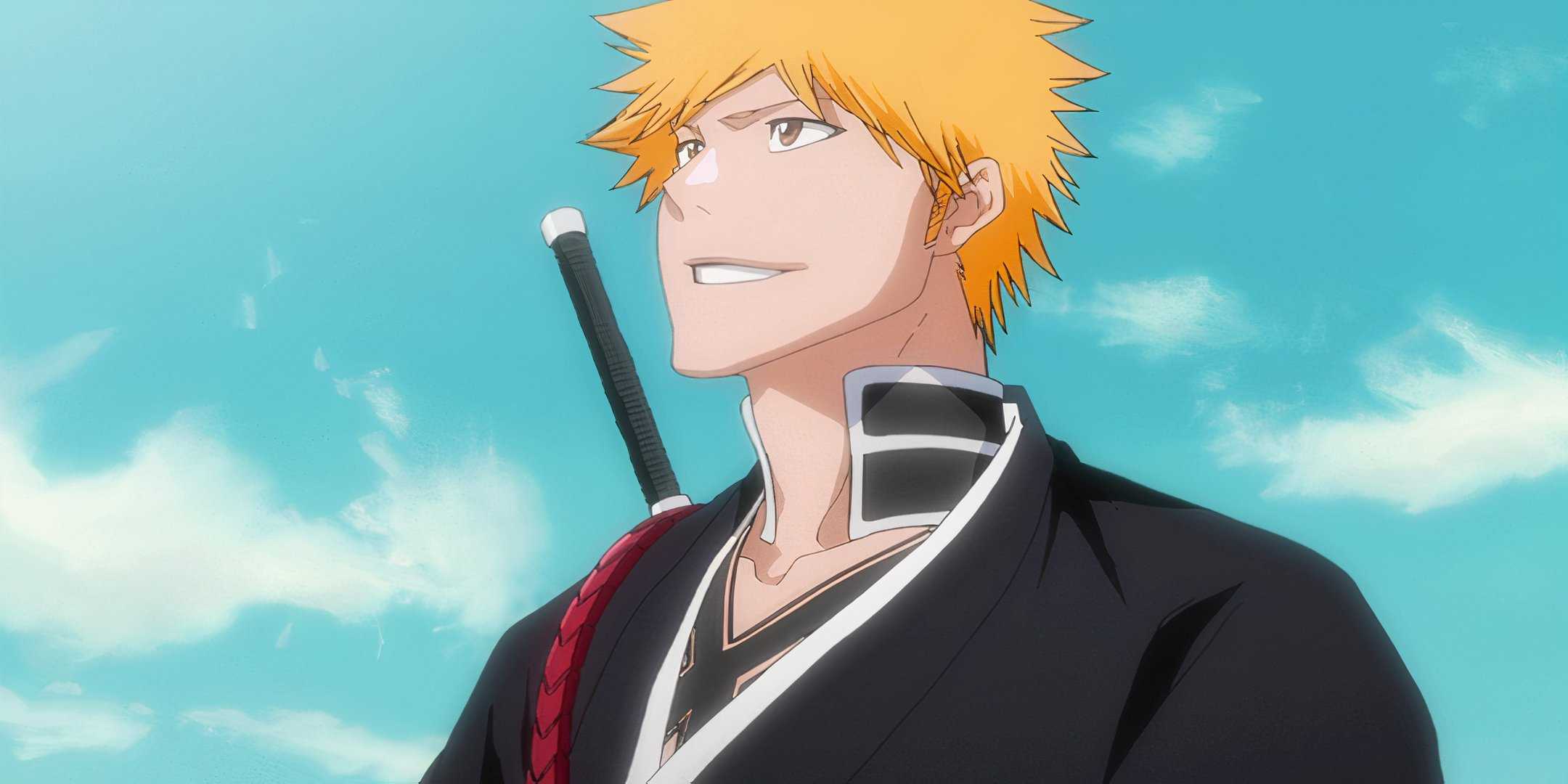
Fifteen-year-old Ichigo Kurosaki has always been able to see ghosts. Then he meets Rukia Kuchiki — a Soul Reaper, one of the sword-wielding psychopomps who shepherd souls to the afterlife and hunt the corrupted spirits known as Hollows. When Rukia is wounded in battle, she transfers her powers to Ichigo, and he becomes a Substitute Soul Reaper: part-time student, full-time guardian of the boundary between the living and the dead. What starts as a monster-of-the-week setup explodes outward into one of shonen’s great mythologies — the Soul Society, a militarized afterlife of thirteen court guard squads with its own politics, paperwork, and captains who will duel you over protocol.
Ichigo’s fight to rescue Rukia from execution pulls him into the Gotei 13’s civil war, then into a long shadow campaign by the traitor Sōsuke Aizen, then the Arrancar wars of Hueco Mundo, the Fullbring arc, and finally the Thousand-Year Blood War against Yhwach and the Quincy — the arc that ended the manga and, a decade later, got the anime ending it always deserved. Underneath the sword fights, Bleach is about what protection costs the protector: every power-up Ichigo earns takes something from him, and the series never lets heroism come cheap.
The cast
The Japanese voice cast is a hall of fame in itself: Masakazu Morita as Ichigo Kurosaki, Fumiko Orikasa as Rukia Kuchiki, Noriaki Sugiyama as Uryū Ishida, Yuki Matsuoka as Orihime Inoue, Hiroki Yasumoto as Yasutora “Chad” Sado, Kentarō Itō as Renji Abarai, Shinichiro Miki as the fan-favorite shopkeeper Kisuke Urahara, and Shō Hayami as the chilling Sōsuke Aizen. The English dub — which debuted on Adult Swim’s Toonami block and carried the series into the American mainstream — features Johnny Yong Bosch as Ichigo and Michelle Ruff as Rukia. Behind the camera, the original 2004 run was directed by Noriyuki Abe at Studio Pierrot; the Thousand-Year Blood War revival is chief-directed by Tomohisa Taguchi with music by Shiro Sagisu, who has scored the franchise since the beginning.
Seasons
The original Bleach anime ran for 366 episodes on TV Tokyo from October 5, 2004 to March 27, 2012, and spawned four theatrical films. When it ended, the manga’s final arc remained unadapted — until the 2022 revival Bleach: Thousand-Year Blood War returned in seasonal cours: The Blood Warfare (October 2022), The Separation (July 2023), The Conflict (October 2024), and the concluding The Calamity, which premiered July 25, 2026 and is airing weekly as of this writing — the grand finale of a story that began with the manga’s first chapter in August 2001, twenty-five years ago. With its conclusion, Bleach becomes the second of Weekly Shōnen Jump’s “Big Three” to finish its story on screen, after Naruto wrapped in 2017.
Critical reception
Bleach holds an 8.4 on TMDB and a place in the canon that no algorithm can revoke. The praise has always centered on the same things: Tite Kubo’s fashion-designer eye for character design, the Soul Society as a genuinely original fantasy setting, and fight choreography with a sense of style no peer could touch. The criticisms are equally famous — the Arrancar arc’s pacing and the legendary filler arcs (the Bounts, the Zanpakutō rebellion) that tested even devoted fans. The Thousand-Year Blood War has been received as a vindication: seasonal production, cinematic animation from Pierrot Films, expanded scenes overseen with Kubo’s involvement, and the manga’s infamously rushed ending given room to breathe.
Cultural impact
Bleach is infrastructure — one of the three series that built the global anime audience everything since has inherited. The Toonami generation, the convention generation, the streaming generation: all of them walked through doors Bleach helped open. Its DNA — the coats, the swords, the swagger-as-storytelling — is visible in every stylish action anime that followed, and Kubo’s designs crossed into streetwear and high fashion in a way few anime ever manage. The franchise has topped 130 million manga copies in circulation, generated a 2018 live-action film, stage musicals, novels, video games, and the Burn the Witch spinoff. Twenty-two years after Ichigo first picked up a sword, the afterlife still has the best tailoring in anime — and the finale airing right now is the end of an era for the medium.