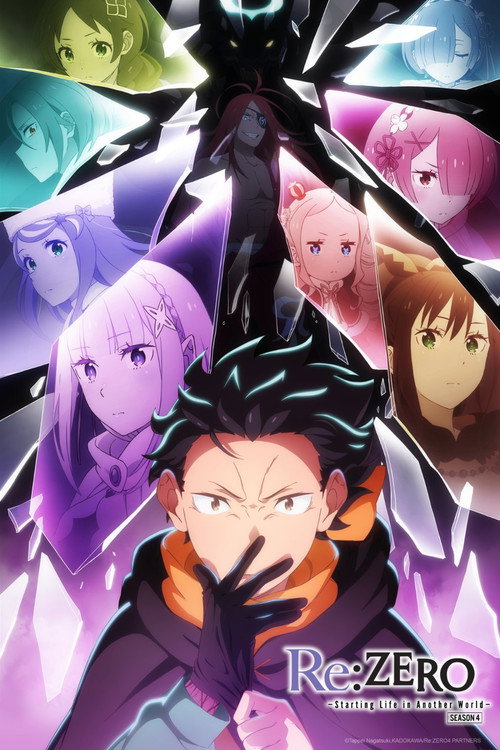
Re:ZERO -Starting Life in Another World- (2016)
Natsuki Subaru, an ordinary high school student, is on his way home from the convenience store when he finds himself transported to another world. As he's lost and confused in a new world where he doesn't even know left from right, the only person to reach out to him was a beautiful girl with silver hair. Determined to repay her somehow for saving him from his own despair, Subaru agrees to help the girl find something she's looking for.
Vivian’s take
A decade on, the isekai that broke isekai still hits like a truck. Natsuki Subaru gets the fantasy wish — yanked from a convenience-store run into another world, rescued by a silver-haired girl, adventure ahead — and the show spends its run making him pay for it in the most literal way the genre allows: dying, resetting, and remembering every single second.
01The Hook
A decade on, the isekai that broke isekai still hits like a truck. Natsuki Subaru gets the fantasy wish — yanked from a convenience-store run into another world, rescued by a silver-haired girl, adventure ahead — and the show spends its run making him pay for it in the most literal way the genre allows: dying, resetting, and remembering every single second.
The death-loop is not a gimmick; it is a thesis about trauma. Every reset keeps the memory and erases the progress, which means Subaru is not grinding levels — he is accumulating scars. No other fantasy series has ever made its protagonist’s power feel this much like a curse.
02The Deep Cut
What works is Subaru himself. He begins as one of anime’s most insufferable protagonists — loud, self-pitying, convinced the world owes him a hero’s arc — and the show’s long game is sanding him into something human without ever sanding off the edges that made him real. It is a character study disguised as a power fantasy’s autopsy.
What does not work is the punishment threshold. The suffering is the point, but there are arcs where the point gets made at a length that tests even loyalists — the show can feel like it is grinding its hero down just to prove it can. The 8.1 is the score of a masterpiece with a high cost of admission, and the cost is real.
Who it is for: anime fans who outgrew power fantasies and want the genre with consequences. If your isekai diet is pure wish fulfillment, this will feel like being mugged by your own escapism — which is rather the idea.
03Cultural Context
Re:ZERO arrived just as isekai became anime’s default setting and asked the forbidden question: what if the fantasy is hell? It carved the lane for every “dark” isekai since, and a decade later the imitators still cannot touch the original’s nerve — because they copied the suffering and missed the thesis.
It also endures as the genre’s great audience divider, and that is a feature. Shows this divisive about their own protagonist do not happen by accident; they happen when a studio trusts viewers to sit with discomfort. In an era of frictionless content, Re:ZERO’s friction is its legacy.
The Premise and the Loop
Natsuki Subaru is an ordinary shut-in teenager yanked into a fantasy world — the standard isekai wish-fulfillment setup. The twist is the price. Subaru's only power is "Return by Death": when he dies, time rewinds to an earlier checkpoint, and he alone remembers everything. What sounds like a cheat code becomes a psychological horror device. Subaru dies constantly — mauled, frozen, cursed, betrayed — and carries every death back with him, accumulating trauma no one else can see or share. He can't even explain the power; attempting to speak of it invites an unseen force that stops his heart. Around him orbits a cast the fandom will argue about forever: Emilia, the silver-haired half-elf whose bid for the royal selection drives the plot; Rem, the blue-haired demon maid whose devotion to Subaru became a genuine cultural phenomenon; her sister Ram; the library-dwelling Beatrice; the trickster spirit Puck; the impossibly perfect knight Reinhard; and the Witch of Greed, Echidna. The question is never whether Subaru can win — it's what surviving costs him.
Four Seasons Deep
The anime, produced by White Fox, premiered in April 2016 with a 25-episode first season directed by Masaharu Watanabe — and its brutally honest portrait of a self-loathing protagonist (the famous "From Zero" speech, where Subaru finally admits he's worthless and starts anyway) set it apart instantly. Season two arrived as a split-cour run across summer 2020 and winter 2021, another 25 episodes digging into Emilia's past and the Witches' Tea Party. Season three was announced in March 2023 and aired from October 2024 to March 2025: sixteen episodes in two arcs — the "Attack Arc" and the "Counterattack Arc" — adapting Arc 5 of Tappei Nagatsuki's light novels, directed by Masahiro Shinohara with themes "Reweave" by Konomi Suzuki and "Nox Lux" by Myth & Roid. Then the announcement fans had stopped daring to hope for: season four was confirmed the moment season three ended, and it aired April 8 through September 30, 2026 — nineteen episodes across the "Loss Arc" and the "Recapture Arc," adapting the legendarily punishing Arc 6, the Pleiades Watchtower storyline, with an opening theme pairing Konomi Suzuki and Ashnikko. Producer Sho Tanaka has already said the team wants to keep going into Arc 7 and beyond. The source light novels — written by Nagatsuki, illustrated by Shinichirou Otsuka, running since 2014 after a 2012 web-novel start — remain ongoing.

Reception and the Isekai It Broke
Re:ZERO arrived just as the isekai genre was curdling into power-fantasy formula — and it detonated the formula from inside. Critics and fans alike seized on its central heresy: the protagonist is the problem. Subaru's arc is about a boy learning that being the main character entitles him to nothing, and the show's willingness to make him genuinely unlikable for stretches of season one remains its bravest choice. The series has topped weekly anime rankings repeatedly across all four seasons, and its set pieces — Rem's confession, the first loop's gut-punch revelations, the mansion's horrors — are modern anime canon. Side stories like the Memory Snow and The Frozen Bond OVAs and the Isekai Quartet crossovers expanded the franchise, but the core thesis never moved: in a genre built on escapism, Re:ZERO is about the impossibility of escaping yourself.
Verdict: A-. The isekai genre’s great deconstruction — brutal, humane, and still unmatched at making fantasy hurt. A decade later, nothing in the genre has caught up.