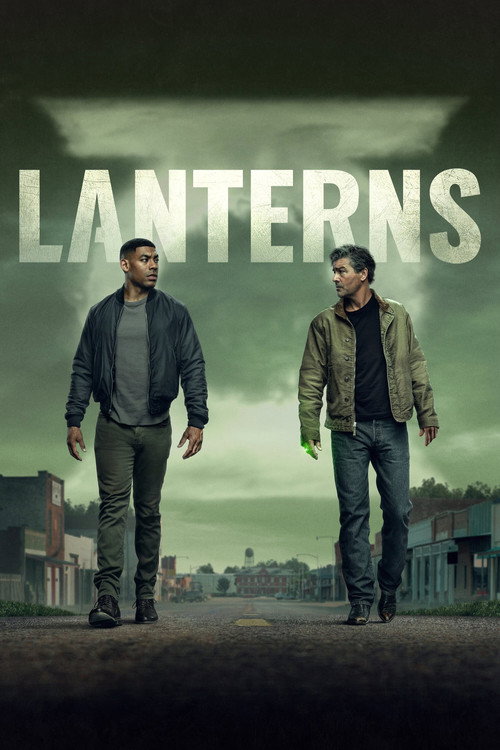
Lanterns (2026)
Two intergalactic cops, new recruit John Stewart and Lantern legend Hal Jordan, are drawn into a dark, Earth-based mystery as they investigate a murder in the American heartland.
The complete guide to Lanterns
HBO's Green Lantern detective series — the premise, the cast, the season one arc, the reviews, and what it means for the DC Universe.

The premise
Lanterns opens with the oldest trick in the detective genre's book — a body in a small town — and then quietly reveals that the small town is sitting on top of something cosmic. The series follows new recruit John Stewart and Lantern legend Hal Jordan, two intergalactic cops drawn into a dark, earth-based mystery as they investigate a murder in the American heartland. The logline is deliberately modest; what the two Lanterns uncover in their Nebraska investigation, HBO has been careful not to spoil, because the slow expansion of the case from a local homicide to something with consequences far beyond Earth is the engine the whole season runs on.
The show's signature move is inversion. Where most cape television starts cosmic and has to find its way back to something human for the finale, Lanterns starts with a corpse and a couple of detectives and lets the impossible leak in around the edges. The mystery is the plot; the mythology is the weather. The power rings still work the way the comics say they do — hard-light constructs born of willpower, the oath, the Guardians — but they arrive as instruments of detective work first and spectacle second. It's a grounded, TV-MA, premium-cable crime story that happens to be about Green Lanterns, and the discipline with which it holds that line is the entire point.
The cast
Aaron Pierre plays John Stewart, the new recruit — a former Marine turned Lantern whose discipline and moral clarity make him both the audience's way in and the show's thematic spine. Stewart is one of the most significant casting corrections in the history of superhero screen adaptation: a character who headlined Justice League Unlimited for a generation of fans and never got his live-action due until now. Opposite him, Kyle Chandler plays Hal Jordan as the legend at the far end of the legend — a Lantern who has been doing this long enough that the shine has worn off the uniform, which gives the central partnership its friction: one man still believes in what the ring means, the other has seen what it costs.
Around them, the cast fans out into the town the show never quite leaves behind. Kelly Macdonald plays Kerry; Garret Dillahunt is William Macon; Poorna Jagannathan is Zoe; Jason Ritter is Billy Macon. The DCU connections run through Nathan Fillion, reprising Guy Gardner after his debut in 2025's Superman, and Ulrich Thomsen as Sinestro — a casting that tells you exactly how far into the Corps' mythology the show is willing to go. Nicole Ari Parker plays Bernadette Stewart and Sherman Augustus plays John Stewart Sr., grounding Stewart's story in family. Laura Linney appears in an undisclosed role that the trailers suggest is designed to push Stewart past Jordan's legacy. The ensemble also includes Paul Ben-Victor as Antaan, J. Alphonse Nicholson, and Jasmine Cephas Jones.
The season
The first season runs eight episodes, premiering Sunday, August 16, 2026 at 9 p.m. ET/PT on HBO and streaming on HBO Max, with new chapters arriving weekly through early October. Showrunner Chris Mundy co-wrote the premiere with Lindelof and King; James Hawes directed the first two episodes, with Stephen Williams, Geeta Vasant Patel, and Alik Sakharov handling the rest. Production began in February 2025, and the trail of trailers — March, May, July — each widened the show's register, from pure heartland noir to footage of Hal Jordan in full uniform off-world, confirming that the mystery's ceiling was never the town it started in.
A second season was already in development before the first finished airing — the surest signal of how confident DC Studios was in the result. Structurally, the season plays like a limited series with an open door: the Nebraska case resolves, but the things it reveals about the Corps, the Guardians, and the larger DCU chessboard are clearly built to carry forward. The finale's placement in early October, in the thick of awards-season conversation, was no accident.
Critical reception
Reviews landed where the show needed them to. TV Guide's review praised its achievement of telling a mystery "in a decidedly TV-MA premium cable mode" while still functioning as a genuine Green Lantern story — rhyming oaths, Guardian visits, familiar villains intact — and singled out its willingness to let real-world material, including the centrality of Stewart's race to his character, live inside the fantasy rather than beside it. The comparisons critics kept reaching for — True Detective, Lindelof's own Watchmen — were compliments about method, not imitation: the show folds the fantastic into a recognizably real world and trusts the audience to meet it there.
The audience showed up, too. The show was reported as the biggest DC Studios premiere in HBO Max history, with more than nine million viewers in its first three days — a number that, if it holds, puts the series in the conversation with the streamer's heaviest hitters and validates the slow-build strategy of selling it as a crime story first and a cape story second.
Cultural impact
Lanterns is the flagship of the great superhero-TV correction. After a decade of multiverse bloat that collapsed under its own continuity homework, the winning formula turned out to be embarrassingly simple: pick a genre, execute it at prestige level, and let the capes be seasoning rather than the meal. It is, with James Gunn and Peter Safran executive producing, the first DCU television project to fully embody the new regime's thesis — and its success or failure was always going to be read as a referendum on whether the DC Universe could be a home for adult drama rather than just event spectacle.
And then there's John Stewart. For the generation that grew up on Justice League Unlimited, Stewart was always the Lantern — the steady, commanding, deeply human center of the Corps — and his absence from live action was one of the genre's longest-running wrongs. The show treats him not as a symbol or a corrective but as a cop with a past, which is both braver and better than either alternative. If the series endures, it will be remembered as the moment Green Lantern stopped being a punchline about a failed 2011 movie and became television's most interesting detective — a man with a ring that can make anything he imagines, investigating a murder nobody can explain, in a town nobody is watching. The infinite, made local.
Vivian’s take
DC finally learned the lesson the genre forgot: the costumes are the least interesting thing about superheroes. Lanterns takes two intergalactic cops — rookie John Stewart, legend Hal Jordan — and drops them into a murder investigation in the American heartland. It is True Detective with power rings, and it is the smartest thing DC has put on television in years.
01The Hook
DC finally learned the lesson the genre forgot: the costumes are the least interesting thing about superheroes. Lanterns takes two intergalactic cops — rookie John Stewart, legend Hal Jordan — and drops them into a murder investigation in the American heartland. It is True Detective with power rings, and it is the smartest thing DC has put on television in years.
The genius is the inversion. Instead of starting cosmic and shrinking to Earth for the finale, the show starts with a body in a small town and lets the cosmic leak in around the edges. The mystery is the engine; the mythology is the weather. Every cape show of the last decade did it backwards.
02The Deep Cut
What works is the partnership. The rookie-legend friction between Stewart and Jordan gives the show its spine — one of them still believes in the uniform, the other has seen what the uniform costs — and the heartland setting does quiet, crucial work: it makes the infinite feel local. A murder nobody can explain is scarier than a planet nobody has heard of.
What does not work, or threatens not to, is the middle. Mystery-box storytelling sags by gravity, and the eternal DC risk hovers over every episode: the moment universe-building homework intrudes on a good crime story. The 8.4 score says the show is holding the line so far — but vigilance, like the rings, requires willpower.
Who it is for: viewers who want their superheroes as a flavor rather than a lecture, crime-drama loyalists who never thought they would watch a Green Lantern show, and everyone who has been waiting for John Stewart to get the live-action showcase the comics owed him decades ago.
03Cultural Context
Lanterns is the flagship of the great superhero-TV correction. After the multiverse bloat collapsed under its own continuity, the winning formula turned out to be embarrassingly simple: pick a genre, execute it, let the capes be seasoning. Crime did it for the Penguin; noir-mystery is doing it here. The cape is not the story anymore — it is the lighting.
It also matters who is holding the ring. John Stewart’s arrival as a live-action lead is a genuine cultural milestone, the kind of casting correction fans campaigned for across eras of the franchise. The show treats him not as a symbol but as a cop with a past, which is both braver and better.
Verdict: A-. The rare cape show that trusts a murder mystery more than mythology — grounded, grown-up, and the clearest sign yet that DC’s television brain has finally switched on.