Dota 2
The hardest game to start and the hardest to quit.
The Story
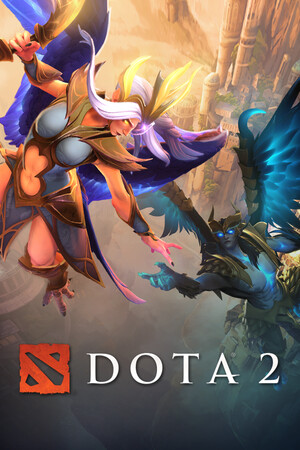
What it’s aboutTwo Ancients, ten players, one map that has been iterated for over a decade. Dota 2 is Valve's free-to-play MOBA: pick from more than 120 heroes — every single one free — and play the most mechanically and strategically dense competitive game ever made.
It hosts The International, the richest tournament in esports history, and a live game that Valve redesigns every year — meaning the player base re-learns the game annually, and loves it for that.
Read the full story
Start with the physicality, because people talk about Dota like it’s chess and forget it’s played with a mouse. Every hero has a turn rate — your character literally cannot spin on a dime — and attack animations with wind-ups you can cancel. Last-hitting is a metronome: you learn each hero’s projectile speed, damage timing, and animation the way a drummer learns tempo. At 25 minutes, one misclicked Blink Dagger ends the game. Input precision isn’t flavor here; it’s the whole competitive substrate.
The business model is the design statement, and it’s the one every live-service game should be embarrassed by. All heroes free. No pay-to-win, ever, in thirteen years. Money buys hats, announcer packs, and a battle pass — cosmetics and spectacle, never power. When a new player asks what they need to buy to compete, the answer is nothing, and that answer is a design choice with moral weight. Respect the grind means the grind is the same for everyone.
Then Valve does the thing no other developer does: they redesign the game annually. Patch 7.33 expanded the map by 40 percent and added universal heroes; every few years the fundamentals shift and millions of players re-learn matchups they thought they knew. Most studios would call that instability. In Dota it’s the content pipeline — the game stays unsolved, which is why the skill ceiling never arrives. A forty-hour RPG earns its runtime or it doesn’t; Dota asks for four thousand hours and, impossibly, keeps justifying them.
The dynasty deserves its own paragraph, because August 2026 made history twice over. Team Spirit’s first Aegis in 2021 was the ultimate underdog run — a team that had qualified through the open bracket beating PSG.LGD in Bucharest. The 2023 title in Seattle proved it was a dynasty. The 2026 title, after fighting through the lower bracket in Shanghai and beating TEAM VISION a third time that tournament, ended the debate: three Internationals (2021, 2023, 2026), breaking the two-title record Spirit had shared with OG and Team Liquid. Yatoro and Collapse stand alone as three-time champions; mid laner Larl joined the two-time club. As OG legend Ceb said before the final, the two had become the uncontested GOATs — and then they went out and proved it.
Zoom out and the competitive lineage is absurd. The International began in 2011 in Cologne with Natus Vincere lifting the first Aegis; the champions roll call runs through Alliance’s legendary 2013 run, Evil Geniuses (2015), Wings Gaming’s fairytale (2016), OG’s back-to-back titles (2018–19, still the only consecutive run), Team Spirit, Tundra Esports (2022), Team Falcons (2025, Hamburg), and now Spirit again. Fifteen editions, fourteen different narratives, one game that has never been dethroned as the deepest competitive title on earth.
The honest criticism, because KB doesn’t do hagiography: the onboarding is a failure. The tutorial teaches you which buttons exist and nothing about the game; the community — guides, coaches, flaming teammates — does the actual teaching. Difficulty as a design choice is fine; a new-player experience that shrugs is not. Valve has sanded the edges over the years, but the learning cliff is still a cliff, and pretending otherwise would be hype without substance.
The International remains the spectacle: crowdfunded prize pools that once topped forty million dollars, the Aegis, the career-defining moments. And the number underneath it all — 407,359 playing concurrently the last time we checked. A thirteen-year-old game with a tutorial that doesn’t work and a community that never leaves. Concurrent counts don’t lie: this is the deepest competitive game ever made, and it isn’t close.
At a Glance
The essentials- Released
- Jul 9, 2013
- Developer
- Valve
- Publisher
- Valve
- Platforms
- PC
- Genre
- MOBA
- Price
- Free to play
Previously Review
Our verdictWhere to Play
Free to playPreviously is an info-only guide: no games are played on Previously. Dota 2 is free to play on Steam.