PUBG: BATTLEGROUNDS
The game that invented the battle royale.
The Story
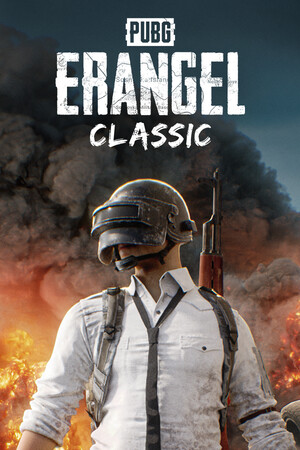
What it’s aboutOne hundred players drop onto an island. One leaves. PUBG: BATTLEGROUNDS — KRAFTON's 2017 phenomenon, born from Brendan ‘PlayerUnknown’ Greene's mods — defined the battle royale: loot, rotate, survive the shrinking circle, and be the last one standing.
It went free-to-play in January 2022 and never left the Steam charts: still one of the most-played games on the platform, still the standard every battle royale gets measured against.
Read the full story
The gunplay first, because it's still the best in the genre and it's not close. PUBG's weapons fire projectiles with travel time and drop — every shot is a physics problem, not hitscan charity. The Kar98k's crack across a field, leading a moving target with a Mini-14 at 300 meters, the full-auto spray you have to physically wrestle: attachments change the weapon's behavior in ways you feel in your hands (a compensator on a Beryl is a different gun). Every battle royale since has sanded this down for accessibility. PUBG kept the ballistics, and the skill expression that comes with them. Respect.
The circle is the design masterstroke — the pressure system that makes 100-player matches actually resolve. Loot phase, rotation phase, the slow squeeze that turns a 8x8 kilometer map into a parking lot. Third-partying — the vulture art of arriving at someone else's fight — isn't an exploit; it's the intended grammar. Erangel's geography teaches risk-reward by location: the School and Georgopol pay out because everyone knows they pay out. Every BR map since is a variation on this syllabus, and most of them are worse at it.
The jank, honestly, because KB doesn't do hagiography. PUBG launched rough — the memes about vaulting, the vehicles with minds of their own — and some of that roughness turned out to be load-bearing. The panic of a buggy moment is part of the game's texture; the stories players tell are never about the clean kills. But credit the long grind: years of optimization later, it's stable and serious, and the current build is the game the 2017 launch wanted to be. A live game earning its redemption in patch notes is a story I respect more than a clean launch.
The free-to-play pivot in January 2022 was the business model catching up to reality — the audience was always going to be massive, and the paywall was just friction. Since then: ranked, training modes, a rotating map pool (Erangel, Miramar, Taego, Deston and counting), collaborations with everyone from Ferrari to Stellar Blade, and console and mobile footprints that keep the whole thing fed. KRAFTON marked the 9th anniversary in March 2026 with a major update, and analysts tracking the Steam charts put the peak concurrent at 1.3 million — matching the prior year’s high — with a sustained peak around 800,000 players a day. For the genre’s originator, nearly a decade in. The clones had bigger marketing budgets. The original kept the ballistics. Concurrent counts don’t lie: chicken dinner is still on the menu.
The origin story is almost as famous as the game. Brendan Greene — PlayerUnknown — was a modder: his DayZ: Battle Royale mod on ARMA 2, then the ARMA 3 variant, proved a hundred-player last-man-standing loop could work at scale. Sony Online Entertainment hired him to consult on H1Z1; then Bluehole (now KRAFTON) flew him to Seoul in 2016 and built a studio around his mod. Early access hit Steam on March 23, 2017, and the numbers were absurd: a million copies in 16 days, three million in the first week, tens of millions within the year. By January 2018 it had 3.2 million concurrent players on Steam — the biggest paid-game peak the platform had ever seen, a record it held for years and only recently began to share. Every battle royale you know is downstream of a modder with a server and an idea.
The empire spread. PUBG Mobile — built by Tencent’s LightSpeed & Quantum studio — became one of the highest-grossing mobile games in history, a billion-downloads phenomenon that turned “chicken dinner” into a global phrase (and spun off Battlegrounds Mobile India after the 2020 ban). The esports circuit — the PUBG Global Championship, the PUBG Continental Series, the Nations Cup — kept the competitive flame serious long after the novelty streamers moved on. The franchise math is the real story: this stopped being just a game years ago. It’s an IP that funds a company.
And it’s still evolving. KRAFTON’s 2026 roadmap is the most ambitious in years: a full transition to Unreal Engine 5 — the team insists it’s “not a simple engine port” — destructible terrain on Erangel, interactive smoke, gunplay meta rotations every four months with new weapons and attachments (the Hybrid Scope and Tilted Grip arrived in April), and the PUBG User-Created Content project so players can build and share their own modes, starting with Team Deathmatch. Beyond the core game, the franchise is expanding into a “PUBG 2.0” platform vision: the extraction shooter Project Black Budget, the console-focused battle royale Project Valor, and the top-down tactical shooter PUBG: BLINDSPOT. Nine years in, the godfather of battle royale is rebuilding the house instead of coasting on the rent. Respect.
At a Glance
The essentials- Released
- Dec 20, 2017
- Developer
- KRAFTON
- Publisher
- KRAFTON
- Platforms
- PC · Console · Mobile
- Genre
- Battle royale
- Price
- Free to play
Previously Review
Our verdictWhere to Play
Free to playPreviously is an info-only guide: no games are played on Previously. PUBG: BATTLEGROUNDS is free to play on Steam.