It sold for $19,000 in 1984. The painting didn't change. Everything around it did — and explaining that gap, not admiring it, is the story.
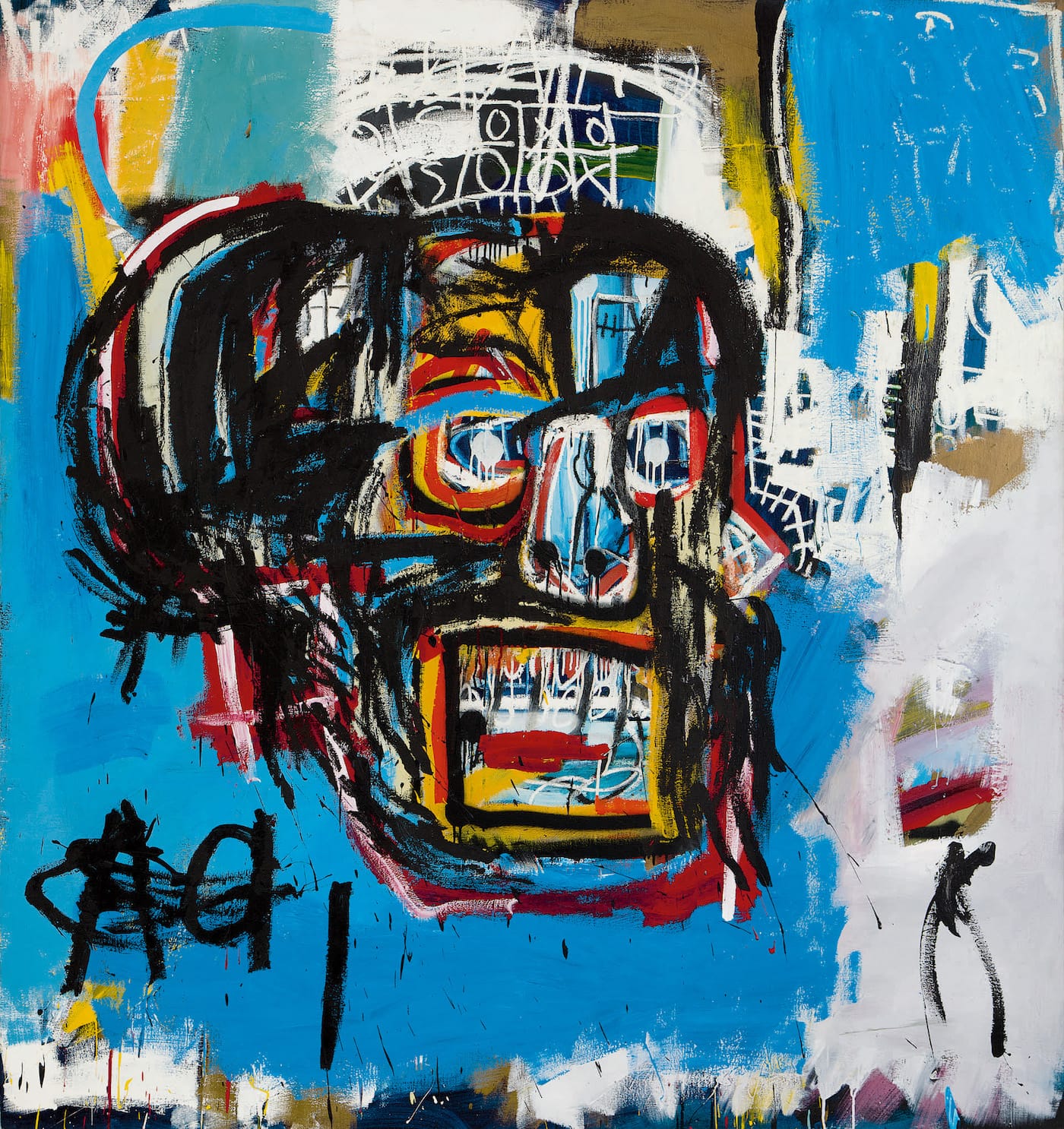
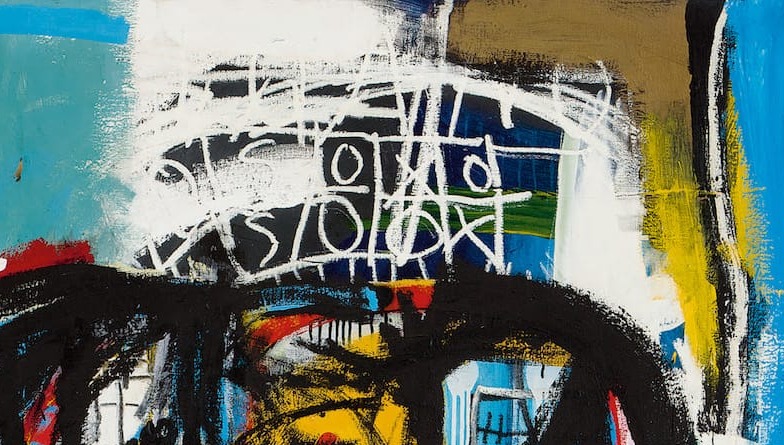
The painting is Untitled, 1982: acrylic, spray paint and oilstick on canvas, 72⅛ × 68⅛ inches — a head six feet tall, built from the materials of the street, the spray can and the oil stick Jean-Michel Basquiat carried from his SAMO graffiti years into the studio. The image is a skull that refuses to sit still as anatomy.
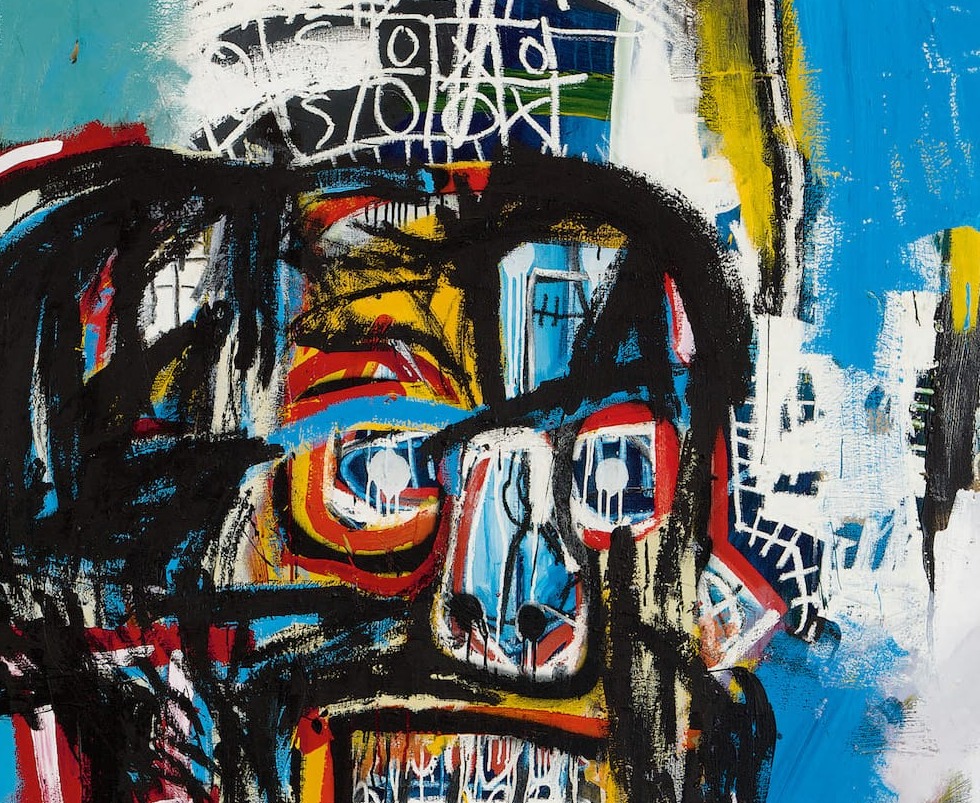
Basquiat had been obsessed with Gray's Anatomy since childhood — a copy given to him while he recovered from a car accident at seven — and the head here is drawn like a medical plate torn open: bared teeth in a grid, staring eye sockets, the cranium mapped with lines, arrows and half-legible notations, black strokes over an electric blue ground with red and yellow breaking through. Part self-portrait, part diagram, part memento mori, painted at 21 in the single year, 1982, that the market has since decided was his peak. He was dead six years later, at 27. The fixed supply behind every number in this story is not a strategy. It is a biography.
The $19,000 painting
Jerry and Emily Spiegel, collectors who bought early and bought seriously, acquired Untitled in 1984 for $19,000. Then the painting essentially vanished — held privately, not exhibited, not traded, for more than three decades. When it came to market in 2017 it arrived with the two things the top of the art market pays for above all else: a canonical image from the artist's canonical year, and freshness. It had no auction history to argue with, no recent price to anchor against. The room had to invent the number in public, in about ten minutes.
The man who had already set the floor
A year earlier, in May 2016, Yusaku Maezawa had paid $57.3 million at Christie's for another 1982 Basquiat — the horned devil Untitled — which was itself the artist's record. So when the skull came up at Sotheby's New York on 18 May 2017, as Lot 24 of the Contemporary Art Evening Auction, the bidding opened at $57 million: exactly where one man's previous purchase had ended. It climbed for about ten minutes. The hammer fell at $98 million; with the buyer's premium the total was $110,487,500, against an estimate of $60 million.
That is the mechanism this story is about. At the very top of the market, a price is not discovered by a crowd. It is set by the two or three collectors competing for the same wall — and in 2016 and 2017 the marginal price-setter for Basquiat was substantially one buyer, bidding by phone from Tokyo through Sotheby's specialist Yuki Terase, doubling his own record in twelve months. When the hammer fell, auctioneer Oliver Barker's line, reported at the time, was: 'Now he goes into the pantheon.' Maezawa announced himself on Instagram within minutes: 'I am happy to announce that I just won this masterpiece.' Sotheby's later cut the sale into a short film, The Battle for Basquiat.
What the price was actually buying
Not materials — acrylic and spray paint on canvas are cheap, and this story will not pretend otherwise. The $110.5 million bought, in order: the strongest image from the most contested year of an artist dead at 27, whose supply cannot grow; a 33-year-unseen provenance that let the room write its own number; and position — the result made Basquiat, a Black artist from Brooklyn who started as a graffiti writer, the most expensive American artist at auction, as that record stood in May 2017, and the painting the most expensive artwork created after 1980. Those titles are dated claims and this story keeps their date on them; the market has moved since.
The print ladder
You can own Basquiat's line without owning a canvas, and the ladder is documented. Unlicensed and poster prints trade at the bottom, in the low hundreds of pounds. The Estate's authorised screenprint programme — editions of 60 to 85 — releases at serious money and climbs: Flexible, released by Pace Prints in 2016 in an edition of 85 priced from $40,000, resold at Sotheby's Singapore in 2023 for roughly US$281,753. Lifetime signed prints sit above that: a signed 1983 Untitled print made over £2.52 million at Sotheby's in November 2022. And then the canvas, at $110.5 million — roughly 390 of the estate prints, about 44 of the signed lifetime prints, or one painting. What the canvas has that no edition does is singularity. There are 85 Flexibles. There is one of this.
Where it hangs now
Maezawa did what he said he would do with it first: he lent it. The painting's first museum exhibition was One Basquiat at the Brooklyn Museum in early 2018 — the museum Basquiat joined as a junior member at six — followed by the Seattle Art Museum. The Chiba museum he planned as its permanent home was still its stated destination when the picture changed hands again: in November 2024 Maezawa sold the painting privately to Ken Griffin, the Citadel founder, for what Artnet reported as US$200 million. Griffin declined to comment on the price, and this story reports the figure as reported, not confirmed.
As of this autumn the painting is on public view again — lent by Griffin to the Pérez Art Museum Miami for Basquiat: Figures, Signs, Symbols, which opened on 25 June 2026 with nine paintings and a sculpture from his collection. The price was set a second time, privately, by the same tiny circle that sets it at the top of this market. The painting still hasn't changed.
Sources · 7 sources
- Sotheby's, Contemporary Art Evening Auction results, 18 May 2017 — Lot 24
- Hyperallergic, 19 May 2017 — sale report and the house's film
- Culture Type, 25 May 2017 — lot detail and the 1984 Spiegel purchase
- Sotheby's Magazine — 'Beyond the $110 Million Basquiat' (Terase phone bid; Barker)
- Artnet News — the reported 2024 private sale to Ken Griffin
- Artsy, April 2026, and Straits Times, July 2026 — the PAMM exhibition and loan
- Brooklyn Museum press release, January 2018 — One Basquiat; Estate credit line