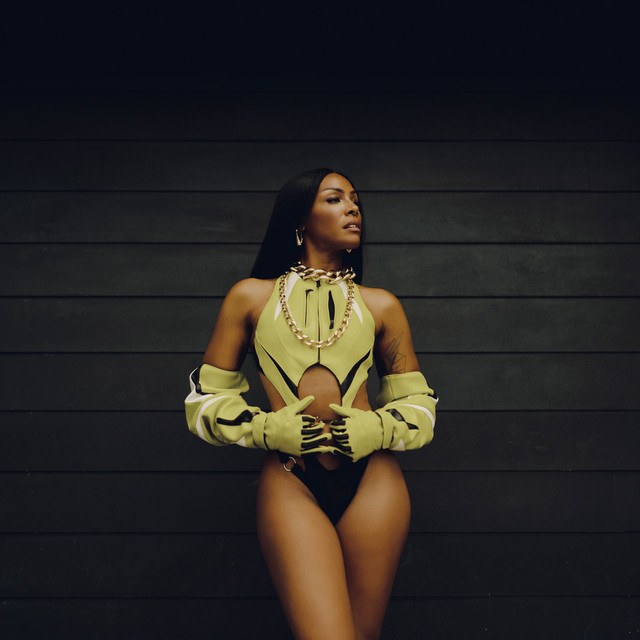
NEW ORLEANS — Dawn Richard doesn't make throwback records. She makes records about where the culture is going. Creole Culture, her new album, arrives October 9 via Merge Records — and instead of memorializing New Orleans, it imagines the city's future, blending Black and Native American Creole traditions with futuristic R&B, soul, pop, hip-hop, jazz, and Afro-Caribbean bass.
The singles sketch the emotional range. "enough" trades flashy production for vulnerability — smooth synth textures, warm percussion, and Richard's voice front and center, intimate without losing the futuristic identity she's been building for years. "baby, can we?" featuring Durand Bernarr leans into the album's soulful chemistry, two singers who understand that the harmony is the conversation.
This completes another chapter in one of the most quietly ambitious catalogs in modern R&B. After the critically acclaimed New Breed and Second Line, Richard keeps pushing the New Orleans-inspired vision forward — not as nostalgia, but as a living language. The heritage isn't decoration here; it's the foundation the future gets built on.
What I keep coming back to is the confidence of the genre-blending. Lesser records treat fusion like a playlist; Creole Culture treats it like a birthright — the brass, the bounce, the bass, the balladry all speaking the same Creole. Richard has always sung like someone who knows exactly where she comes from and exactly where she's taking it.
The Merge Records home matters, too. An independent label with a long memory for artists who don't fit the algorithm's boxes is the right soil for a record this specific — one that asks the listener to meet it on its own terms instead of sanding down the edges. Creole Culture doesn't explain New Orleans to outsiders; it speaks to the people who already know, and invites everyone else to catch up.
October 9. A record about a city's future, sung by one of the few artists with the range — and the roots — to imagine it.
Key facts
Reporting this story is based on
- Dawn Richard Announces New Album Creole Culture For October 2026 Release, Shares New Single "Enough"
mxdwn Music — 2026-08-05 - Dawn Richard Announces New Album 'Creole Culture'
Clash Magazine — 2026-08-05 - Dawn Richard Announces New Album Creole Culture, Shares Latest Single 'enough'
Consequence — 2026-08-05 - Creole Culture
Merge Records (via Bandcamp) — 2026
Album announcement, tracklist, and single details via mxdwn Music, Clash, and Consequence (Aug. 2026); artist background via Merge Records/Bandcamp.
To understand why this record matters, you have to understand the trilogy it completes. New Breed (2019) was, in Richard's words, “the story of New Orleans through my father's eyes.” Second Line: An Electro Revival (2021) was her mother's — a record that landed at No. 21 on the year's best-albums lists. “But the story felt unfinished,” Richard said, “like my version of the story was untold.” Creole Culture is that version. Not a memorial, not a history lesson — a utopian soundscape, an intoxicating blend of R&B, soul, hip-hop, pop, and jazz, imagining a New Orleans that survived and thrived despite everything visited upon it. As Richard put it: “Creole Culture is my way of saying that New Orleans culture doesn't have to live in the past to be authentic. It can be progressive. It can be global. It can be pop culture. It can look like me.”
The “me” in that sentence is doing a lot of work. Richard is a Black and Native American woman who has spent a lifetime making music on her own terms — from the MTV Making the Band years with Danity Kane to one of the most quietly ambitious solo catalogs in modern R&B. Since Second Line she's released two collaborative albums with neoclassical composer Spencer Zahn — 2022's Pigments and 2024's Quiet in a World Full of Noise — and teamed with Toronto saxophonist Joseph Shabason on a Sade tribute, “Broken Hearted Sade.” On Creole Culture she steps into the role of King Creole, rebuilding her hometown in her image — steeped in history, as Merge puts it, “but with its flag planted firmly in the future.”
The guest list reads like a family reunion and a summit at once. Big Freedia opens the record on “A Creole Culture Intro.” Anjelika “Jelly” Joseph brings the choir to “Chuuuuurch.” Tarriona “Tank” Ball lends her unmistakable tone to “L V R.” Durand Bernarr, already heard on the June single “baby, can we?,” returns for what the early previews promise is the album's soulful center. And then there's “Groove City,” featuring Frank Richard of Chocolate Milk — her father's band, the living link between New Breed's eyes and this record's voice. The full eleven-track sequence runs from the intro through “Enough,” “Only Fans,” “Pilates,” “Motives,” “Fiesta,” and the closer “Faith in the Fire.” Co-executive producing the whole thing is Katalyst, the Inglewood-based collective founded by drummer and producer Greg Paul, who Richard says helped expand the vision beyond genre entirely.
Then there's “enough” itself — the single that's been out since August and the clearest window into what this album is for. Richard calls it a song about “unlearning the lie that your value has to be earned”: “Sometimes the greatest act of resistance is believing you were always worthy.” It floats on horn-filled production built around a sample of Sister Nancy's beloved 1982 dancehall classic “Bam Bam,” with Richard singing to her partner and hyping herself up in the same breath — triumphant and tragic, sexy and mournful, braggadocious and contemplative, the way Merge's own notes describe the record. Richard has been taking the new material on the road since August — Chicago first, then New Orleans, New York, Philadelphia, and Washington, D.C. For more on the R&B season, see our coverage of Lucky Daye's Aloud, Nao's autumn soulful suite, and Victoria Monét's Frequency of Love. October 9. A record about a city's future, sung by one of the few artists with the range — and the roots — to imagine it.