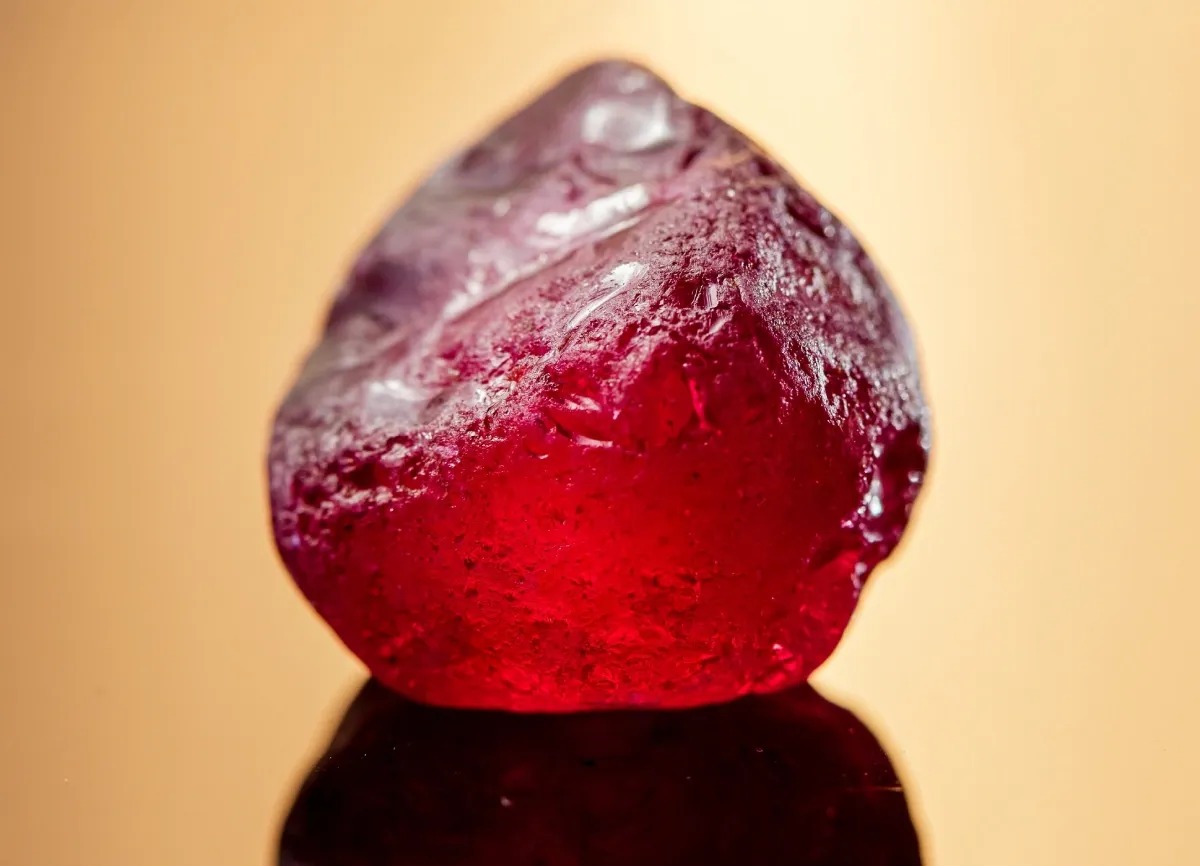
Begin with the material rather than the price. In July 2022, at FURA Gems' Montepuez mine in Mozambique, miners recovered a rough ruby of 101 carats: a single crystal, roughly three centimetres by two, whose color and transparency were visible before anyone cut it. FURA named it Estrela de FURA — Star of FURA — and in September 2022 it was unveiled in Dubai as the largest gem-quality ruby rough ever found.
That claim is specific and it is the one that matters. Rubies are corundum colored by chromium, and fine stones above five carats are rare; above ten, exceptional. A rough of 101 carats showing gem color through its skin is a different category of object from a large stone that merely exists. Weight it could spare. What it could not survive was a bad cutting decision.
The cut was the gamble
FURA's founder and chief executive, Dev Shetty, has said the company weighed selling the rough to trade clients, then decided instead to cut it and realize its full potential. Cutting is where a great rough is usually spent: every facet plane removes weight, and the cutter is trading carats for light. The team FURA assembled — advisors drawn from the trade's senior benches, cutting in Bangkok — brought the crystal down to a cushion of 55.22 carats. Nearly half the stone was cut away to free the color.
Five laboratories examined the result: Gübelin, SSEF, GRS, AGL and Bellerophon. All five converge on the same core account — a natural ruby, Mozambique origin, with no indications of heating. Heat is the trade's ordinary lever for improving a ruby's color and clarity; a stone that reaches vivid red without it keeps a distinction no treatment can add later. Bellerophon's report, no. B7316 of 14 February 2023, weighs the stone at 55.222 carats, measures it at 21.09 × 19.79 × 14.84 millimetres, grades the color vivid red — 'pigeon blood' in the trade's oldest compliment — notes its strong red fluorescence, and gave it the lab's Elysium Award. Two of the five labs applied the pigeon's-blood term; the convergence on no-heat is unanimous.

What the room paid
Sotheby's offered the finished stone in New York on 8 June 2023, as Lot 59 of its Magnificent Jewels sale, with an estimate on request and an expectation, stated in advance, of more than $30 million. The hammer fell at $30 million; with the buyer's premium the price realized was $34,804,500. Divided by the finished weight, that is $630,288 per carat.
The buyer, as Sotheby's reported it, was a private collector from the Middle East. The sale total that day, $95.9 million, was a record for a Sotheby's New York jewellery auction, and the ruby shared the bill with the Eternal Pink diamond, which made the identical $34,804,500 — the first time two stones above $30 million had sold in a single auction.
One object, described two ways
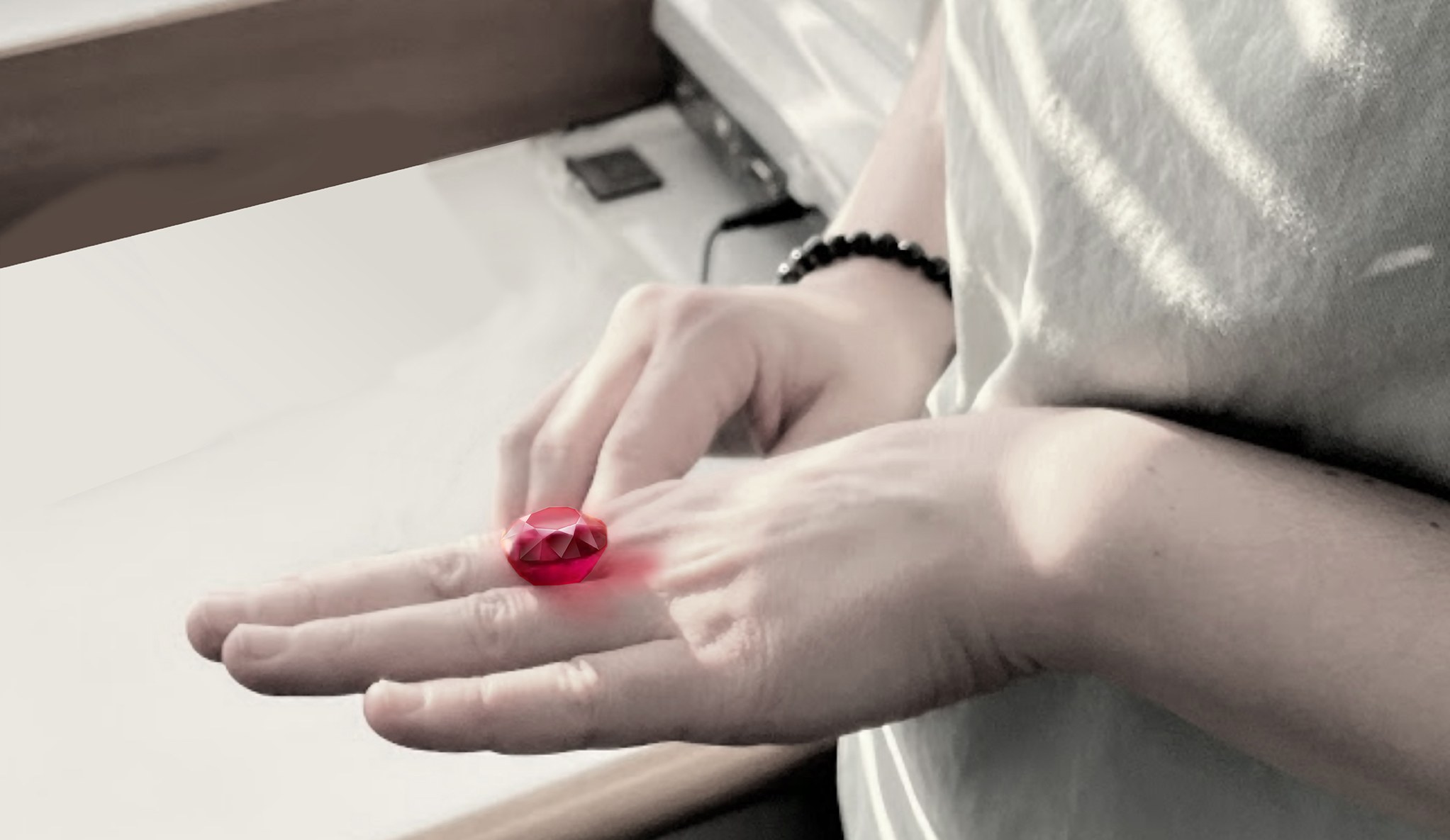
The catalogue describes the lot as the cushion-cut ruby set as a ring, size 6½ — and that is how the sale was reported. The same lot page carries a saleroom notice that settles the question the other descriptions raise: the ruby was currently unmounted, and would be remounted for the purchaser by Sotheby's on request. Guinness World Records, which lists the stone as the most expensive ruby ever sold, describes it unmounted. Both accounts are true to their moment: catalogued as a ring, handed over loose, with the mounting offered to whoever won it. The pictures on this page show the stone the way the buyer received it.
The record it took — and still holds
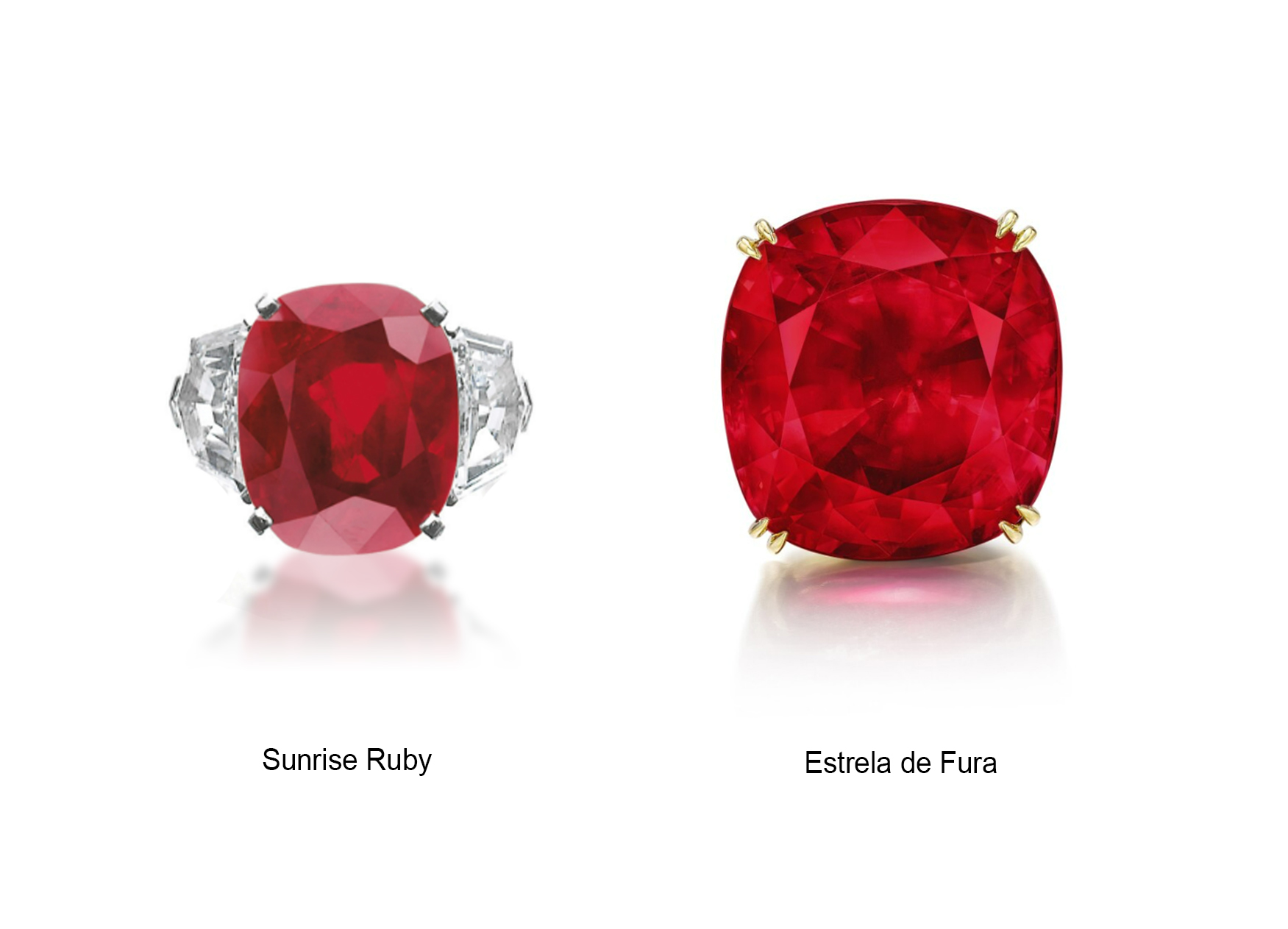
The prior benchmark was the Sunrise Ruby, a 25.59-carat Burmese stone in a Cartier ring that made $30.3 million at Sotheby's Geneva in May 2015 — about $1.19 million a carat, still the higher per-carat figure. The Estrela took the totals: the highest auction price ever paid for a ruby, and for any colored gemstone, as the record stands in November 2026 — current roundups of record rubies still name it the holder. It is also, at more than twice the Sunrise's weight, the largest ruby ever sold at auction.
A finished comparison gives the scale of the market below it. Houses such as Graff, Harry Winston and Tiffany sell fine unheated rubies by the stone, quoted on application rather than from a public list, and exceptional stones in the one-to-five-carat range transact in the tens of thousands per carat. Weigh the Estrela against a strong commercial benchmark instead: a certified unheated Mozambique ruby of about a carat from a working gem dealer asks in the low thousands per carat — the Estrela's $630,288 is roughly two hundred times that rate, and the stone is fifty-five times the size. Size and price per carat are supposed to move against each other. Here, uniquely, they did not.
What the buyer owns is a stone whose origin broke a hierarchy. For a century the finest rubies were Burmese by definition, and Mozambique — mining at Montepuez only since the late 2000s — was the trade's volume story, not its pinnacle. The Estrela is Mozambique material that five laboratories examined and none could fault, cut from the largest gem rough of its kind on record, and bid to a number no colored stone had reached. Whether it is ever resold is unknowable; named stones of this rank tend to disappear for a generation. The record it set is a single verifiable event: one room, one afternoon, $34,804,500.
Sources · 7 sources
- Sotheby's lot page and result (Lot 59, Magnificent Jewels, New York, 8 June 2023), incl. the saleroom notice on mounting
- Rapaport News, 11 June 2023
- Forbes (Anthony DeMarco), June 2023
- GlobeNewswire / FURA Gems-Sotheby's release, 6 April 2023
- Bellerophon Gemlab — the examining laboratory's own account and report B7316
- Guinness World Records — most expensive ruby
- Galerie Magazine record-ruby roundup, updated 11 November 2026 (record still standing)