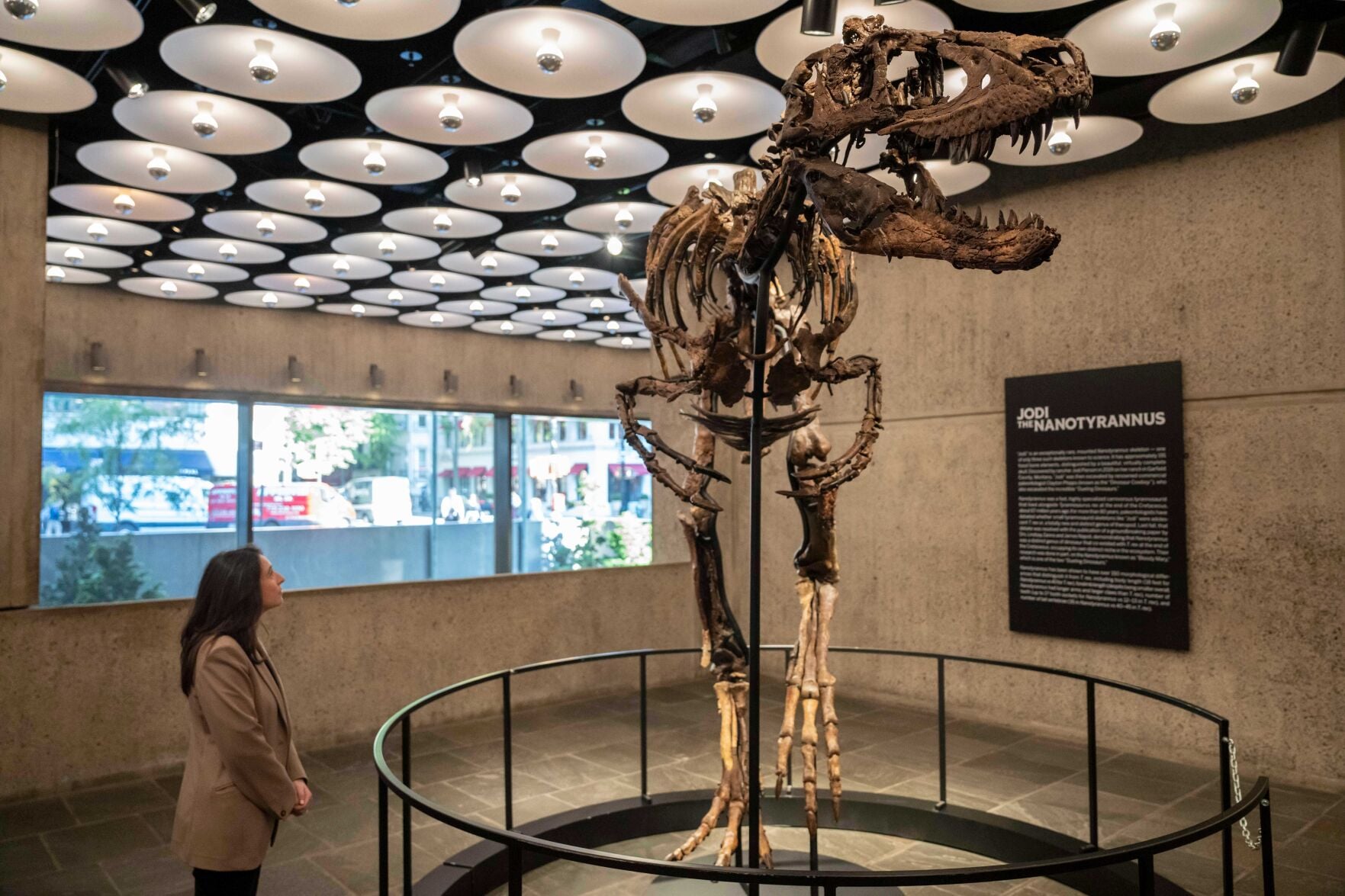

Twelve minutes. That is all it took on Tuesday at Sotheby's New York for a dinosaur most people have never heard of to become the second most valuable fossil ever sold at auction. When the bidding closed, "Jodi" — a mounted Nanotyrannus skeleton, roughly 67 million years old — stood at $47.3 million, a figure that includes the auction house's fees; ARTnews reported the hammer price itself at $40.5 million. Six bidders competed online and by phone, the Associated Press reported, and the room broke into applause when the winning bid landed. The buyer, bidding by telephone, has not been identified.
Sotheby's had estimated the skeleton at $6 million to $9 million. Measured against the top of that range, the final result is more than five times what the house expected — for an animal that, until very recently, half of paleontology insisted did not exist.
Second only to a T. rex
The only dinosaur that has ever sold for more is the one Jodi is constantly mistaken for. "Gus," a Tyrannosaurus rex, brought $50.1 million at Sotheby's this past July, Smithsonian Magazine reported — a 38-foot giant, roughly twice Jodi's length. Behind Jodi now sits "Apex," the Stegosaurus that sold for $44.6 million in 2024. Sotheby's holds all three of the top fossil prices in history, and the gap at the top of that list is no longer between species anyone can tell apart at a glance: it is $2.8 million between a T. rex and the smaller predator that spent a century in its shadow.
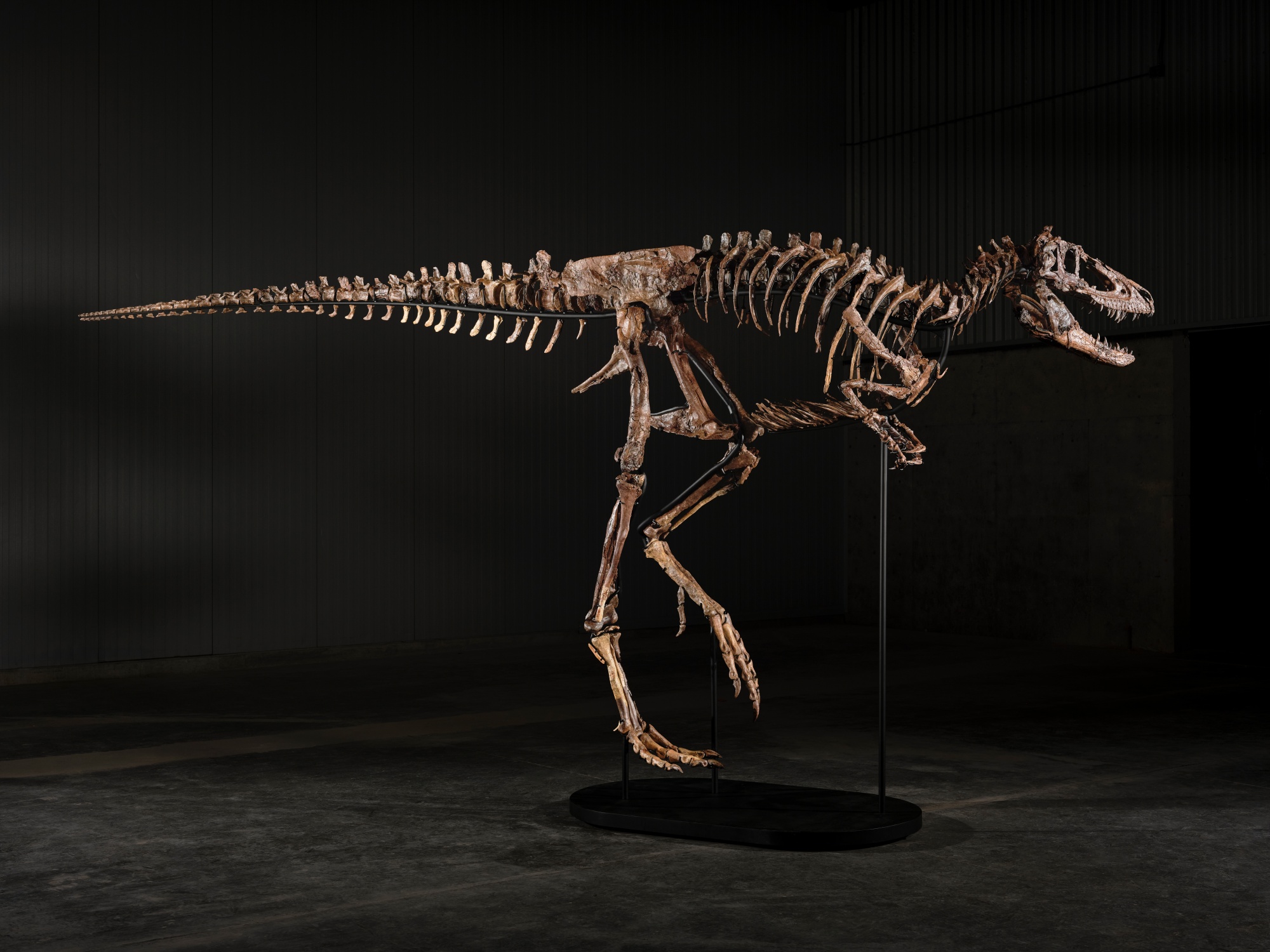
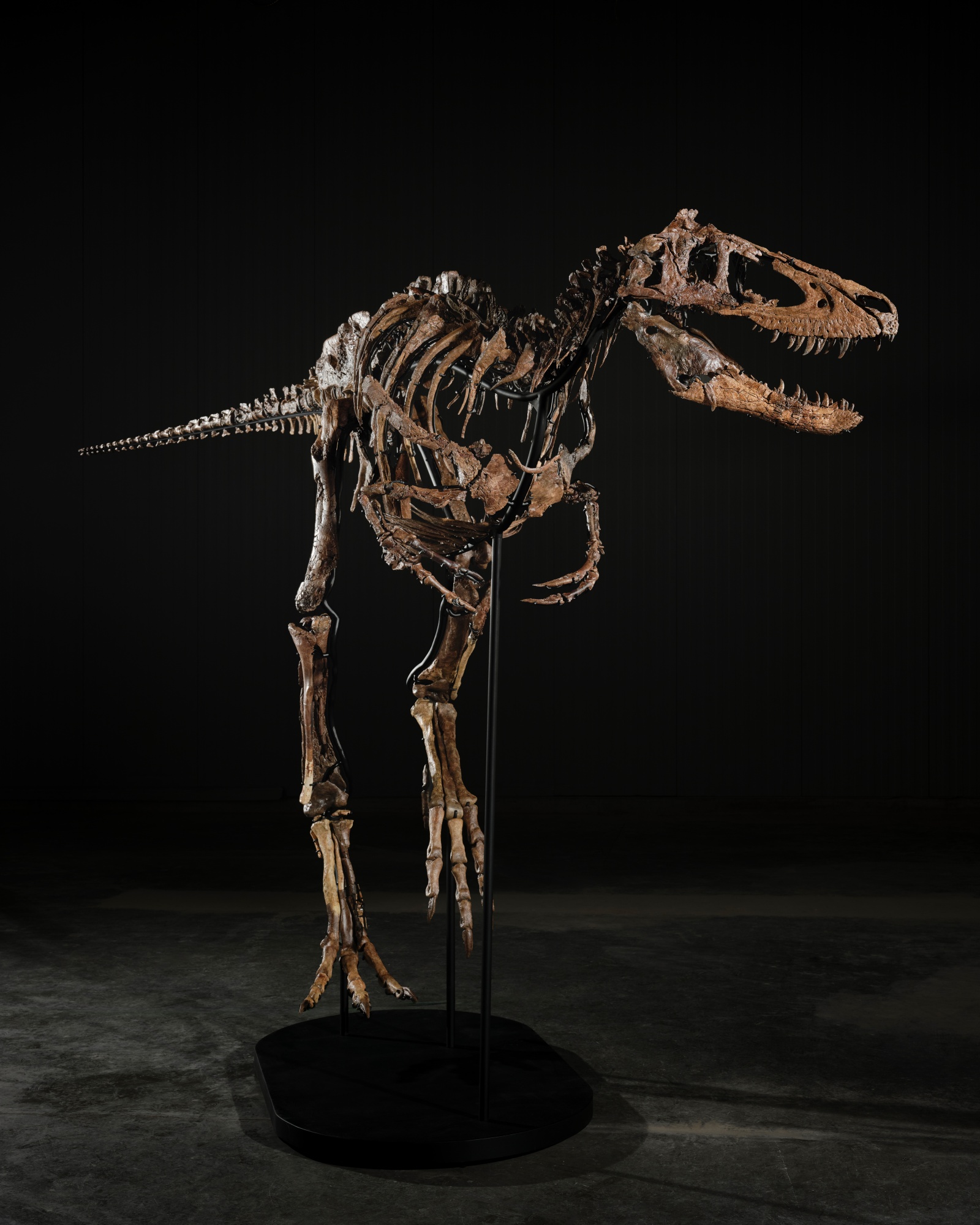
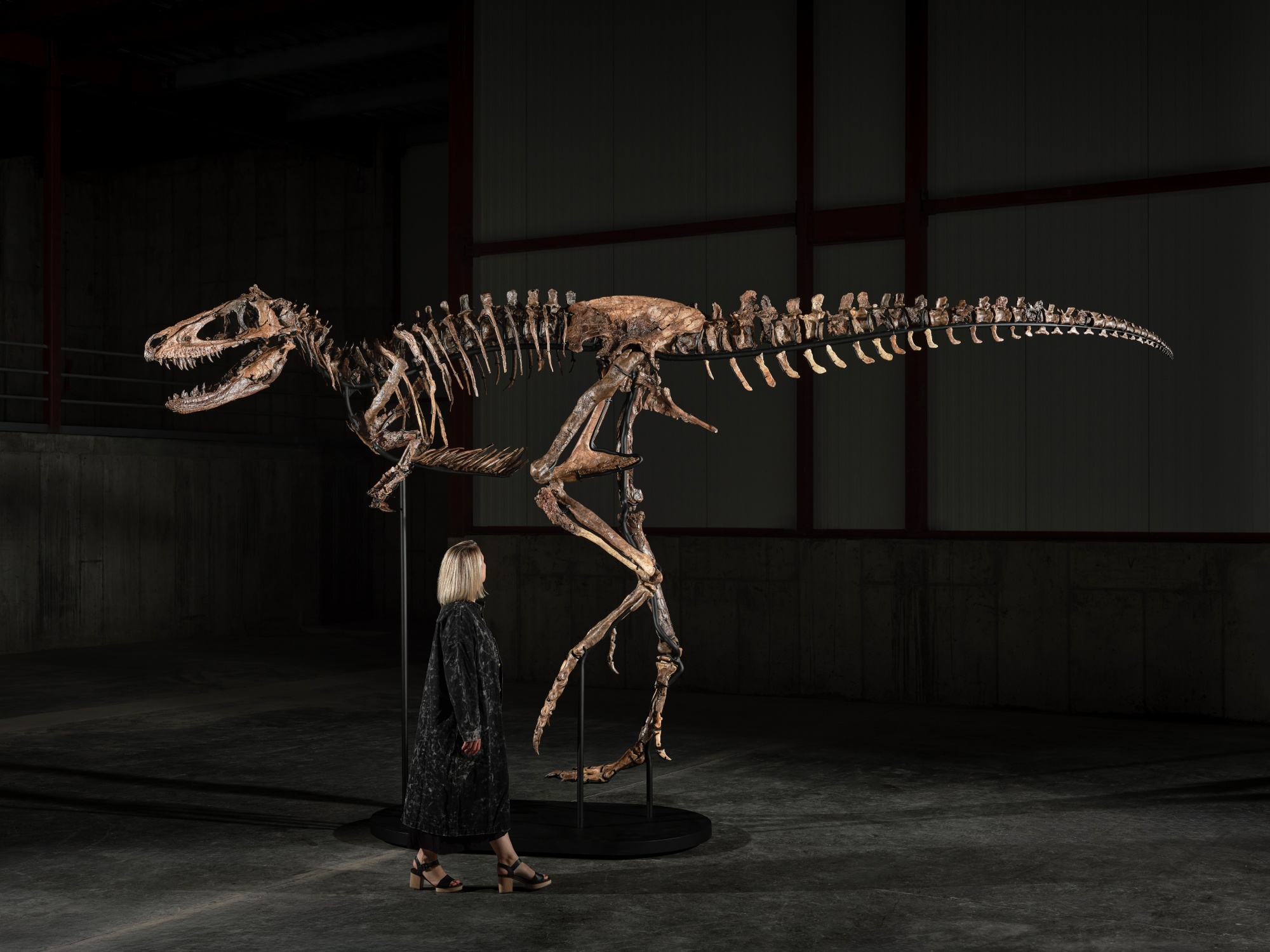
What the money bought is genuinely rare. According to Sotheby's own catalogue, Jodi is an adult Nanotyrannus cf. lancensis from the Hell Creek Formation of Garfield County, Montana — 9 feet 6 inches tall on its armature, 19.6 feet from nose to tail, and made up of approximately 191 fossil bone elements from a single individual. The skeleton is about 70% complete, with missing elements restored in 3D-printed and sculpted material for the mount. Its centerpiece is a virtually complete skull — 53 bones, around 50 teeth in varying stages of eruption, and one rooted tooth fused, oddly, to the outside of the right jaw. The sepia color of the bones is the mineral signature of Hell Creek, the same ground that produced the most famous T. rex specimens ever found.
The identity fight is part of the price
For decades, the scientific argument over Nanotyrannus was simple to state and impossible to settle: were these small, slender tyrannosaur skeletons a distinct genus that lived alongside T. rex — or just teenage T. rexes that had not grown into the famous silhouette yet? Jodi has lived both lives. In 2023 the skeleton was exhibited at Frieze Masters in London under the name "Chomper," presented as a juvenile T. rex with a $20 million asking price. It did not sell. Sotheby's provenance for the 2026 sale now calls that identification what the house considers it to be: a misidentification.
What changed is a study published in Nature in October 2025, in which researchers Lindsay Zanno and James Napoli concluded that Nanotyrannus was its own genus — fully grown adults at a size T. rex passes through on the way up — and named two species within it. Jodi went to auction as Nanotyrannus cf. lancensis; the "cf." is the catalogue's honest hedge, a marker that this individual specimen's assignment still carries some uncertainty. Jodi was the first Nanotyrannus ever offered at auction since that ruling, Smithsonian Magazine noted — and the market priced the verdict instantly. As a maybe-baby T. rex, the skeleton could not get $20 million. As its own animal, confirmed rare and suddenly historic, it got $47.3 million.
A rancher, a shovel, and one of three
The name is not a brand. The fossil was discovered in 2019 by Jodi Pierson, a Montana rancher, on her own privately owned land near the town of Jordan — about eight miles from the site of the celebrated Dueling Dinosaurs. Pierson enlisted her cousin, commercial paleontologist Clayton Phipps, to excavate it, a dig documented on the Discovery Channel series Dino Hunters. In a statement after the sale, Sotheby's head of science and natural history Cassandra Hatton thanked "the team of professional fossil hunters whose efforts to discover and excavate the specimen" brought the moment about, calling it "a testament to the fact that we can all make major contributions to science."
Part of what bidders were paying for is how little company Jodi has. Sotheby's describes the skeleton as one of only three substantial Nanotyrannus skeletons known to science — the most famous of the others forms half of the Dueling Dinosaurs and sits in a North Carolina museum. Jodi's skull, completeness and exhibition-ready mount made it, in the house's words, the finest and most complete example available. "Available" is the operative word: of the three, this was the one the market could actually buy.
Where Jodi goes next is a private matter
That is where the applause fades. The buyer is anonymous, and where the skeleton goes from here — a museum wall, a private hall, a vault — has not been disclosed, nor whether researchers will have access to study it. Some scientists have opposed sales like this one, the Associated Press reported, arguing that significant fossils belong in museums and institutions where they can be studied by researchers and seen by the public. IFLScience put the worry more bluntly, counting Jodi among dinosaurs "lost to science" the moment the hammer fell. Sotheby's notes the skeleton was offered with full rights and full documentation of its condition, authenticity and legality of ownership — the paperwork is impeccable. The future is unwritten.
The Culture Desk's read: strip away the auction theater and the stake here is access. Science spent decades arguing over what Jodi is, settled the argument a year ago, and the settlement is exactly what made the skeleton worth $47.3 million — knowledge produced in public, priced in private. The number is real and the record book is rewritten: second only to a T. rex, five times its estimate, out of a Montana ranch. Whether it is also the last time researchers get a good look at one of three known Nanotyrannus skeletons is now one anonymous buyer's decision. — Previously Staff
Sources
- Smithsonian Magazine — A Rare Nanotyrannus Skeleton Sells for $47.3 Million, Becoming the Second Most Valuable Dinosaur Ever Auctioned
- Associated Press — A dinosaur fossil that looks like a mini T. rex just sold for a giant $47 million
- Sotheby's — "Jodi" — A Mounted Nanotyrannus Skeleton (sale catalogue)
- IFLScience — Rare Nanotyrannus Jodi Joins Dinosaurs "Lost To Science" Following $47.3 Million Auction Sale