The first cones went out on August 31. By the time the Las Vegas Grand Prix runs on Saturday night, November 21, crews will have spent the better part of four months turning 3.8 miles of working city streets into a Formula 1 circuit and turning it back again. The racing takes three nights. The building and unbuilding take the rest of the fall.
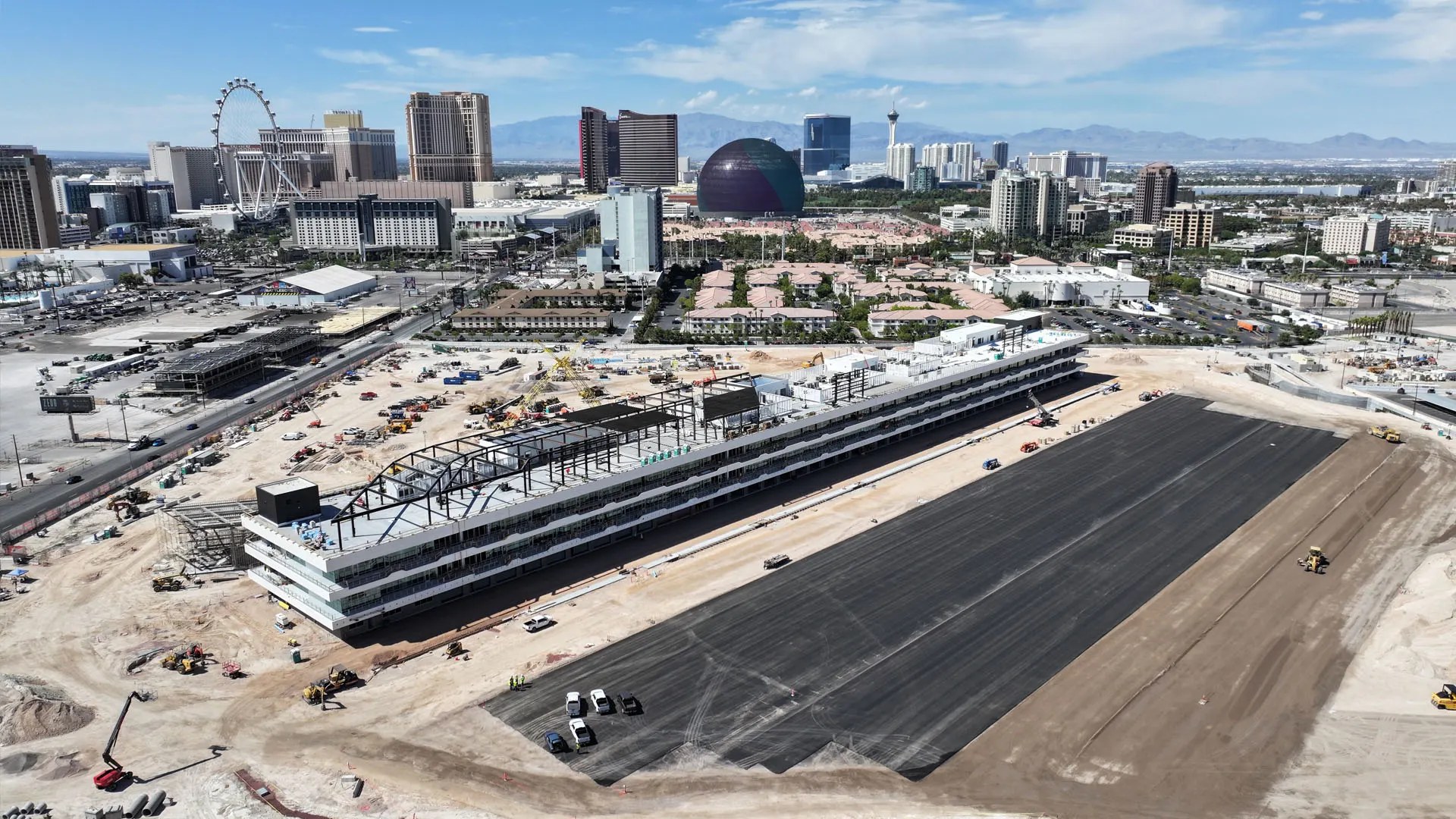
Almost none of it stays. The barriers, the lights, the grandstands and the bridges are a kit — assembled every year over the same streets, struck every year in the weeks after the race. The one exception sits on 39 acres at Harmon Avenue and Koval Lane: a 300,000-square-foot paddock building that Formula 1 built for itself on land it bought, because this race is the rare one the sport promotes on its own dime. Everything else about the event is rented from the calendar, a few weeks at a time.
What follows is the machine, in the order it runs: how the circuit was built the first time, what goes up and comes down every year since, how the people who work inside it get to their shifts, what the businesses on the route say it costs them, and how the money gets counted — because in Las Vegas, the counting is its own argument.
The First Build
Formula 1 mapped 23 possible circuits around Las Vegas before settling, in early 2022, on the one that runs down the Strip. Craig Wilson, the sport's head of vehicle performance who worked with the Tilke design firm on the route, told Formula 1's own site that the Strip was the selling point from the start — every layout drawn included it. The result is 3.853 miles and 17 turns, with a straight down Las Vegas Boulevard of about 1.2 miles where the cars reach roughly 217 mph.
Building it meant repaving the whole route. The top four to six inches of asphalt came off nearly four miles of streets, and Formula 1's construction chief, Terry Miller of Miller Project Management, ran most of the work at night. "We did a lot of work at night, but that's difficult in a city that never sleeps," Miller told Formula 1. The paddock went up on a site with a 25-foot slope that had to be leveled, with a pedestrian tunnel threaded underneath and a construction team the sport puts at more than 400 people. Miller's outfit did in about 14 months what he compared to a four-year stadium build. The Grand Prix's Dan Wendling put the land and building together at roughly $500 million, and the wider capital program — the paving, drainage, utilities, bridges and lighting — at close to $400 million in the sport's own accounting of the project.
The first race weekend, in November 2023, showed what the machine still had to learn. Nine minutes into the opening practice session, Carlos Sainz's Ferrari hit a loose water valve cover at about 200 mph and destroyed the underside of the car. Around 30 of the covers were found across the circuit. The session was abandoned, the track was inspected and repaired, and the second session finally ran at 2:30 in the morning in front of empty grandstands — the spectators had been sent home before it started. The reason the covers could not simply be welded down, as some other street circuits do, is local: Clark County code requires the covers to stay accessible, so they are inspected and secured on a schedule instead. East Harmon Avenue flooded in the run-up to that same weekend. The race itself ran clean on Saturday night. The lessons of that weekend are still in the paperwork three years later, which is a later section of this story.
The Kit That Goes Up and Comes Down
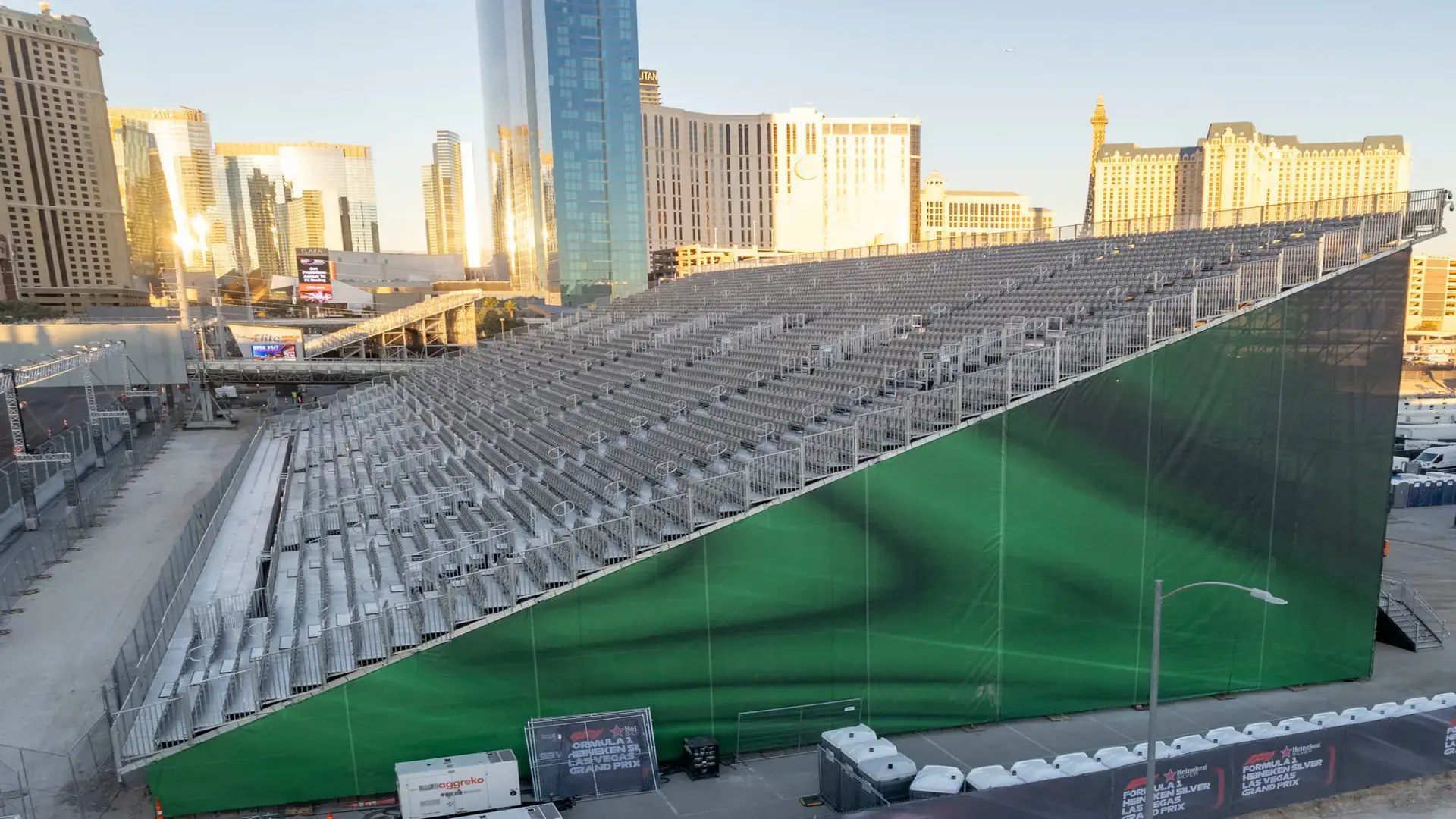
The annual furniture, as Las Vegas Grand Prix has itemized it in its own briefings, runs to 3,500 concrete barrier blocks, 7.6 miles of barriers, 1,750 light units — about 1,400 of them for the track — 18 grandstands, four temporary vehicle bridges, three pedestrian bridges and 42 track openings that close and reopen as the schedule demands. Race week brings in roughly 12,000 additional workers on top of the year-round staff, by Wendling's count. Then all of it goes away again. The contractor that built the permanent piece of the circuit — the PENTA Building Group, which delivered the paddock — has walked through the construction on camera, and the scale of the job is easier to see than to describe:
Watch: the PENTA Building Group, the paddock's contractor, on constructing the Grand Prix track (via Autodesk Construction).
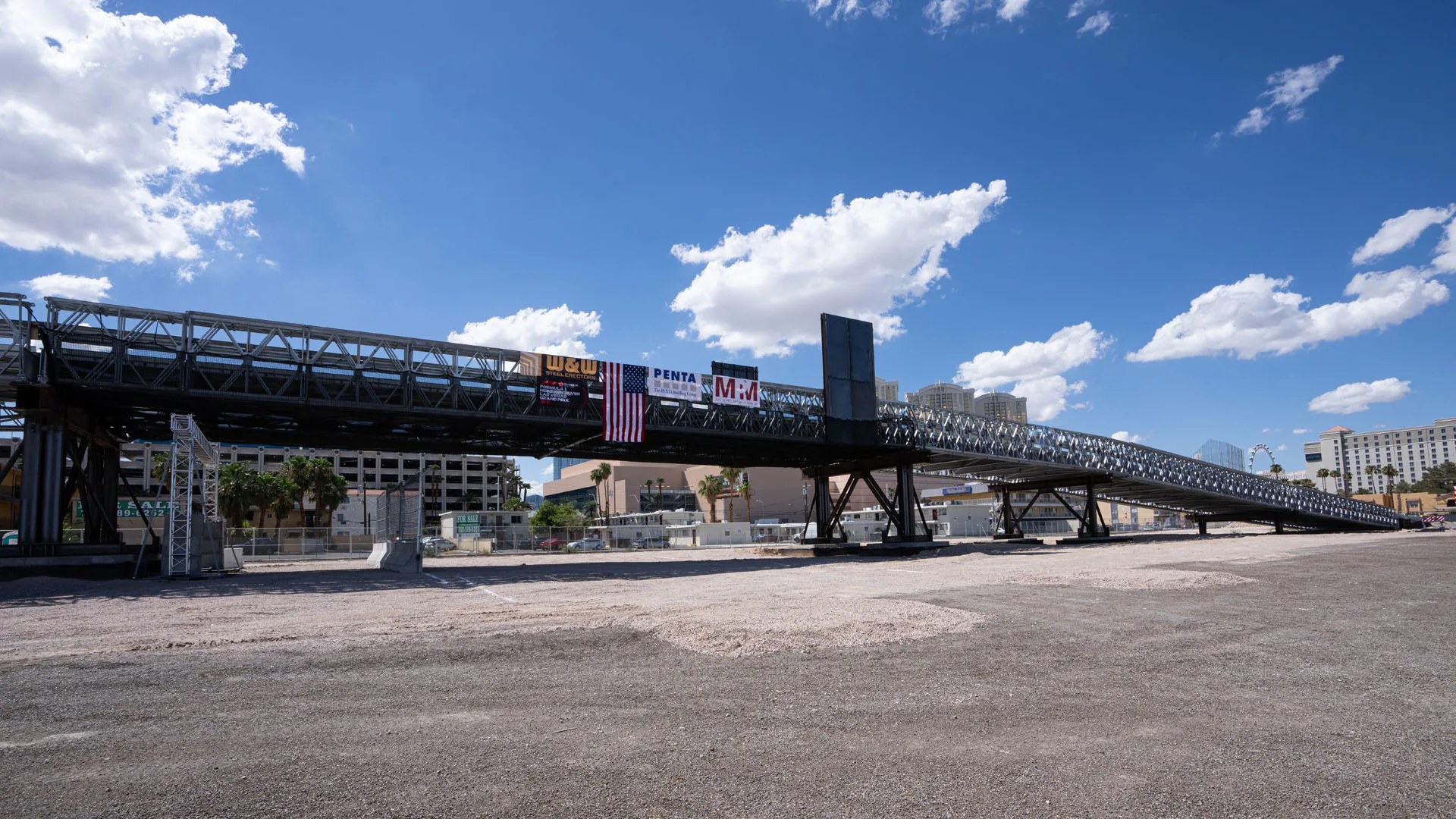
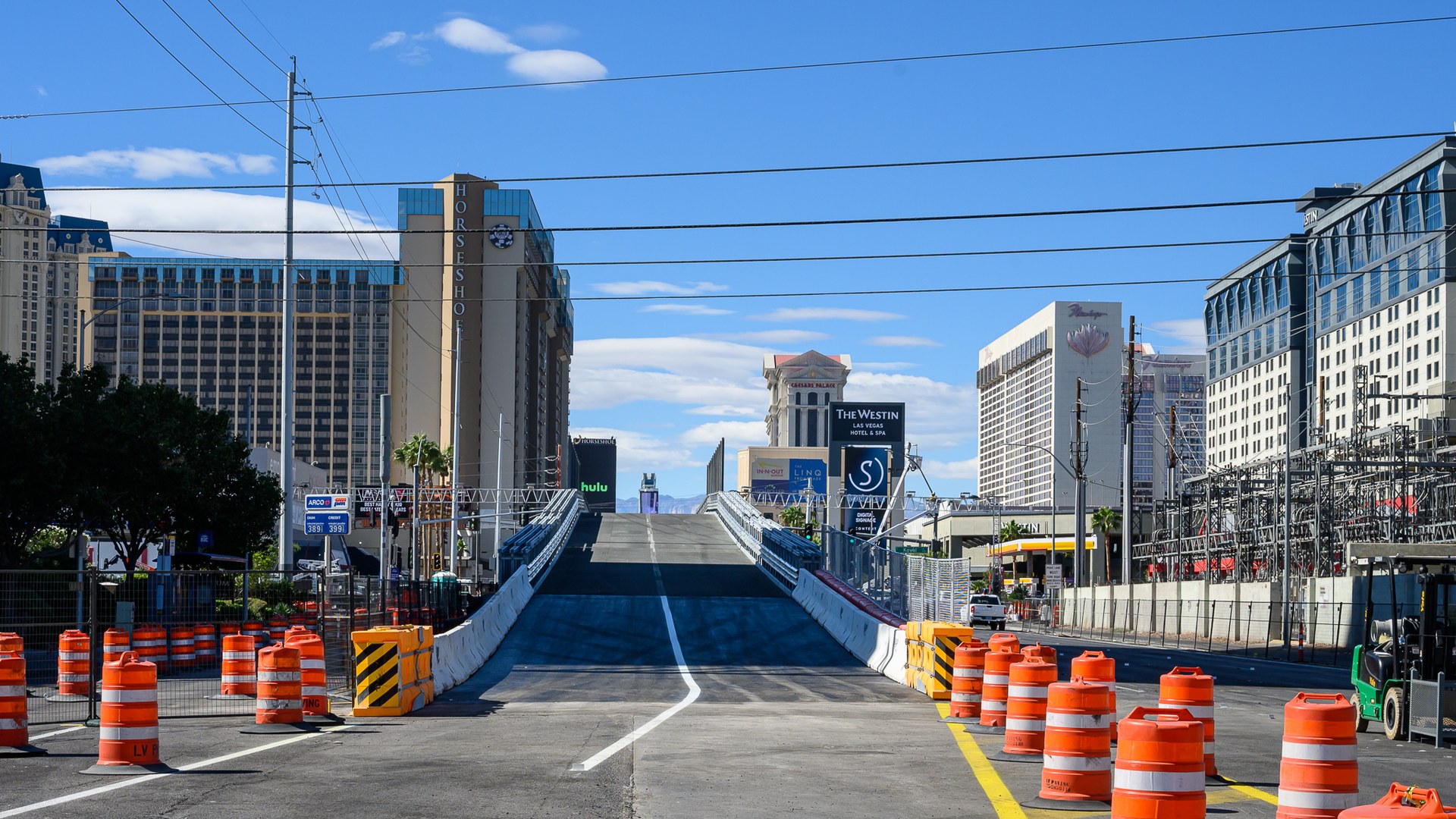
The biggest single piece of the kit is the bridge over Flamingo Road at Koval Lane. The intersection underneath it carries more than 50,000 vehicles on a normal day, according to Clark County's figures as reported by FOX5 Las Vegas during this year's closure. In 2023 the bridge took ten days to install. In 2024 it took seven. This year, as in 2025, the Review-Journal reported, it took five — the intersection closed around the clock from the night of Sunday, October 11 to the night of Friday, October 16. The structure itself is a steel truss span built to be craned apart and stored, then craned back together the following fall.
LVSportsBiz, which has covered the build-out longer than any outlet in town, counts the whole operation at 17 weeks from the first barriers to the last. The organizers' own preliminary calendar for 2026 is more precise and a little less generous: track build from August 31 to November 15, the race November 19 to 21, dismantle from November 23 to December 23, the bridge coming out December 13 to 18, and one lane restriction near the Bellagio still on the books for December 29. Social-media explainers have told visitors the city is fully restored by Christmas. The organizers' calendar says otherwise, and the gap between those two sentences is where a lot of this story lives.
Getting 10,000 People to Work Inside a Racetrack
When the circuit closes, the land inside it does not empty out. It fills with the night shift. Clark County Commissioner Tick Segerblom has put the number at about 10,000 employees who need access to the properties inside the circuit on a race night — dealers, servers, bartenders, housekeepers, valets — working jobs that start while the roads around them are a racetrack. The Las Vegas Convention and Visitors Authority has spent about $300,000 on a bus contract to move them, with 4,300 parking spots at the Las Vegas Convention Center and park-and-ride lots feeding the shuttles, according to the local-news roundup Las Vegas Locally. The same money that sponsors the race, in other words, also pays to bus the workforce around it.
The lived version of that system is a commute. A cocktail server at the Flamingo told the Las Vegas Review-Journal in 2023 that her usual 25-minute drive had doubled and sometimes tripled. The resorts responded that first year with money of their own: the Venetian put up a $250,000 prize pool and a Tesla for employees who worked race-week shifts, Caesars put up $100,000 and a BMW, and Wynn Las Vegas put up $70,000 in cash and prizes, all reported by the Review-Journal at the time. Two years on, the account from behind the bar has a different sound. A bartender working the Strip told Eater Vegas during the 2025 race that Grand Prix weekend had become "the slowest weekend of the year. The money is not there." Both accounts are on the record. They describe the same weekend from two different posts inside it.
Race week itself runs on a daily rhythm that outsiders rarely see. The circuit seals before each evening's session, and the roads reopen to the public between sessions — Formula 1's own logistics account describes the circuit reopening to the city each day of the event, which is also why there are no support races filling the afternoons. A street circuit in a working city is a part-time racetrack. The other part of the time it is Flamingo Road.
The Businesses on the Route
The shops and restaurants along Koval Lane and Flamingo Road sit in the hardest geography the race creates: close enough to be inside the disruption, too small to negotiate with it the way a resort can. Their fight with Formula 1 has now run for three years, and it has sorted itself into three different endings.
Ellis Island, the casino and brewery just off Koval, sued in December 2023. The case was dismissed in May 2024 after what Ellis Island's team described as productive conversations, and the property is now an official partner of the Grand Prix. The second ending belongs to Battista's Hole in the Wall and the Stage Door Casino, the two old-Vegas institutions on the corner by the circuit's edge. Their suit survived in part: a federal court dismissed their claim under Title II of the Civil Rights Act but let a First Amendment retaliation claim proceed, and their landlord, RDG, joined the case in January 2025 with claims of its own. That litigation is still running. Ferraro's Ristorante, the fine-dining Italian restaurant off Paradise Road, took the third path and simply stated its number in public: the restaurant put its 2023 loss from the race at $2.5 million.
The widest claim is also the least tested. Nine businesses along the route came together with a loss figure of $23 million in the account LVSportsBiz published, tied to a petition whose organizers put the broader ask at $30 million. Those figures come from the businesses themselves and their petition; no court or auditor has adopted them. In November 2025, a group of the disputes that had been running since the first race were settled on confidential terms — the dollar amounts, if any, were not disclosed. Formula 1's position, as Autosport and Motorsport.com reported it at the time of the settlements, was that no money changed hands and the resolutions took the form of partnerships. The businesses that settled have not described the terms differently in public.
One more charge from the first year explains a lot of the temperature. In 2023, businesses near the circuit received demands tied to a licensing fee of $1,500 per person of capacity for properties with views of the track. The reported recalibration, in later coverage, put the effective figure nearer $50,000 per venue. The fee episode was reported widely at the time; the recalibrated figure rests on a thinner record, and the Grand Prix has never published a rate card. It is included here because the businesses themselves still cite it, three years on, when they explain why they hired lawyers.
Three Ways to Count the Money
Ask what the race is worth and the answer depends on who paid for the arithmetic. The Las Vegas Convention and Visitors Authority commissioned its economic-impact figures from Applied Analysis, the Las Vegas firm whose reports are the standard citation. For the first race, the headline number was $1.5 billion. The same summary that produced it put net new economic activity at $329 million and credited $587 million of the total to one-time construction and capital spending — the building of the paddock counted as part of the race's impact. Las Vegas Grand Prix's own post-race release for that year used a different figure, over $1.2 billion. For 2024, the Applied Analysis number was $934 million. Steve Hill of the LVCVA has more recently used about $800 million as the working figure for what the event brings. All of those numbers exist at the same time, in the same town, about the same three nights.
Clark County keeps a different set of books, and its ledger is smaller and less flattering. Segerblom, who sits on the county commission that issues the race's permits, has described the county's own accounting of the 2023 race as a net loss of $462,865 — the road wear, public safety and staff time on one side, the permit fees and revenue on the other. The Grand Prix's supporters answer that the county ledger was never where the money was supposed to land; the room tax and the resorts were. On the hotel side of the ledger, there are two records as well. MGM Resorts CEO Bill Hornbuckle said the first race produced the best hotel weekend in the company's history. Jeremy Stephenson, a local analyst who went through the hotel revenue data himself, found that even after adjusting for inflation, the first race's November produced the lowest hotel revenue of the three Grand Prix years, and published that finding in the Review-Journal. The same paper's newsroom, working from Black Book data, reported that the 2024 race week came in soft in the middle: hotel occupancy down 21 percent and revenue down 29 percent against the comparison week. A rate study by Truist, cited by LVSportsBiz, recorded the same softening from the other direction — the average MGM race-night room that went for about $1,500 in 2023 was going for about $800 in 2024. Meanwhile the product at the top held its price: MGM's Bellagio Fountain Club, at roughly $11,000 a seat, sold out for 2024, as the Review-Journal reported. Both things happened. The top of the market and the middle of the market had two different races.
The Public Ledger
The public's money in this race flows mostly through one pipe. The LVCVA — the convention authority funded by the room tax visitors pay — started as a sponsor at $6.5 million a year. In February 2025 it raised that to $10 million a year for three years; about $2.5 million of each year's money buys race tickets and employee transportation, according to the Review-Journal's reporting of the deal — the authority is, among other things, paying to move the workforce the race displaces. In July 2026 the authority approved $100 million across ten years, 2028 through 2037, matching the extension that now keeps the race on the calendar through 2037. None of it comes from the county's general fund or from residents' taxes directly; all of it comes from the tax on the hotel rooms the race is supposed to fill.
One bill from the first race is still open. Clark County's position is that Formula 1 owes $40 million toward the cost of the road work the first build required. Formula 1's position is that it never agreed to pay for repaving beyond the first year. Both positions have been stated plainly and in public, by the county and by the Grand Prix, and as of this fall neither has moved — the Review-Journal and News 3 Las Vegas have both reported the standoff in those terms. The $40 million sits in the same unresolved file as the county's net-loss ledger: the public side of the race's accounting, still open three years after the first green flag.
The Lawsuit the First Night Left Behind
What a seat costs this year is a market of its own — from the $50 general-admission floor to the five-figure hospitality tiers that sold out months ahead — and Previously has priced that whole ladder on its own page: The Price of Access. One number from it belongs in this accounting: the average ticket runs $1,638, a figure the Grand Prix's communications director confirmed to LVSportsBiz in October. But the cheapest seats at the very first race produced the longest paper trail.
The fans sent home before the 2:30 a.m. session in November 2023 became a class action — Diep v. Liberty Media, in federal court in Nevada — and the settlement, when it came, was precise: a fund of $3,047,986 for roughly 32,000 ticket holders, which works out to about $68.28 for a Thursday-only ticket and about $120.94 for a three-day ticket, once the claims process runs. The court granted the settlement preliminary approval on March 9, 2026, and set the final fairness hearing for November 4, 2026. A ruling from that hearing had not been posted on the settlement's public record as this story was published. The fans from the first night are, on paper, the last unsettled account from the first build — three years, almost to the week, after the night itself.
Then It All Comes Down
The racing ends on Saturday night, November 21. The unbuilding starts Monday, November 23, and the organizers' calendar gives it a month: dismantle through December 23, the Flamingo bridge — the one that took five days to install in October, down from ten in 2023 — coming out between December 13 and 18 behind another five days of round-the-clock closure at Flamingo and Koval, and the last lane restriction, by the Bellagio, clearing on December 29. The extension that runs through 2037 comes with a promise attached, reported when the deal was struck: permanent bridges at Flamingo and Koval, so that one day the five-day closure stops being an annual event. Until then the calendar for next fall is already written in pencil — first cones in late August, bridge week in October, three nights of racing in November, and a city handed back to itself, piece by piece, in the weeks before the new year.
Sources · 7 sources
- Las Vegas Review-Journal
- LVSportsBiz
- Formula 1
- Eater Vegas
- Autosport
- News 3 Las Vegas
- FOX5 Las Vegas