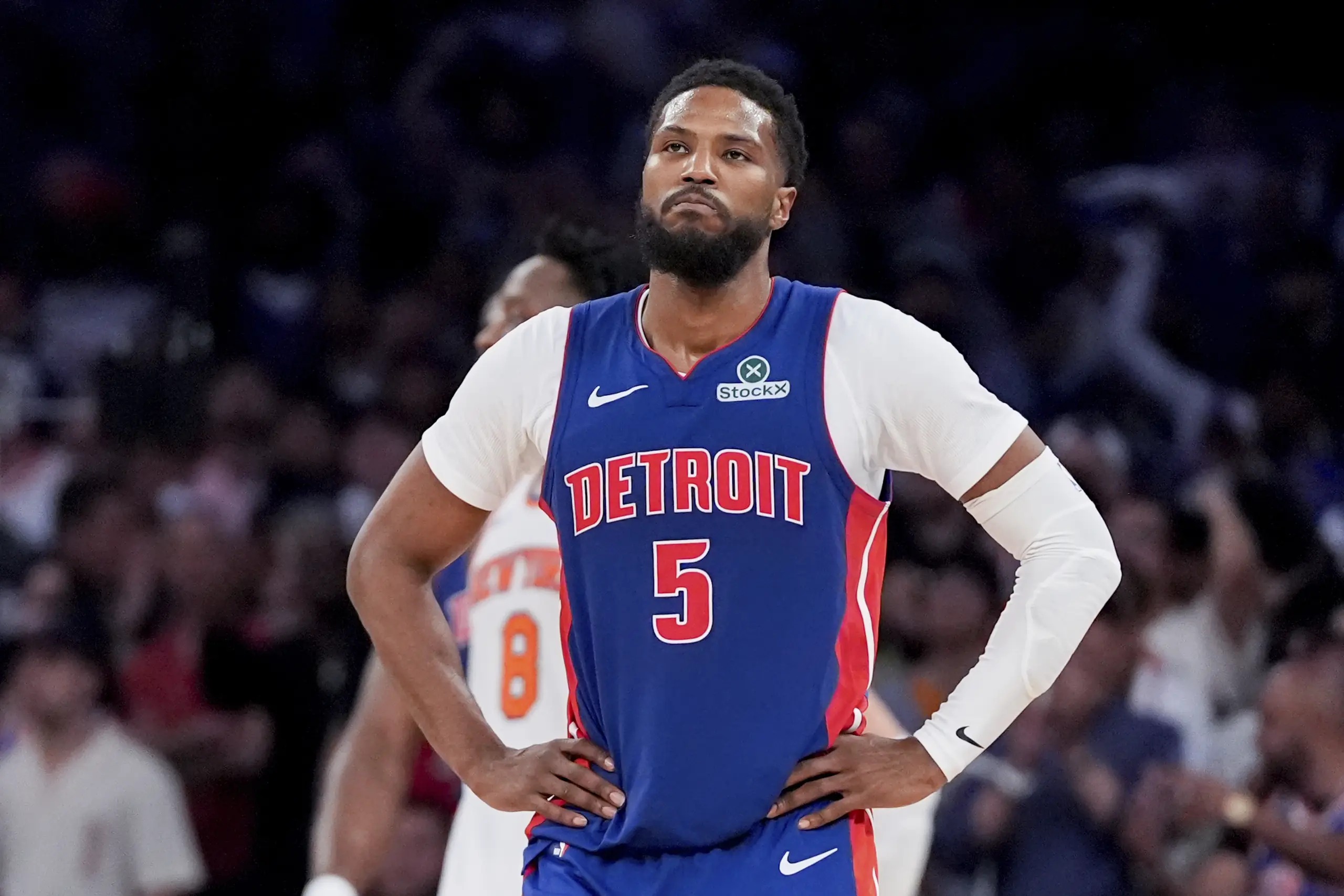

The plea is the end of the argument. What remains is the sentence.
Former NBA guard Malik Beasley has agreed to plead guilty in his federal sports betting case, his attorney, Steve Haney, told ESPN and The Athletic on Tuesday — and a spokesperson for the U.S. Attorney's Office for the Eastern District of New York confirmed that an agreement has been reached. Beasley, 29, is scheduled to change his plea at a Dec. 9 hearing in Brooklyn. Haney told the Milwaukee Journal Sentinel that plea negotiations with federal prosecutors began on Oct. 24. He declined to describe the terms of the deal, and the U.S. Attorney's Office declined to comment on the specifics — so the two questions that matter most, which charges the plea covers and what sentence Beasley faces, are not yet public. What is public is everything prosecutors put in the indictment, and it is devastating.
The charges
Beasley was indicted in June as one of six defendants in the case, and pleaded not guilty in July to four counts: conspiracy to commit wire fraud, bribery in sporting contests, honest services wire fraud conspiracy, and conspiracy to commit money laundering. On paper, the exposure is enormous — the wire fraud and money laundering conspiracy counts each carry statutory maximums of 20 years, and the sports bribery count up to five. A plea agreement will cut that down to whatever Beasley and the government have actually agreed to, and nobody outside the case is saying what that is yet. Sentencing would follow the plea; no date has been set.
What prosecutors say he did
The indictment's story is a debt story. Prosecutors say Beasley — who earned $59,948,525 across his NBA career, according to Spotrac — had accumulated “multimillion-dollar gambling losses” by the 2023–24 season, borrowed money from former NBA player Ed Davis, his old Minnesota teammate, and joined a scheme to pay it off: he would move his own numbers, up or down, and the bettors around Davis would wager on his prop lines knowing which way they would land. In a message in late December 2023 cited in court documents, Davis wrote: “Only way you can beat Vegas is sports betting. Everything else, they got the edge.” Prosecutors allege Davis helped run the scheme and relayed the information to bettors, who wagered hundreds of thousands of dollars across the operation.
The indictment names four games from Beasley's season with the Milwaukee Bucks — and it reads like a receipt book:
Jan. 26, 2024, against Cleveland: Beasley played 27 minutes and finished with three points and three rebounds. Text messages indicated he was willing to underperform on the boards, prosecutors say, and fraudulent wagers “totaling tens of thousands of dollars” were placed on his rebounds going under.
Feb. 27, 2024, against Charlotte: the two-way game. Prosecutors say Beasley signalled he would go over his rebounding line of about 3.5 and under his scoring line of about 12.5. He finished with six points and four rebounds — both bets landed. Roughly $25,000 in wagers produced more than $77,000 in profit.
March 10, 2024, at the LA Clippers: Beasley played 38 minutes and needed one more rebound to clear the line. He got it — his fourth — with one second left in the game. The celebration, prosecutors said, is right there in the texts: “He pushed Connaughton out of the way lmaooooooo.”
March 21, 2024, against Brooklyn: the failure. Beasley grabbed six rebounds — allegedly too many — and the bet missed.
The circle closes
Beasley is the fourth of the six defendants to choose a guilty plea. William Brown pleaded guilty earlier this month; bettor Robert Gorodetsky is set to formally enter his plea on Nov. 20; and Ernesto Plascencia's attorney confirmed Saturday that he will plead guilty as well. The two men still fighting the case are the two at its centre on paper: Ed Davis, accused of helping lead the scheme, and Paolo Zamorano, Davis's agent. Both have pleaded not guilty.
The season it erased
To understand what this plea costs, remember where Beasley stood 18 months ago. In 2024–25 with Detroit he played all 82 games, averaged 16.3 points, and made 319 three-pointers — a Pistons franchise record and the second-most in the NBA that season — finishing as the runner-up for Sixth Man of the Year. Detroit, back in the playoffs for the first time since 2019, was preparing a three-year, $42 million contract to keep him. Then, in June 2025, the federal investigation surfaced — ESPN reported it first, the AP confirmed it — and the contract vanished before it was ever signed.
His attorney asked for patience then. “There have been no charges against Malik,” Haney told the AP in June 2025. “We hope people reserve judgement until he's charged — or if he is charged.” He was charged — indicted a year later, in June 2026. The NBA ran its own investigation alongside the federal one and never cleared him; his agent acknowledged the camp was still waiting on the league. No team signed him. He played briefly in Puerto Rico in 2026, and he is not on an NBA roster now. The league's only word on Tuesday was procedural: “We are aware of the recent report regarding Malik Beasley and will be monitoring the proceeding,” an NBA spokesperson said.
What happens next
On Dec. 9, in a Brooklyn courtroom, Malik Beasley will stand up and say the word that ends his defence. He will be the second NBA player to plead guilty in the federal gambling cases, after Jontay Porter — who pleaded guilty in July 2024 in a separate scheme, was permanently banned by the NBA, and, more than two years on, is still waiting to be sentenced. That precedent hangs over everything: the league has not announced any discipline for Beasley, but it has already shown, with Porter, exactly how it answers a guilty plea on game manipulation. Sentencing, when it comes, will be set by the terms nobody has disclosed yet. Previously will update this story when the plea agreement becomes public and when the league rules.
Status as of publication: guilty-plea agreement confirmed on the record by attorney Steve Haney (ESPN, The Athletic) and by a spokesperson for the U.S. Attorney's Office for the Eastern District of New York (ESPN). Plea hearing set for Dec. 9, 2026, in Brooklyn. Plea terms — the counts covered and any sentencing agreement — have not been disclosed by either side. The game-by-game conduct described above is alleged in the federal indictment, as reported by the Milwaukee Journal Sentinel and other outlets.
Sources · 8 sources
- ESPN — Oct. 27, 2026 — Tom Schad, with Shams Charania and David Purdum contributing: Haney confirms the agreement; EDNY spokesperson confirms; the four counts; the six defendants and their plea postures; the NBA's statement
- The Athletic via USA TODAY — Oct. 27, 2026 — The Athletic's reporting (Mike Vorkunov): plea negotiations with the EDNY, the Dec. 9 Brooklyn plea date, career earnings of $59,948,525 per Spotrac
- Reuters via Field Level Media — Oct. 27, 2026 — Haney to ESPN and The Athletic; the indictment's allegations; career lines (578 games, 11.7 ppg, No. 19 pick in 2016)
- Milwaukee Journal Sentinel — Oct. 27, 2026 — negotiations began Oct. 24; the indictment's game-by-game account of Jan. 26, Feb. 27, March 10 and March 21, 2024, including the co-conspirators' text messages
- The Associated Press via Sportsnet — Oct. 27, 2026 — the plea reports; the Porter precedent (separate scheme, guilty plea 2024, permanent NBA ban, awaiting sentencing)
- The Associated Press — June 29, 2025 — the investigation surfacing during Beasley's free agency; Detroit's interest in re-signing him; Haney's "reserve judgement" statement; the NBA's cooperation statement
- Heavy — Oct. 2026 — prosecutors' figures for the Feb. 27, 2024 Charlotte game (~$25,000 wagered, more than $77,000 in profit); the collapsed three-year, $42 million Pistons contract
- Hoops Wire — Oct. 27, 2026 — Davis accused of helping lead the scheme and lending Beasley money; plea terms and covered charges not yet specified