
MONDAY, OCTOBER 26, 2026
We’re watching this one in real time — four episodes into six as of this writing — so nothing below touches how it ends. If you haven’t started, you can read this safely and start tonight.
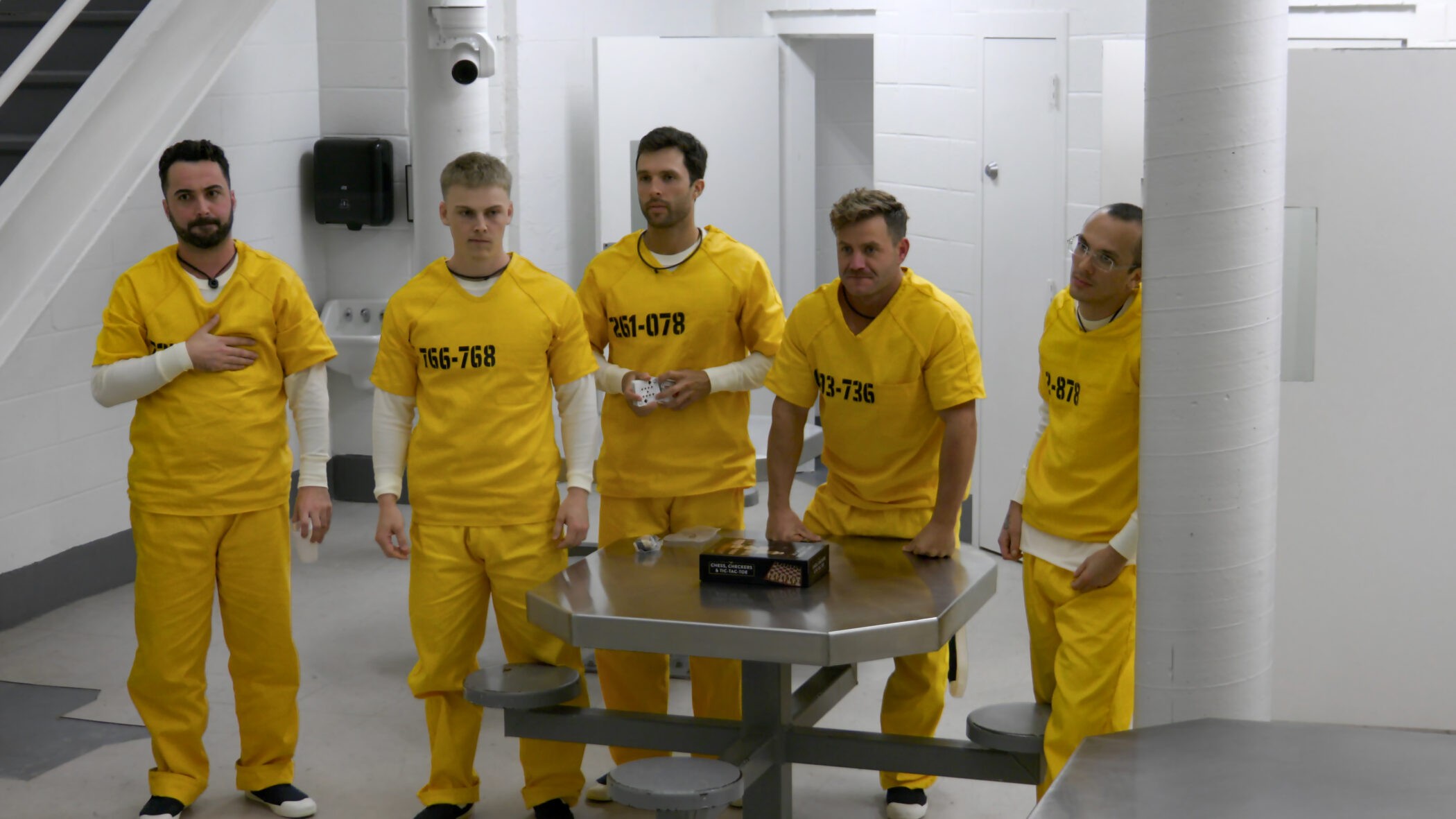
Here is the pitch, and it sounds like a dare: take 30 volunteers, walk them into a real prison, flip a coin for who wears the guard uniform and who wears the yellow jumpsuit, and leave the cameras running for two weeks. That is The New Stanford Prison Experiment, Netflix’s six-episode unscripted series, and it is built on the most notorious name in psychology.
You probably know the original even if you’ve never read a word about it. In August 1971, Stanford professor Philip Zimbardo turned a basement corridor in the university’s psychology building into a mock prison and randomly split 24 male college students into guards and prisoners. The study was supposed to run two weeks. It was shut down after six days, as the guards’ treatment of the prisoners turned abusive and prisoners began breaking down. It became the textbook warning about how fast a role can swallow a person — and, in the decades since, one of the most argued-over studies ever run, with its methods and conclusions challenged by researchers who dug into the archives. Zimbardo died in October 2024, two years before Netflix decided to ask his question again: does power corrupt?
This time, it’s a real prison — with an exit door
Netflix did not rebuild the basement. The new series filmed inside a decommissioned section of the Cherokee County Adult Detention Center in Georgia — a working jail — with 30 participants drawn from across the country: eight guards, 22 prisoners, a mixed cast of men and women from different backgrounds, where the 1971 study used only male students. The show comes from Alfred Street Industries, the company run by Jane Lipsitz and Dan Cutforth — the team behind Top Chef and Project Runway — and they knew exactly what name they were borrowing. “If we were simply recreating the original experiment, that would be unconscionable,” Lipsitz told Netflix’s Tudum, promising “a very different journey.”
The differences are the point. Every volunteer was psychologically screened before going in. Psychologists are on hand around the clock. Anyone can walk out at any moment, for any reason, by saying one safe word: “Pineapple.” Remote cameras watch the pod instead of a crew standing inside it. And in the monitoring room, three very different experts narrate what the cameras see: Harvard behavioral psychologist Alison Wood Brooks, retired federal corrections professional Michael Cantrell, and Pulitzer Prize-winning journalist Trymaine Lee. Filmofilia’s account of the producers’ rules walks through the full safeguard list — it is longer than the original study ever had.
Four phases, and the power keeps moving
The show runs on phases — the production rearranges the power structure on a schedule instead of letting one hierarchy harden for two weeks — and the early episodes deliver the friction you’d expect: rules, resentments, small fights over food and routine that confinement turns into tests of loyalty.
As the phases advance, the experiment starts handing the people inside a say in how the place runs — the uniforms matter less, the personalities matter more. Old resentments don’t vanish; they just have to be argued out by the same people who caused them, and watching participants catch their own contradictions is more interesting than watching anybody play jail tyrant. That is as far as we’ll describe it — the back half earns its surprises, and it would be a shame to spend them here.
The honest fine print
Critics are split on this one, and we’ll say so plainly: Tapestry’s critics roundup has big-name reviewers calling it tame reality TV wearing a lab coat, and the expert commentary does occasionally explain a moment you already understood. Fair. But as science, argue away — as television, this works. The cast is genuinely varied in temperament, the small conflicts are weirdly gripping, and the premise stays live the whole way through because nobody on screen, guards included, seems entirely sure what they’re going to do next. Cutforth told Variety before launch: “It’s going to cause conversations and people are going to have very strong feelings.” Four episodes in, he’s right.
All six episodes — about 45 minutes each — are streaming now on Netflix. Start it tonight.
Sources · 4 sources
- What is the Stanford Prison Experiment — and why did Netflix turn it into a reality show? Entertainment Weekly · Oct 2026
- The New Stanford Prison Experiment — Netflix Gives 30 Volunteers a Real Prison and a Safe Word Martin Cid · Oct 2026
- Netflix’s New Stanford Prison Show: The Producers’ Rules Filmofilia · Oct 2026
- Netflix Restages the Stanford Prison Experiment as Reality TV Tapestry · Oct 2026