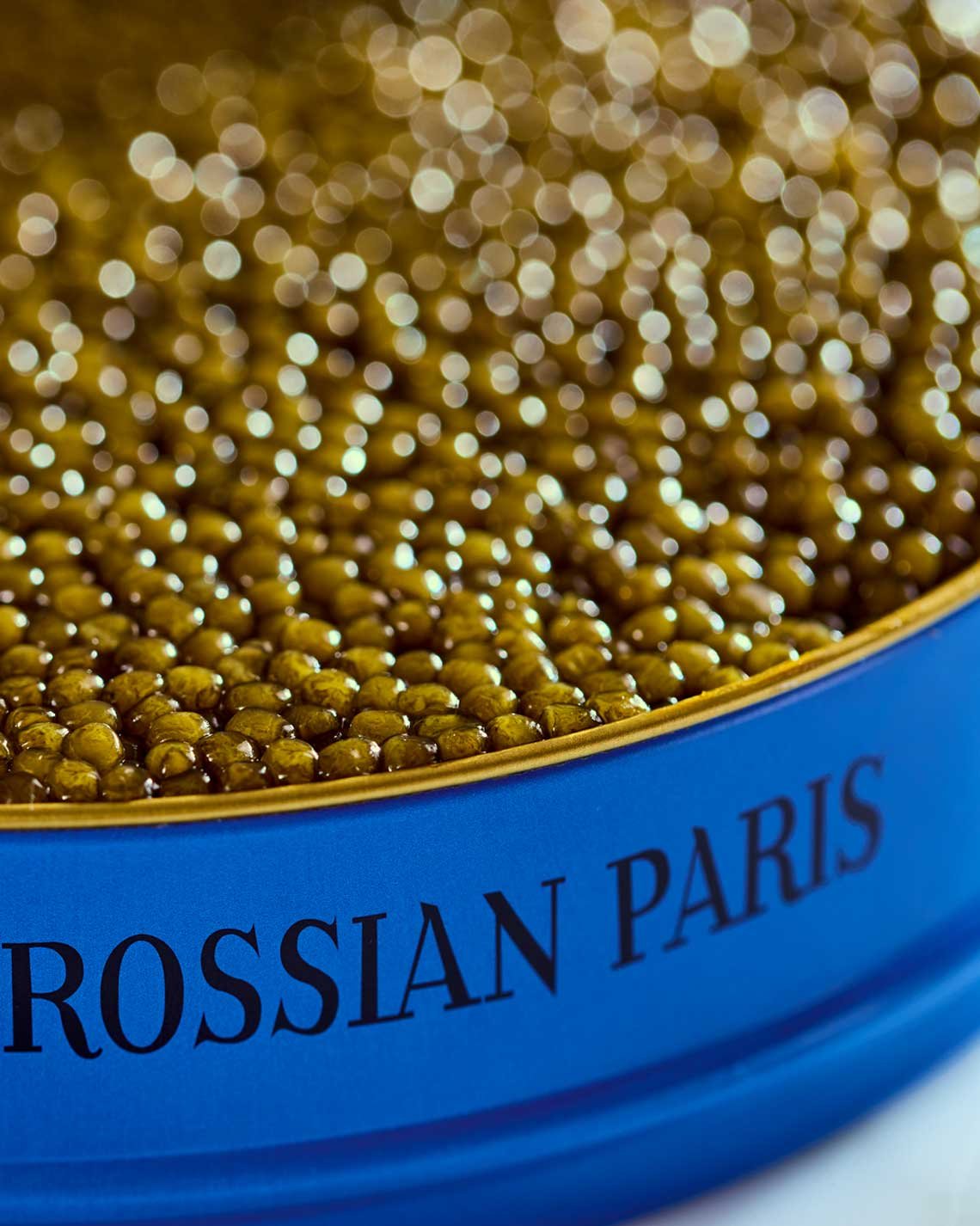
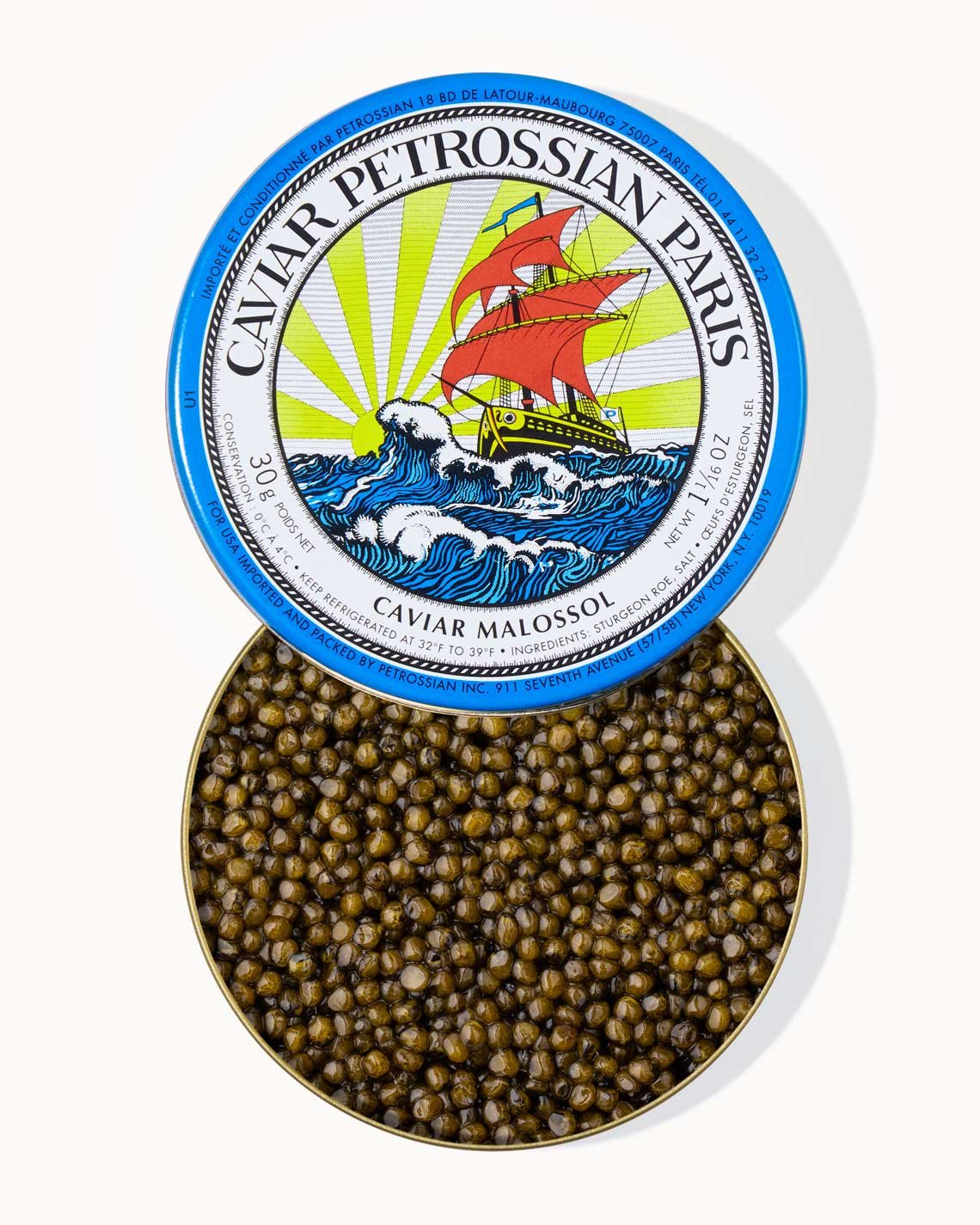
Some tins you open. This one you unveil. The lid comes off Petrossian’s blue tin and the whole surface is beads — large, firm, golden-green, lit up like something poured rather than packed. This is Special Reserve Kaluga Huso Hybrid, the highest grade the Paris house sells, and it starts at $565 for 30 grams. One ounce. One person. That is the front door.
Kaluga is the fish the caviar world rebuilt itself around. True Beluga — the Caspian giant whose roe defined luxury for a century — has been barred from import into the United States since 2005. The Kaluga Huso Hybrid is the answer the farms bred: a naturally occurring cross of Kaluga sturgeon (Huso dauricus) and Amur sturgeon (Acipenser schrenckii), raised sustainably and harvested for the qualities Beluga made famous — big beads, deep richness, a finish that refuses to leave. Petrossian puts the flavor in three words: buttery, bursting, clean. If you prefer butter to brine, this is your tin.
What “Special Reserve” actually means
Petrossian grades its caviar in three tiers — Royal, Tsar Imperial, and Special Reserve at the top. Same fish, different selection. The Royal grade of this same Kaluga hybrid starts at $219 for 30 grams; the Special Reserve starts at $565. The gap is the grading: only select batches make the cut, chosen bead by bead for size, color — bright jade green running to golden amber — and the clean pop the house is known for, then matured under Petrossian’s own handling before a tin is ever sealed. You are not paying for a different sturgeon. You are paying for the strictest pass over the harvest, and for a hundred years of knowing exactly what to reject.
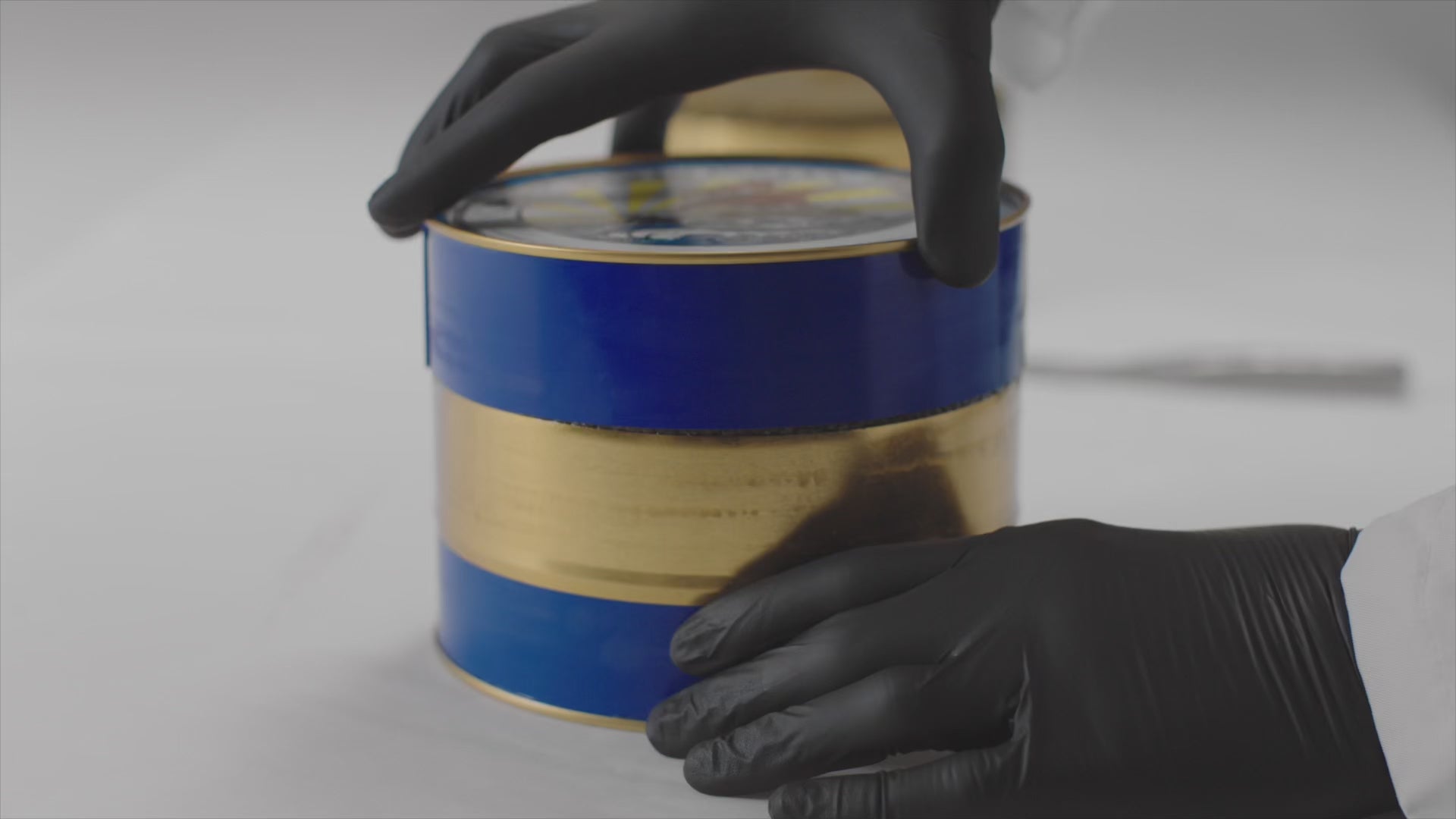
$565 — serves 1. The way in. $925 — serves 1–2. $2,278 — serves 2–4. The dinner-party tin. $4,488 — serves 4–8. $8,976 — serves 8–16. $17,952 — the top of the line. Nobody needs it. That is rather the point.
The ritual is part of the price
Caviar this graded is served cold enough to make the tin sweat — Petrossian says 26 to 32 degrees Fahrenheit, over crushed ice, in glass or crystal. Plan on an ounce a person for a generous tasting. And the spoon matters: mother of pearl, always. Metal reacts with the roe and bends the flavor toward the spoon itself; pearl leaves the bead alone. Watch the house’s own serve and it is all touch and no tools — a pearl spoon, a small mound of beads, nothing between you and it.
A century in the blue tin
Petrossian is not a brand that found caviar; it is the house that introduced Paris to it. Founded in 1920 by brothers Melkoum and Mouchegh Petrossian, the house built its name bringing Caspian roe to the grand tables of Paris, and the blue tin — the red-sailed ship riding the illustrated wave — became the most recognized caviar packaging on earth. A century on, the fish are farmed rather than wild, the Kaluga swims where the Beluga cannot be sold, and the tin still does the same job: it tells the table, before a single bead is tasted, exactly whose standard this is.
Order it and it travels the way it should — FedEx Priority Overnight, packed cold in the house’s isothermic tote, good for four weeks refrigerated and unopened. After that, the clock is yours. Open it, keep it cold, keep the metal away, and eat it the way the house has served it since 1920: slowly, and with people who know what they’re looking at.
Sources · 3 sources
- Petrossian — “Special Reserve® Kaluga Huso Hybrid” product page — prices, sizes, serving guidance, species and shelf life (petrossian.com, November 6, 2026)
- Petrossian — Caviar collection pages — Special Reserve Kaluga Huso Hybrid from $565, available in 30g, 50g, 125g, 250g, 500g and 1kg; Royal Kaluga Huso Hybrid from $219 (petrossian.com)
- Petrossian Caviar NYC menu via SinglePlatform — Special Reserve Kaluga Huso Hybrid listing with species (Huso dauricus & Acipenser schrenckii), flavor profile and color record