
URDA, Spain
A high-speed Renfe train slammed into the rear of a stopped Iryo train in central Spain on Wednesday morning, derailing cars, sending wreckage down an embankment and killing at least 64 people — the second deadly crash this year involving the same two rail companies on the same line.
UPDATE — Wednesday, October 28, 2026 (8:14 AM PT): Spain's transport minister, Óscar Puente, has given the first official account of how the crash happened. Puente told reporters in Madrid that a computer communications failure automatically halted traffic on the line and set the Renfe AVE's signal at red — the stopped Iryo train was ahead on the track — but the AVE was then authorized to continue despite the active red signal, breaking protocol, and that "an erroneous decision" was made to restart the train, Reuters reported. Puente said he had "not blamed anyone" — he was setting out the established facts — and that what caused the crash is for the official investigation to clarify. The confirmed death toll stands at at least 64. (Reported by Reuters via USA Today and The Times.)
UPDATE — Wednesday, October 28, 2026: Officials have sharply raised the confirmed death toll. Castilla-La Mancha president Emiliano García-Page announced that at least 64 people are now confirmed dead — 40 aboard the stopped Iryo train and 24 aboard the Renfe AVE — with around 80 people injured, dozens of them seriously, and officials warning the toll is expected to rise further as crews work through the two most damaged cars. The cause of the crash remains officially unknown. (Reported by Reuters, the Associated Press and The Times.)
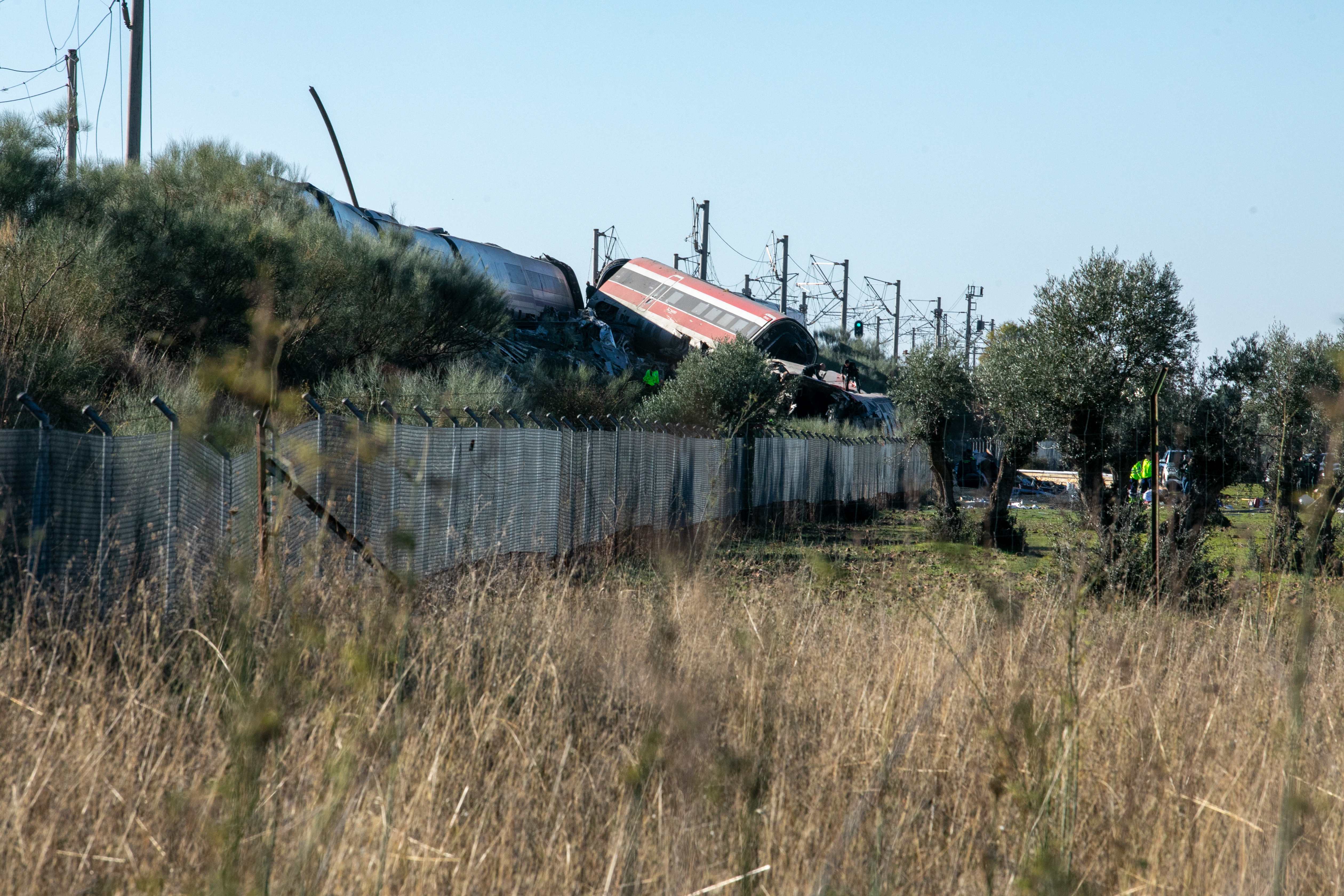
The crash happened at 8:54 a.m. local time near Urda, in Toledo province, on the high-speed line between Madrid and Andalusia, the Associated Press reported, citing Spain's rail infrastructure operator, Adif. The Renfe AVE had left Madrid's Puerta de Atocha station at 8:00 a.m. bound for Seville Santa Justa with 397 people aboard. Ahead of it on the same track, an Iryo train carrying 147 people — 146 passengers and a baby — had stopped. The AVE ran into its tail, knocking two of its cars off the track, regional government spokeswoman Esther Padilla told state broadcaster TVE. One car was shredded into pieces of metal, scattering debris down a gravel slope on a flat stretch of fields between Urda and Los Yébenes.
The toll, and the warning attached to it
Regional president Emiliano García-Page confirmed the dead included 24 people on the Renfe train and six on the Iryo train, and as the rescue continued on Wednesday the regional government raised the confirmed toll to at least 31, according to AFP and Cadena SER. García-Page later raised the confirmed toll again, to at least 64 — 40 of the dead aboard the stopped Iryo train and 24 aboard the Renfe AVE — according to Reuters, the Associated Press and The Times. At least 80 people were injured, 50 of them seriously. Officials were blunt that the count is not final. “Sadly, we expect more fatalities,” García-Page said on national broadcaster RTVE, and Padilla — who had confirmed 10 deaths earlier in the morning before the figure was raised — warned from the start that the number “will surely rise.”
Still-higher provisional figures from emergency services — 39 given to COPE, and up to 50 attributed to Civil Protection sources by Cadena SER and El Español — circulated in Spanish media on Wednesday, before officials raised the confirmed count. The regional government never confirmed them, and Padilla said she could not confirm the higher numbers; the confirmed toll of at least 64 has since overtaken them. This story will be updated as officials revise the official count.
Health Minister Mónica García said rescue crews were concentrating on the two most damaged cars. “It was a high-speed impact, so we are expecting this to be a tragedy,” she told TVE.
The response
Castilla-La Mancha activated its territorial emergency plan, Platecam, at 9:15 a.m. and raised it to operational level 2 at 10:30 a.m., formally requesting the Military Emergencies Unit (UME), which deployed to the scene alongside firefighters, the Civil Guard and medical teams. Three medical helicopters and two mobile intensive-care units were sent, an advanced medical post was set up for triage, and the town of Urda opened its sports pavilion for affected passengers at the request of civil protection authorities. A family information line was opened at 900 122 112.
Adif suspended all high-speed service between Madrid, Ciudad Real and Andalusia. Prime Minister Pedro Sánchez canceled his schedule, writing on X that he was “dismayed by the serious train accident in Toledo” and that “all my thoughts are with the victims and their families.” King Felipe VI and Queen Letizia said they were “deeply saddened and concerned,” and Spain's governing and opposition parties suspended planned political events.
Iryo, the Italian-owned private operator, said it had “activated its security protocols and is closely working with authorities.”
The cause of the crash is not known. Padilla said so directly on Wednesday, and an investigation is underway. Nothing further about why the Iryo train was stopped, or why the AVE reached it, has been officially established.
The angle: same companies, same corridor, nine months apart
This is not Spain's first high-speed disaster of 2026. It is the second — and it involves the same two companies.
On January 18, near Adamuz in Córdoba province, an Iryo train traveling from Málaga to Madrid derailed and its cars crossed onto the opposite track, where they were hit by an oncoming Renfe train bound for Huelva. Forty-five people were killed and more than 150 injured. It was Spain's deadliest rail crash since 2013, and it shook public confidence in the high-speed network — Europe's largest, some 3,900 kilometers of track, second in the world only to China's.
Nine months later, the Adamuz investigation is still open. Reporting on the probe has described a broken rail joint found at the site, and Spain's accident investigation authority has just three investigators assigned exclusively to the case — few enough that the inquiry may miss its one-year reporting deadline. The questions from January had not been answered when the same corridor produced a second disaster on Wednesday, with the state operator's train striking the private operator's train from behind.
Spain's high-speed rail disasters — the timeline
- July 24, 2013 — Santiago de Compostela, Galicia. A Renfe Alvia train from Madrid to Ferrol entered the Angrois curve at roughly twice the speed limit and derailed. 80 killed, 144 injured — Spain's deadliest rail disaster since 1944.
- January 18, 2026 — Adamuz, Córdoba. An Iryo train derailed onto the opposite track and was hit by an oncoming Renfe train. 45 killed, more than 150 injured. Investigation still open.
- October 28, 2026 — Urda, Toledo. A Renfe AVE rear-ended a stopped Iryo train. At least 64 killed, at least 80 injured — officials expect the toll to rise.
Previously's take: Spain built the most ambitious high-speed rail network in Europe and then opened it to competition, and the system was the country's pride. Twice in nine months, on the same Madrid–Andalusia corridor, that system's two operators have now been involved in crashes that killed dozens — and the investigation into the first one hadn't finished, with three investigators carrying it, when the second one happened. Whatever the Urda investigation finds, that is the fact Spain has to answer for: not one failure, but a second one that arrived before the first was explained.
— Previously Staff
Sources · 7 sources
- Associated Press (apnews.com) — the crash, the García-Page confirmation of the dead by train, the response and the January crash record.
- AFP via The Times live coverage — the regional authorities' revised official balance of at least 31 dead, communicated Wednesday afternoon.
- Reuters — García-Page's announcement raising the confirmed toll to at least 64, with the breakdown of the dead by train (40 aboard the Iryo, 24 aboard the Renfe AVE); corroborated by The Times' live coverage of the revision.
- Cadena SER (cadenaser.com) — García-Page raising the confirmed toll to 31 at the scene; the Guardia Civil's aerial images of the site.
- El País (elpais.com) — Adif's suspension of the Madrid–Andalusia high-speed line and the toll accounting.
- EFE (lado.mx) — Castilla-La Mancha's request for the Military Emergencies Unit and the Platecam escalation.
- Wall Street Journal (wsj.com) — the toll expected to rise; García-Page on RTVE.