
MONDAY, NOVEMBER 2, 2026
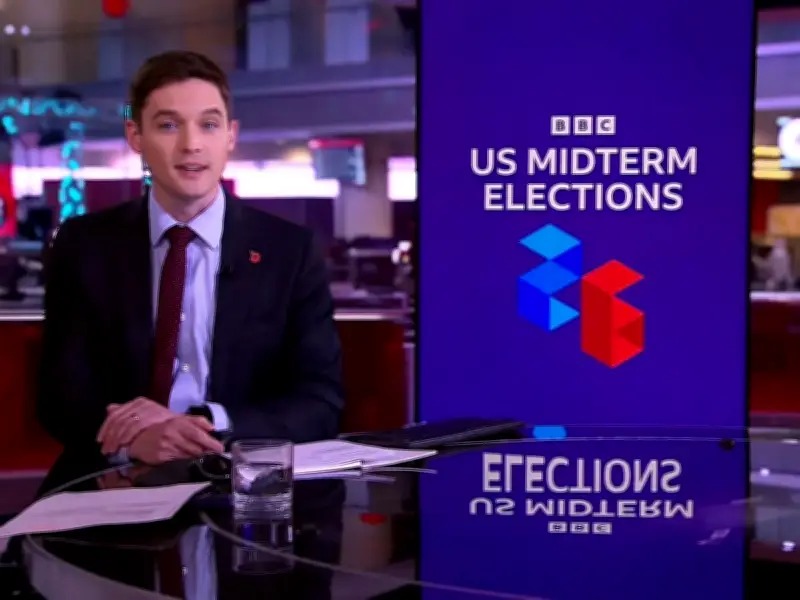
Let’s rewind the tape, because this is the cleanest own goal television has scored all year, and it took one letter, one shiny desk and one live broadcast to do it. During a BBC News bulletin on this week’s US midterm elections, the studio graphic did everything right. It stood tall beside the newsreader in the corporation’s purple, it carried the BBC blocks up top, and it read, in clean white capitals, exactly what it was supposed to read: “US MIDTERM ELECTIONS”, alongside a US flag, as Brit Brief’s account of the bulletin records. Nobody misspelled anything. Nobody typed the wrong word into a chyron and sent it out to embarrass the building. The failure was underneath the graphic, in the one place no producer ever rehearses: the reflection of that graphic in the newsreader’s glossy desk, where the word flipped upside down and the “L” in “Elections” landed looking like an “R”. On screens at home, under a perfectly correct headline, the desk was announcing something else entirely: “Erections”. The Sun, which carried the frame as the moment it was, put the blunder plainly — the error was televised while an anchor was covering the US Midterm Elections, the wording of which was reflected to spell “Erections”. Read that sentence twice, because it carries the framing lock this whole story stands on: this was not a typo. This was optics. The BBC was beaten by physics, furniture and timing, live, the night before the United States votes. Every Rewind grades the tape that exists, and this tape is a single frame that grades itself.
The frame that did it
Look at the still the way the internet looked at it, because the still is the story and there is no second angle coming to save anyone. A presenter in a dark suit and a remembrance poppy sits at the desk, hands folded, mid-bulletin, doing the most ordinary job in broadcasting: telling Britain about an American election. Beside him, the purple panel carries the bulletin’s whole authority — the BBC name, the words “US MIDTERM ELECTIONS”, and the red-and-blue geometry the corporation uses when it wants you to know this is serious. And then, in the polished black surface of the desk, the panel appears again, upside down and backwards, the way reflections are — except one letter does not survive the trip. An upside-down “L”, Brit Brief explains, made it look more like an unconventional letter “R”, and so the reflected word, the one floating right there in front of the newsreader’s hands and his glass of water, reads “ERECTIONS”. It is not subtle. It is not a freeze-frame-and-squint situation, the kind of thing only a producer with a pause button and a grudge could find. Once you see it, it is the only word on the screen. The correct graphic is still standing there doing its job, and it does not matter, because the eye goes to the desk the way a congregation goes to a typo in the hymn sheet. Television is a visual medium that spends fortunes controlling every pixel it emits, and this pixel was emitted twice — once correctly, by the graphics department, and once by a piece of furniture with no supervisor.
Scott Bryan saw it first
Somebody was always going to see it, and television being television, it was a professional. The moment was first spotted by TV critic Scott Bryan, who said on X: “BBC News errrr… you might want to check the reflection.” Bryan is not a random viewer with a phone camera pointed at his set; Brit Brief identifies him as a TV critic and co-host of Must Watch, a BBC podcast — which is to say the reflection was flagged by a man who watches television for a living, on behalf of the very broadcaster whose desk had just betrayed it, and his entire review was one raised eyebrow and a screengrab. That is the critic’s art at its purest. He did not need a column. He did not need a thread. He posted the frame, pointed at the desk, and let the desk do the rest of the talking, and the frame did what frames like that do: it travelled, it accumulated an audience, and it turned a weekend bulletin in London into the election-eve story nobody at the BBC had scheduled. The screengrab is the receipt, and it is why this story needs no embellishment from this desk or any other. The joke was broadcast by the BBC, spotted by its own critic, and published by its own desk — the reflective one. Everything after that was just distribution.
The internet did the rest
What the viewers did with the frame is the second half of the tape, and it is glorious, because the public graded this exactly the way a Rewind would: punching up at the institution, never at the man reading the news, and funnier than anything a comedy desk could have written on deadline. “Stay with us for the opinion pole results,” one person said. “They’re going to have to open up a Department for Reflections Corrections at this rate,” said another — a line so good it has been promoted into this story’s verdict, with credit to its anonymous author. A third joked: “You raise an important point.” And a final viewer simply put: “This is art.” Brit Brief’s harvest from the same thread runs in the same spirit: “Will they face stiff competition from Sky News?”; “Is that a seismic shift in Congressional voting intentions, or are you happy to see me?!”; and a prediction that the incident could inspire a sketch on SNL UK. Fairness, which this desk practises even on furniture, requires the dissent to be entered into the record: not everyone was convinced, and one sceptic argued about the letterforms themselves, objecting that an upside-down letter ruined the illusion for them. Noted, and overruled by the evidence of the frame itself, which sits at the top of this page in full public view. The people have seen the desk. The people have read the desk. The desk has been read into history.
Why the timing made it immortal
A reflection joke on a quiet Tuesday in March is a screenshotted chuckle and a forgotten timeline by lunch. This one landed on the eve of a US midterm election, and timing is the multiplier on every broadcast blunder ever aired. The context, as both reports lay it out, is real and it is heavy: midterms are held in the middle of each four-year presidential term; tomorrow’s voting will see Democrats and Republicans fighting over control of Congress; the elections will not change who the president is — President Trump will still be in power whatever happens, with two years of his term remaining — but they can determine which party controls Congress and therefore holds the influence. That is the bulletin the BBC was delivering: the sober, authoritative, London-explains-America explainer, the kind of broadcast the corporation exists to make, aimed at an audience about to watch another country decide who runs its legislature. And into that broadcast, at the exact moment of maximum international attention, the desk inserted the one word no election explainer has ever survived with its dignity intact. The stakes made the frame. If the graphic had been about a garden show, the reflection would have been a curiosity. Because it was about the midterms — because the word it bent was Elections, during Elections, on the night before Elections — it became the only election graphic anyone will remember from this cycle, and it was authored by a tabletop.
The BBC’s answer, so far
And the institution? As of the reporting this story stands on, the institution has said nothing at all. “The beeb is yet to comment on the matter,” The Sun records, and there the matter rests: no statement, no correction, no Department for Reflections Corrections staffed or unstaffed. Honestly, what would the statement say? There is no error to correct, because the graphic was right. There is no one to discipline, because the culprit is a desk, and it is load-bearing. There is no apology available that improves on silence, because any sentence the BBC issues about this will be printed next to the frame, and the frame wins every time it is printed. This desk has graded its share of institutional self-owns this season — earlier today, a Connecticut incumbent discovered that the campaign signs she took down were reporting their own location — and the BBC entry belongs on the same shelf for the same reason: a powerful institution, with every professional safeguard money and reputation can buy, undone not by an enemy or an error but by a surface it polished itself. Somewhere in that building there is now a note in a gallery log, in the driest language British broadcasting can produce, recording that the desk reflection was checked. It will be checked forever now. That is what a Rewind is for. More from this desk lives on Previously’s news front.
THE VERDICT — After review: nobody at the BBC misspelled anything. The graphic said Elections, the desk said Erections, and the desk — being furniture — cannot be fired. The institution takes the donkey, the Department for Reflections Corrections takes the case, and the newsreader, who had the right word in front of him the whole time, is acquitted.
Sources · 3 sources
- Hilarious moment BBC News accidentally airs ‘erections’ in middle of live broadcast on US Midterm Elections The Sun · Nov 2, 2026 (the reflected wording, Scott Bryan’s X post, viewer reaction, the BBC yet to comment, Election Day Tuesday)
- BBC News viewers distracted by reflection blunder during US midterms report Brit Brief · Nov 2, 2026 (the “US Midterm Elections” graphic and US flag, the upside-down “L” reading as “R” in the desk reflection, Bryan’s role and flag, the sceptic’s objection)
- Hilarious moment BBC News accidentally airs ‘erections’ in middle of live broadcast on US Midterm Elections The Sun (Irish edition) · Nov 2, 2026 (same report)